This isn’t a story about lagging behind. It’s a strategic play rooted in geopolitical awareness, industrial foresight, and architectural thinking. India isn’t just building chips; it’s building an ecosystem.
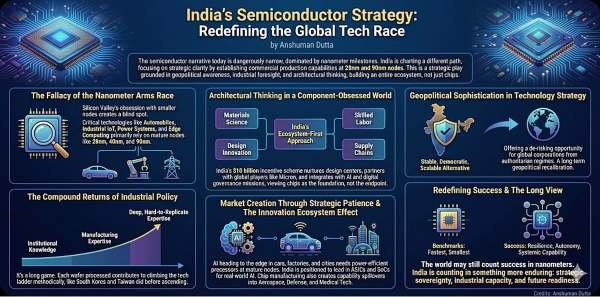
The semiconductor narrative today is dangerously narrow. Industry discourse is dominated by nanometer milestones 3nm today, 2nm tomorrow as if smaller nodes alone define technological relevance. But while much of the world is caught in this tunnel vision, India is charting a path that is not about compromise, but strategic clarity. By establishing commercial production capabilities at 28nm and 90nm nodes, India is not playing catch-up it’s rewriting the rules of the race.
This isn’t a story about lagging behind. It’s a strategic play rooted in geopolitical awareness, industrial foresight, and architectural thinking. India isn’t just building chips; it’s building an ecosystem.
The Fallacy of the Nanometer Arms Race
Silicon Valley's obsession with smaller nodes has created a significant strategic blind spot. The assumption that leadership demands chasing the edge of physics ignores the realities of where most of the demand actually lies.
Automobiles, industrial IoT, power systems, and edge computing—these critical technologies primarily rely on mature nodes like 28nm, 40nm, and 90nm. The global chip shortage of 2020–2022 wasn’t about 5nm chips for phones—it was about these foundational processes, which power medical devices, telecom infrastructure, and everyday electronics.
India’s focus on mature nodes aligns with real-world needs. It recognizes that technological prestige means little if it doesn’t solve existing supply-demand imbalances. This isn’t about backwardness—it’s about strategic leadership grounded in market realities.
Architectural Thinking in a Component-Obsessed World
India’s most insightful move isn’t its choice of nodes, but its ecosystem-first approach. Chip manufacturing is not a standalone function—it’s a complex convergence of materials science, supply chains, skilled labor, and design innovation.
India’s $10 billion semiconductor incentive scheme isn’t just about factories. It’s about nurturing design centers, partnering with global players like Micron, and integrating with AI and digital governance missions. This reflects architectural thinking—where semiconductors are the foundation, not the endpoint.
Many developed economies treat chips as isolated industrial assets. India’s strategy is to embed chip production into a broader ambition: technological sovereignty through systemic integration.
Geopolitical Sophistication in Technology Strategy
The global chip landscape resembles a geopolitical chessboard, with Taiwan as the queen everyone wants to guard. India isn’t trying to outmaneuver TSMC at the advanced node level—that would take decades and hundreds of billions. Instead, it offers something the world needs more urgently: a stable, democratic, and scalable alternative.
India’s vast domestic market provides a launchpad for scale. Its governance model and English-speaking workforce make it a natural fit for global corporations looking to de-risk from authoritarian regimes. This isn’t a reactionary move—it’s a long-term geopolitical recalibration.
The Compound Returns of Industrial Policy
India’s approach to semiconductors isn’t driven by quarterly results. It’s a long game—about building institutional knowledge and manufacturing expertise that compounds over time.
Technological capability at 14nm or 7nm doesn’t emerge overnight. It’s a progression—each wafer processed, each defect fixed, each tool calibrated contributes to deeper, harder-to-replicate expertise. India is not shortcutting this curve; it’s climbing it methodically, much like South Korea and Taiwan did before ascending the tech ladder.
Market Creation Through Strategic Patience
Perhaps the most underrated part of India’s strategy is its potential to create new markets. AI isn’t just cloud-based anymore—it’s heading to the edge: in cars, factories, and cities. These edge applications don’t need 3nm chips; they need power-efficient, cost-effective processors manufactured at mature nodes.
With its software strength, growing hardware capabilities, and a massive internal market, India is positioned to lead in ASICs and SoCs tailored for real-world AI use cases. This is where future demand lies—and India is aligning for that shift.
The Innovation Ecosystem Effect
Chip manufacturing doesn’t just produce chips—it creates capability spillovers. Precision engineering, materials science, process optimization—these benefits extend into aerospace, defense, medical tech, and beyond.
India’s famed software industry, when combined with its nascent hardware base, sets the stage for end-to-end innovation. Think full-stack solutions, not piecemeal components. In a world shifting from modular to integrated systems, this capability is gold.
Redefining Success Metrics
Much of the global tech industry is addicted to benchmarks: fastest chip, smallest node, most transistors. But India is rethinking what success should mean.
It’s optimizing for resilience, autonomy, and systemic capability. It’s not about winning the next sprint—it’s about building institutions that endure. In a volatile global tech environment, that’s the more sustainable advantage.
The Compounding Nature of Technological Sovereignty
India’s semiconductor push isn’t a standalone initiative. It’s woven into a broader fabric of digital transformation: 5G rollout, AI research, digital ID systems, and smart governance.
These initiatives create mutual reinforcement. AI use in healthcare or agriculture drives demand for specialized chips; domestic fabs reduce cost and increase control. This is a self-reinforcing flywheel of innovation, scale, and sovereignty.
Strategic Implications for Global Technology Leadership
India’s model offers a new playbook for nations aspiring to tech independence. You don’t need to out-engineer TSMC on day one. You need to create new markets, build ecosystems, and invest patiently in institutional growth.
As AI moves from data centers into domain-specific applications, the need for co-designed hardware and software becomes acute. India’s integrated capabilities are well-suited for this next wave—precisely where opportunity lies.
The Long View on Innovation Strategy
India’s approach reflects a nuanced understanding of how innovation unfolds—not in sudden leaps, but through long-term accumulation of skills, infrastructure, and insight.
It’s a bet on sustainable competitive advantage, not hype-driven positioning. As the global tech environment grows more unpredictable, India’s emphasis on optionality and control could prove not just smart—but decisive.
The world may still count success in nanometers. India is counting in something more enduring: strategic sovereignty, industrial capacity, and future readiness.
Contact to : xlf550402@gmail.com
Copyright © boyuanhulian 2020 - 2023. All Right Reserved.