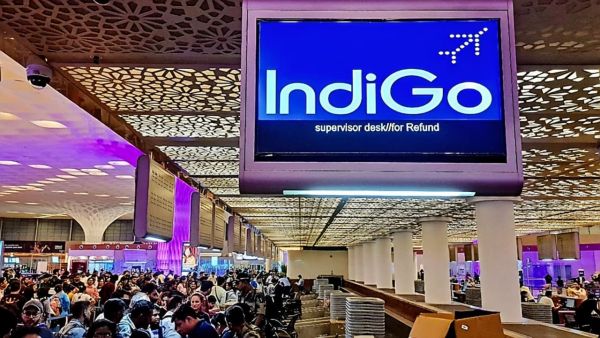
Indigo Crisis: Why suddenly India's largest airline faltered? How pilot shortage, FDTL rules, ELAC upgrades and system overload combined to bring operations to a standstill – learn the real truth about this crisis.
New Delhi. Indigo has been going through a crisis for the last six days, the likes of which has never been seen before in the history of Indian aviation. More than 220 flights were canceled in Delhi and Mumbai. Thousands of passengers got stuck. DGCA sent show cause notice to IndiGo. How did India's largest airline collapse in six days? To understand the depth of this entire matter, the things told by Aviation Expert Group Captain MJ Augustine Vinod (Retd.) are shocking. This crisis was not the result of a single mistake or a single decision. It was an explosion caused by many small problems coming together in one place. It was a classic Domino Effect, where small holes lined up and a big disaster happened.
Were the irregularities in Indigo deliberate?
Some media reports claimed that IndiGo created this crisis itself, so that the new FDTL rules could be circumvented. But Vinod clearly rejects this theory. He says that no big company will ever cause such a big loss to itself. This is logically impossible. The financial loss suffered by IndiGo in this crisis is many times more than any possible benefit. That means it didn't happen intentionally - it happened accidentally, but for a variety of reasons.
Has the Indian aviation system suddenly broken down?
IndiGo is such a big airline that even a small glitch in any of its operations can disrupt flights across the country. But this time the glitch wasn't "small"—it was a system failure. Aviation expert and retired Group Captain MJ Augustine Vinod reveals the real roots of this crisis and his analysis is shocking. He said clearly: "This was not a conspiracy or a deliberate decision. It was a sudden burst of small errors accumulating in the system."
Can a small technical glitch bring down the entire Indigo system?
Yes. This is what Vinod calls the domino effect. He pointed out an important reason that many people are not aware of is that both IndiGo and Air India had recently upgraded Airbus ELAC software on many of their Airbus aircraft. Vinod's question was: "Did this upgrade cause any operational shock? If so, was the system strong enough to handle it?" He says that the airlines' system runs on a very tight schedule. That means every pilot plans minute by minute, every flight is just-in-time, every aircraft operates continuously. In such a situation, even a small error spreads very quickly throughout the airline. And the same thing happened. They call this the Swiss-cheese failure model of aviation – small holes (faults) line up, and the system collapses.
Was the real crisis “pilot shortage”?
Indian aviation has been growing rapidly for the last 10 years, but there has always been a shortage of pilots, especially captains. Vinod explains that it takes 6-7 years to become a captain. The training program for a captain is 10–12 months. Promotion from First Officer to Captain is not easy. There are less training centers in India. There is a rapid increase in the number of pilots going abroad, which means that every year more pilots go abroad than are made. These airlines like Etihad, Emirates, Qatar, Lufthansa, their salaries are almost 3 times that of India. Vinod says, “How will you stop someone? By paying more salary, but ticket prices in India are limited, so the airline cannot pay more.” This becomes a dangerous cycle: fewer pilots → more work → fatigue → tighter FDTL rules → more pilots → more cancellations. Indigo got caught in one such trap.
Did FDTL rules shake up Indigo system?
DGCA implemented new FDTL rules to prevent pilot fatigue. These are equivalent to the rules of the world. But was India's aviation system ready for this? Vinod says that “even a small policy in a big system can cause a big earthquake.” Indigo carries 65% of India's domestic passengers. Even a small change in such a large operation brings a big impact. As soon as the new FDTL was implemented, there were fewer pilots than before, increased fatigue monitoring, increased holidays, strict shifts i.e. the schedule immediately deteriorated.
Is training infrastructure India's biggest weakness?
Vinod explains, "We do not have enough centers for pilot training. That's why we send cadets to America, New Zealand, South Africa." That means India keeps its own essential aviation backbone dependent on outside countries. Also, many airports in India are so small that they cannot “absorb” shock. For example, in the big airports of Europe, the capacity is so much that the system does not break down even if the extra crowd increases. It is the opposite in India. Slight crowd - lounge full - runway overload - ground staff pressure - cascading delay.
Is there shortage of staff in DGCA also?
This part is shocking. Vinod explains that “DGCA is still running on the same manpower as it was 30 years ago.” Aviation is growing, but the staff of the monitoring organization remains the same. This slowed down monitoring. Inspection reduced. Training approval delays, airline pressure—all increases.
Did Indigo make a mistake by adding more flights in winter?
Indigo had increased flights for the peak season. But at that time they had no idea that so many pilots would suddenly leave the job. Vinod explains, “Find out how many pilots have gone to Etihad and Emirates in six months – the numbers will surprise you.” That is, IndiGo had planned according to the old available pilot number – but pilot migration was much more than they had calculated.
Did other airlines take advantage of the opportunity?
When Indigo got stuck, some airlines increased the tickets a lot. Extra charges made expensive. Vinod got angry and said, “This is suicide… finding opportunity even in trouble. God is watching everyone.” He said that the fare limit is only on the base fare, hence many airlines make food charges, seat charges, extra baggage, convenience fees all expensive.
So what happened in Indigo?
Real reasons in short:
- Timing of ELAC upgrade
- Pilot shortage and migration
- New pressure of FDTL rules
- India's weak training system
- overloaded airports
- DGCA staff shortage
- IndiGo's huge market share has adverse effects
- Old schedule-fails due to new rules
- All this together did not happen in a single day-
- This was stress that had been building up over many months.
Will the situation return to normal in the coming weeks?
it's hard to say. Vinod's signal is clear that “This is not just a crisis of one airline, it is a crisis of India's aviation system.” That means improvements will have to be done simultaneously in pilot training, airport capacity, DGCA resources, FDTL implementation. IndiGo will reboot its system, but the country's aviation infrastructure is still lagging behind.
Contact to : xlf550402@gmail.com
Copyright © boyuanhulian 2020 - 2023. All Right Reserved.