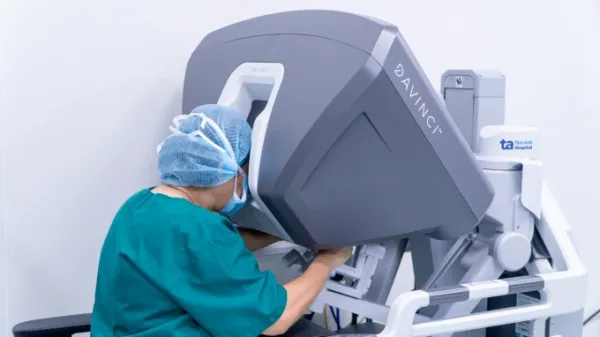
Dr. Nguyen Ba My Nhi, a Level II Specialist at HCMC’s Tam Anh General Hospital, gently presses the pedal and firmly grips the controller to begin a cancer patient’s hysterectomy.
Three meters away, four robotic arms lifted, and the surgery began.
From the operating booth, Nhi, 60, director of the hospital’s obstetrics and gynecology (OB-GYN) center, gives the order: “Commence procedure.”
In the center of the 65-square-meter hybrid operating room, a 10-person team of assistant surgeons, anesthetists, and scrub nurses stand ready to follow the lead of the robot remotely operated by Dr. Nhi.
On the 3D screens, images of the patient’s abdomen are magnified 15 times, with every blood vessel, every thread-thin tissue showing up clearly.
Nhi leads the four robotic arms inside the patient’s abdomen, dissecting, cutting, stitching, stanching.
After 1.5 hours the patient’s uterus is completely removed and taken out through the vaginal canal.
It was the first-ever gynecological surgery using the Da Vinci Xi robot at Tam Anh General Hospital on November 4, and another milestone in Nhi’s 30-year career.
She was also one of the pioneers in developing minimally invasive endoscopic surgery in OB-GYN in Vietnam.
Though telesurgery emerged in the 1980s, authorities in the U.S. did not approve its use for gynecological treatment until 2005.
In Vietnam the first surgery of this kind was done in 2016, but only recently in OB-GYN.
Conventionally, doctors physically approach a patient to operate. But with robotic assistance, they only have to be within three to five meters of the patient and control four robotic arms to perform the surgery.
Vietnamese surgeons are utterly unfamiliar with the latter, and are used to standing next to the patient, listening in on every breath and sensing the tension in every tissue on their fingertips, Nhi says.
So a doctor performing remote surgeries will need to undergo rigorous training and follow time schedules as strictly as modern pilots, she says.
“To perform telesurgery has been my greatest aspiration for the last 20 years.”
From her operating booth, Dr. My Nhi directs a telesurgery on a patient. Photo by Tue Diem
Nhi is one of the pioneers in endoscopic OB-GYN surgery in Vietnam.
Tu Du Hospital set up an endoscopy department in 1996, and she was appointed its deputy head. A year later she became the youngest head of a department at the hospital, responsible for all specialist activities.
Her rich experience involving more than 10,000 endoscopic surgeries has seamlessly translated into her telesurgical practice. Reminiscing about her first attempt, she says: “I was so excited I could not sleep”.
In 2007, while attending the Endoscopic Surgery Conference in the U.S, Nhi witnessed her first remote hysterectomy.
“At that time I wondered when Vietnam would gain access to this technique,” she says. The biggest obstacle was not skill or expertise, but the multi-million-dollar price tag of these robotic systems, which would put off most hospitals, she explains.
Back in Vietnam, every time she was faced with a complicated surgery or an unsuccessful endoscopic effort that required a switch to open surgery, she would think, “If only we had robots”.
In OB-GYN, there are tissue areas lying deep inside and between intertwining vessels that prove challenging to traditional endoscopy. But these cases can be handled with ease with rotatable robotic arms.
Tam Anh General Hospital has treated a large number of Vietnamese diasporic and foreign patients over the past few years.
It has also been seeing an increase in the number of OB-GYN patients seeking to register for remote surgery.
In 2023 an American report documented around 390,000 OB-GYN telesurgeries.
In 2024 the market for this procedure was estimated to be worth US$9.5 billion, and it is expected to reach $17.87 billion by 2029, a 13.5% annual increase.
Tam Anh General Hospital has adopted a wide range of advanced technologies, robotic applications and AI across departments for assisted reproduction, diagnostic imaging, neurosurgery, and others.
To embrace the latest, most specialized treatment regime, the hospital decided to install the Da Vinci Xi surgical robotic system, the most modern model in Southeast Asia for minimally invasive treatments.
But to install it, the doctor using it must adhere to stringent regulations set by its American manufacturer Intuitive Surgical. They include undergoing rigorous training in Vietnam and taking a certification test in Singapore.
Nhi says the OB-GYN center held meetings to thoroughly discuss and identify the medical personnel to be sent for this training.
Its goal was to become the first facility in Vietnam to master modern telesurgery techniques in OB-GYN.
For this, it chose Nhi and two of her students to undergo intensive online courses involving theoretic frameworks and hours of practice on 3D models.
At the end of their training, the three were required to take a two-part assessment: a theoretical portion that could be completed online and a practical portion for which they would operate on a manikin, each requiring a minimum score of 80-90% to pass.
“After 30 years of operating on thousands of patients and teaching hundreds of doctors locally and internationally, I became a student this time”, muses Dr. Nhi.
She speaks about sitting before a computer screen and listening attentively as an instructor at the robotic training center explained every step for using the robot.
Upon completing the foundational courses, she headed to Singapore for advanced training.
Only after passing theoretical and model-based tests could she proceed to be graded by experts on her hands-on skills: hand-eye–foot movements, pedal controlling techniques, problem-solving skills, and the simultaneous manipulation of different tools.
Eventually, to qualify as lead surgeon, she had to perform at least nine telesurgeries under the supervision of an international evaluation committee and receive approval from the global robot training system.
Nhi admits she was “nervous” on her first day at the operating booth, worried she might not be able to handle a malfunction should it arise.
“But when my eyes fixed on the 3D display system, it was like I entered a different dimension.
“A magnified world, so clear and so close that even the slightest blood vessel seemed to be right in front of me”.
The robot became the doctor’s right arm in the operating room, eliminating the need to hunch for hours on end in physically inconvenient postures or be limited to the extent her wrist can move. Every action unfolded with improved ease and accuracy.
Furthermore, her three-decade experience with the scalpel afforded Nhi an immediate, clear vision of the anatomical structure and potential risks.
“My experience allows me to be quick, decisive and fully confident with every move I make while controlling the robot”
Dr. My Nhi controls the robot that performs a hysterectomy on a patient called Thanh. Photo by Tue Diem
The special ‘pilot’
Teleoperators in Vietnam are scarce, and the vast majority are men.
After returning to Vietnam after her training at Intuitive Surgical, Nhi continued to refine this new technology along with senior colleague Associate Professor Dr Vu Le Chuyen, who has 10 years of experience in telesurgery.
Head of the urology – nephrology – andrology center, Chuyen has performed more than 200 telesurgeries.
When introducing the Da Vinci Xi robotic surgery system for gynecological treatment, Chuyen saw in Nhi great meticulousness and patience, which were perfectly suited for the technology.
He also realized that telesurgery helped overcome the normal physical stamina limitation of his female colleagues, who often became fatigued when there was an extended surgery.
The mechanical arms offer great stability and flexible rotation in confined spaces, enabling doctors to perform complex operations with significantly less physical strain than in traditional endoscopic surgeries.
“I feel like I was born to do telesurgery”, Nhi says.
She controls the robot with ease, without using too much force or hunching her shoulders.
Telesurgery requires the doctor to be careful, sensitive and gentle, all of which Nhi seems to be gifted with.
OB-GYN telesurgeries are intrinsically different from other surgeries such as cardiology, urology or general surgery simply because of physiology: even if the surgical site is wide open, a patient’s uterus and ovaries are concealed by their small intestines, colon and bladder.
And, within the narrow space in the pelvis, doctors need to patiently peel over every tissue layer to find the area needing treatment.
The greatest potential of telesurgery lies in its ability to expand the boundaries of human capacity, Nhi says.
It can help tackle challenging cases, decrease pain, complication rates and the duration of hospitalization and preserve the patient’s reproductive ability and physical appearance, she explains.
Cases such as early-stage gynecological cancer, uterine prolapse and large fibroids can also be treated with greater precision and safety, she says.
“Robots cannot fully replace endoscopy, but will definitely take over complicated cases and those requiring high accuracy.”

Patient Thanh meets Dr. My Nhi after her robotic hysterectomy. Photo by Trung Vu
Remote surgeries at the OB-GYN center are gradually increasing.
On Nov. 18, Thanh, the first patient to undergo this surgery at Tam Anh General Hospital came for a follow-up visit, and said she is healing much quicker than she had feared.
Against the current backdrop, where robots and AI are redefining the medical profession, Gen-X doctors like Nhi are at a critical juncture: to adapt or be left behind.
She attends national and international conferences on a monthly basis to learn about the latest technologies and improve her leadership and management skills.
“Catching up with technological advances is like learning a life skill; only by fully grasping a robot’s structure, operating principles, and AI-application processes can doctors integrate technology safely and efficiently,” she says.
Vietnam’s first female surgeon to lead robotic obstetrics-gynecology surgery
Story by Tue Diem
Contact to : xlf550402@gmail.com
Copyright © boyuanhulian 2020 - 2023. All Right Reserved.