Why most space telescope images could be blurry by 2030
08 Dec 2025
A NASA-led study has warned that the increasing number of satellites in Earth's orbit could ruin over 95% of images taken by some space telescopes in the next decade.
The reflected light from these satellites appears as streaks or satellite trails in telescope images.
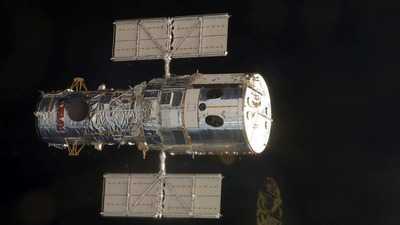
The problem has already been observed with NASA's Hubble Space Telescope and is expected to worsen as more satellites are launched into orbit.
Satellite trails could affect multiple telescopes
Impact
The study, published in Nature, predicts that other telescopes like NASA's SPHEREx, the European Space Agency's ARRAKIHS and China's Xuntian Space Telescope could also deliver streak-filled images.
Alejandro S. Borlaff, the lead author of the study and a NASA scientist, explained that valuable astronomical events could be lost forever if a satellite crosses during observations.
Satellite launches have surged in recent years
Growth in satellites
The problem of satellite trails has been exacerbated by the fact that more satellites have been launched in the last four years than in the previous 70 years of spaceflight combined.
As of December 1, there are over 10,000 active satellites orbiting Earth, according to data from Jonathan McDowell, an astrophysicist at Harvard-Smithsonian Center for Astrophysics.
SpaceX owns most of these with over 7,800 Starlink satellites already operational.
Future of Hubble Space Telescope images at risk
Predictions
Between 2018 and 2021, when there were fewer satellites in orbit, about 4% of Hubble Space Telescope images had light streaks from satellites.
However, Borlaff and others predict this number could increase drastically with at least one in every three images taken by the Hubble Space Telescope showing one light streak.
For SPHEREx telescope, ARRAKIHS and Xuntian, they expect a staggering 96% of the images will be contaminated somehow.
Satellite trails could also affect ground-based telescopes
Ground impact
The study by Borlaff and others suggests that the increase of satellites could also affect images taken by ground-based telescopes.
The American Astronomical Society (AAS) has already warned that an increase in satellites in Earth's lower orbit could create glares and light streaks in their images.
"We will continue to facilitate collaborative work with the satellite industry to fully understand and minimize the impacts of large satellite constellations on astronomy," AAS Deputy Director of Public Policy Roohi Dalal told NPR.
Contact to : xlf550402@gmail.com
Copyright © boyuanhulian 2020 - 2023. All Right Reserved.