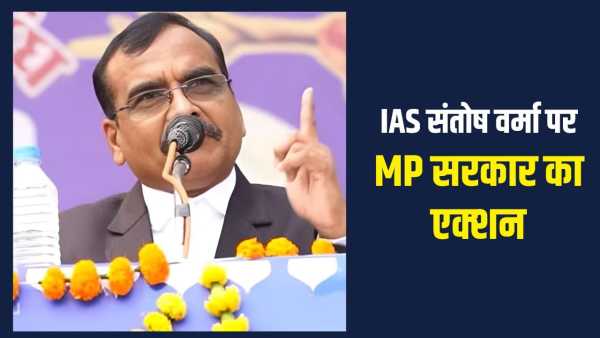
Madhya Pradesh government has sent a proposal to the Center to dismiss IAS officer Santosh Verma.
Madhya Pradesh government has removed IAS officer and state president of Scheduled Caste-Tribe Officers and Employees Association (AJAKS) Santosh Verma from his department. Now the government is preparing to take strict action against them. Due to making controversial and indecent statements, there are preparations to dismiss him on the instructions of Chief Minister Mohan Yadav. The proposal has been sent to the Centre. At present he has been attached to the General Administration Department.
Santosh Verma made a controversial statement at the AJAKS program in Bhopal on 23 November. He had said, “Unless a Brahmin donates his daughter to my son and establishes a relationship with him, he (the son) should get reservation.”His statement went viral on social media. The Brahmin community expressed strong displeasure over this and demanded action against Santosh Verma across the country.
Now after the recent action on IAS Santosh Verma, the question arises that what is the procedure to dismiss an IAS officer, does the state not have the right to do so?
Does the State or the Center have the right to dismiss IAS?
The right to suspend any IAS officer lies with the government for which he works. If they do it for the Central Government, then they do it for the Central and State Governments, the State Government has the right to do it. According to Supreme Court Advocate Ashish Pandey, IAS, IPS, IFS come in All India Service. Without the permission of the Central Government, the State Government cannot suspend only 3 people (Chief, Secretary, DGP and Chief Forest Conservator).
On the basis of their posting, the state or central government can suspend them, but only the one who recruits has the right to dismiss them. Officers belonging to All India Services are appointed through the President. Therefore, the President has the right to dismiss them.
What is the process of suspending?
Supreme Court Advocate Ashish Pandey says, if the state government suspends an All India Service officer like IAS, then this information has to be given to the Cadre Control Authority within 48 hours. In this way communication is an essential part of the entire process.
The state government has to submit the complete report of suspension to the Center within about 15 days. The suspension is for 30 days, if the suspension is to be continued even after this, permission is required from the Central Government. After getting the permission, it remains valid for 120 days. There is a rule to extend it up to 180 days, but for this the recommendation of the Central Review Committee is necessary. If corruption charges are imposed on an IAS officer, then after the recommendation of the committee, it can be extended to a maximum of 2 years.
How does the process of dismissal take place?
We understand this from the case of IAS officer Santosh Verma. The state government has sent a proposal to the Center to dismiss him i.e. remove him from the post. In such cases, once the proposal goes ahead, the Centre's DoPT (Department of Personnel and Training) takes the process forward and a show cause notice is issued to the officer. A certain time is given in the notice to respond to the allegations.
If their answer is not satisfactory then investigation begins. The investigating officer records the statements of both the department and the accused officer and the investigation report is prepared. The investigating officer submits his report to the disciplinary authority. After this, advice is taken from UPSC and the accused officer is given a last chance to present his side. After the reply of the accused officer and the advice of UPSC, it is decided whether there will be dismissal or not. After this, the final order of dismissal is issued by the President.
Contact to : xlf550402@gmail.com
Copyright © boyuanhulian 2020 - 2023. All Right Reserved.