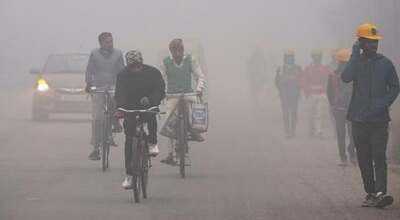
New Delhi | The Commission for Air Quality Management (CAQM) on Saturday invoked the strictest measures under its air pollution control plan, GRAP, including a ban on all construction and demolition activities in Delhi-NCR after pollution levels rose sharply amid unfavourable meteorological conditions.
The Sub-Committee on GRAP had earlier in the day decided to invoke Stage III of the Graded Response Action Plan (GRAP) across the entire NCR with immediate effect as air quality continued to worsen.
However, noting a further sharp rise in pollution levels since morning, the sub-committee held an urgent meeting at 6.30 pm to review the situation and weather forecasts by the IMD and IITM.
It observed that Delhi's Air Quality Index (AQI), which stood at 401 at 10 am in the "severe" category, continued to rise steadily due to very low wind speed, a stable atmosphere and unfavourable weather conditions that prevented dispersion of pollutants.
The AQI climbed to 431 at 4 pm, 436 at 5 pm, 441 at 6 pm and 448 at 7 pm, the panel said.
It said these conditions, along with calm winds and mist or haze during the night, are likely to persist, further trapping pollutants over the region.
This is in addition to the actions under Stages I, II and III of GRAP already in force in NCR, the statement added.
Stage IV of GRAP brings the strictest restrictions in Delhi-NCR.
Under this stage, the entry of trucks into Delhi is stopped, except those carrying essential commodities or providing essential services. However, CNG, LNG, electric and BS-VI diesel trucks are allowed.
The plying of Delhi-registered diesel heavy goods vehicles (BS-IV and below) is banned, again with exceptions only for essential services.
All construction and demolition activities are banned, including even linear public projects such as highways, roads, flyovers, power transmission lines, pipelines and telecom works, which are otherwise allowed in lower stages.
Schools are required to run classes in a hybrid mode (online and physical) not only for primary students but also for higher classes (VI to IX and XI) in Delhi and the most affected NCR districts, with students given the option to attend online where feasible.
Under Stage IV, state governments are asked to consider additional emergency steps, such as closing colleges and educational institutions, shutting non-essential commercial activities and even introducing odd-even rules for vehicles if the pollution situation worsens further.
During winters, the Delhi-NCR region enforces restrictions under GRAP, which categorises air quality into four stages - Stage I (Poor, AQI 201-300), Stage II (Very Poor, AQI 301-400), Stage III (Severe, AQI 401-450), and Stage IV (Severe Plus, AQI above 450).
Unfavourable meteorological conditions, combined with vehicle emissions, paddy-straw burning, firecrackers and other local pollution sources, lead to hazardous air quality levels in Delhi-NCR during winters.
Contact to : xlf550402@gmail.com
Copyright © boyuanhulian 2020 - 2023. All Right Reserved.