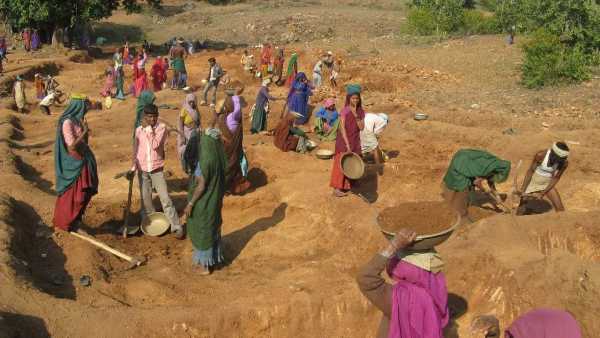
Developed India Guaranteed Employment and Livelihood Mission will replace MNREGA.
The central government is going to introduce a new rural employment law in the Lok Sabha, which proposes to repeal the two-decade old Mahatma Gandhi National Rural Employment Guarantee Act (MGNREGA) and replace it with a new bill, namely the Vikas Bharat Guaranteed Employment and Livelihood Mission (Rural) (VB-G RAM G) Bill, 2025.
The objective of this bill is to replace MNREGA with a revamped framework, which aims to bring rural employment and development in line with the national vision of Developed India 2047. It has been included in the supplementary list released on Monday.
Ahead of the introduction of the Developed India-Employment and Livelihood Mission (Rural) Bill, or VB-G Ram Ji Bill, in Parliament, the government has released answers to some questions regarding the draft. Which is very important to read and understand. So that Ji-Ram-JiK can be understood completely.
1. What is the proposed VB-G Ram Ji Bill?
The Vikas Bharat-Employment and Livelihood Mission (Rural) scheme, which is also being called VB-Ji Ram Ji, will replace the nearly 20-year-old MNREGA system. The draft bill guarantees 125 days of work per year to every rural household whose adult members are willing to do unskilled manual labour. The draft bill will link employment generation to long-term rural development through four priority sectors.
- Water security through water related works
- Core Rural Infrastructure
- Livelihood Infrastructure
- Special actions to reduce the impact of extreme weather
All assets created under the scheme have been included in the evolving India National Rural Infra Stack, which will help in ensuring coordinated and planned national development.
2. How different and better than MNREGA?
The new Act is a significant upgrade of MNREGA, enhancing employment, transparency, planning and accountability while addressing infra weaknesses. Major improvements have been included in this…
Employment Guarantee: The guarantee has increased from 100 days to 125 days, which will provide more income security to rural families.
Focus on Strategic Infra: MNREGA works were scattered across multiple categories without a strong national strategy. The new Act will focus on 4 key types of actions that ensure sustainable assets that are directly linked to water security, basic rural infra, livelihood-related infra creation and climate adaptation.
Integrating with local and national schemes: The new Act will mandate devolved gram panchayat schemes, which are prepared by the panchayats themselves and link them with national schemes like PM Gati-Shakti.
3. What will be the benefit to the rural economy?
- Water Security: Water related works have been given priority. Mission Amrit Sarovar has already created/revitalized more than 68,000 water bodies, showing visible impact on agriculture and groundwater.
- Core Rural Infra: Roads, connectivity and core infra will boost market access and rural business activities.
- Livelihood Infra: Storage, market and production assets help in income diversification.
- Climate Resilience: Infra for water harvesting, flood drainage and soil conservation protects rural livelihoods.
- Employment and Consumption: 125 guaranteed days will increase the income of families, which will boost the rural economy.
- Reduction in migration: With more rural opportunities and durable assets, migration pressure will reduce.
- Digital System: Digital attendance, digital payments and data-based schemes increase efficiency.
4. What will be the benefit to farmers from the new scheme?
Labor Availability Guarantee: States may notify a period of up to 60 days during peak sowing/harvesting periods when MNREGA work will remain closed. This will prevent labor shortage during important agricultural operations and prevent workers from being transferred to workplaces with guaranteed wages.
Stopping wage inflation: Stopping public works during peak season will prevent artificial wage inflation, which will prevent increase in food production costs.
Water and Irrigation Resources: Priority water projects will improve irrigation, groundwater and multi-sea crop efficiency.
Better connectivity and storage: Basic and livelihood infra will help farmers to store produce, reduce losses and access markets.
Resilience to climate change: Flood-drainage, water harvesting and soil conservation protect crops and reduce losses.
5. What benefits will the workers get from the new scheme?
- high income: 125 guaranteed working days = 25 percent more potential income.
- Fixed task: Hyper-locally developed Gram Panchayat schemes will ensure planned, pre-determined work availability.
- Digital Payment and Security: Electronic salaries (already 99.94 per cent in 2024-25) will continue with fully biometric and Aadhaar-based verification, thereby eliminating wage theft.
- Unemployment Allowance: If work is not given, states will have to pay unemployment allowance.
- Workers also benefit from property construction: Workers build and benefit from better roads, water and livelihood assets.
6. Why is there a need for change in MNREGA now?
MNREGA was created in 2005, but a lot has changed in rural India.
- Poverty rate has declined from 25.7 per cent (2011-12) to 4.86 per cent (2023-24) due to increase in consumption, income and financial access as recorded in MPCE and NABARD RECSS survey.
- The old structure is no longer compatible with today's rural economy, with stronger social security, better connectivity, increased digital access and more diverse means of rural livelihoods.
- In view of this framework change, the open model of MNREGA has become outdated.
- Guaranteeing a Developed India: VB Ji Ram Ji Bill will modernize the system, increase guaranteed days, reset priorities, and create a more accountable, targeted, and relevant employment framework for today's rural economy.
7. Why the shift from demand based to standard funding?
MNREGA can be aligned with the budget model used for most schemes of the Government of India without reducing the employment guarantee from standard funding.
Demand based model makes allocation uncertain and budget inconsistent. Standard funding uses objective parameters, which ensures predictable rational planning, while also ensuring that every eligible worker receives employment or unemployment allowance.
8. Will standard funding weaken the 125-day guarantee?
- No, increasing the number of days of employment to 125 will strengthen the guarantee.
- The accuracy of the forecast was proven in FY 2024-25, when the allocation was exactly in line with the demand.
- It will be the responsibility of both the state and the centre.
- Special relaxation will be given during disasters.
- If work is not provided, unemployment allowance will be mandatory.
- Thus, the right to guaranteed employment will be legally protected.
9. Weren't efforts made to reform MNREGA earlier?
Important reforms were made, but they could not address deep structural problems.
- Key Benefits (FY 2013-2014 vs FY 2025-2026):
- Women's participation: 48% → 56.74%
- Aadhaar-linked active workers: 76 lakh → 12.11 crore
- Workers on APBS: 0 → 11.93 crore
- Geo-tagged properties: 0 → Over 6.44 crores
- E-payment: 37% → 99.99%
- Personal assets: 17.6% → 62.96%
Despite these advances, funds continued to be embezzled, digital systems were circumvented, and assets were often less than spent.
The enormity and persistence of these problems demonstrated that the MNREGA structure had reached its limits, creating the need for a new, modernized Developed India Employment and Livelihood Mission (Rural) Guarantee: VB Ji Ram Ji (Bharat Ji Ram Ji) Bill.
10. What were the problems in MNREGA due to which changes became necessary?
- An investigation conducted in 19 districts of West Bengal revealed non-work, violation of rules and misuse of funds, due to which MNREGA was stopped.
- Monitoring conducted in 23 states in the financial year 2025-26 revealed that work was either not delivered or was not commensurate with expenditure, machines were being used where labor was required and there were large-scale lapses in the presence of MNREGA.
- In 2024-25, a total of Rs 193.67 crore was embezzled in the states. In the post-pandemic period, only 7.61 percent of the families completed 100 days of work.
- These serious problems like leakage, weak verification and poor compliance required a new framework, not minor changes. The GRG Act will create a clean, digitally governed, accountable and infrastructure-focused system.
11. What measures are included in the new Act?
- AI-based fraud detection
- Central and State Steering Committees for monitoring
- Focusing on 4 key areas for rural development
- Increasing the monitoring role of Panchayats
- GPS/mobile-based monitoring
- Real Time MIS Dashboard
- Weekly Public Disclosure
- Strong Social Audits (twice a year in each Gram Panchayat)
12. Why the shift from central sector to centrally sponsored scheme?
- Because rural employment is naturally local.
- Now the state will share the cost and responsibility.
- Better incentives to prevent abuse
- Schemes according to regional conditions through Gram Panchayat schemes
- The Center will maintain the standards, while the states will implement with accountability.
- This partnership model will reduce abuses while improving efficiency.
13. Will this put a financial burden on the states?
- No. This structure is balanced and is in line with the capacity of the states.
- Standard Ratio: 60:40 (Centre:State)
- North-Eastern and Himalayan States/Union Territories: 90:10
- Union Territory without Legislature: 100% funded from central funds
- The states were already paying 25 percent material and 50 percent administrative expenses.
- Predicted standard allocation will help in budgeting.
- States may request additional assistance during disasters.
- Better monitoring will reduce long-term losses caused by embezzlement.
14. Why is 60 days of nowork mandatory?
- This will ensure availability of labor during sowing/harvesting.
- This can prevent the rapid increase in food prices.
- Workers naturally turn to agriculture, where seasonal wages are higher.
- The 60 day period will be cumulative, not continuous.
- Out of the remaining approximately 300 days, workers will get guaranteed work for 125 days.
- In this way both farmers and workers benefit.
Contact to : xlf550402@gmail.com
Copyright © boyuanhulian 2020 - 2023. All Right Reserved.