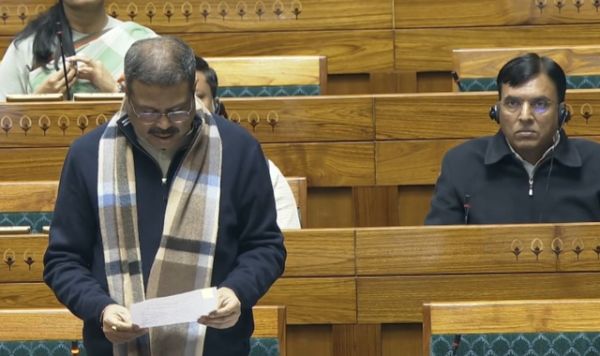
Union Minister for Education Dharmendra Pradhan introduced the Viksit Bharat Shiksha Adhishthan Bill, 2025 in Lok Sabha, today.
The purpose of the Bill is to empower Higher Educational Institutions (HEIs) of Bharat to achieve excellence through effective coordination and the determination of standards.
The National Education Policy (NEP) 2020 was formulated through extensive nationwide consultations and, as envisaged in Chapter 18, calls for a fundamental transformation of the higher education regulatory system. Under the visionary leadership of Lt. Dr. K. Kasturirangan, Chairperson, NEP Drafting Committee, Former Chairperson, ISRO, the policy is guided by a holistic and future-oriented vision that emphasizes academic autonomy, multidisciplinary education, research excellence, and global competitiveness rooted in Indian values. Building on this inclusive consultative process, the Bill has been prepared and incorporates relevant global best practices, carefully studied, contextualised, and suitably adapted to the Indian higher education context, in alignment with national priorities and Dr. Kasturirangan’s vision of an equitable, flexible, and innovation-driven education system.
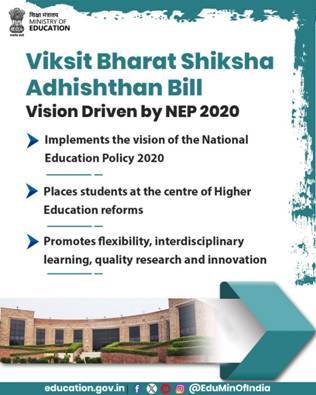
On 12th December, 2025, the Union Cabinet chaired by the Prime Minister Shri Narendra Modi approved the Viksit Bharat Shiksha Adhishthan Bill, 2025 for the introduction in Parliament.
This Bill is being introduced under the provisions of Entry 66 of the Union List in the seventh schedule of the Constitution of India which provides for “Co-ordination and determination of standards in institutions for higher education or research and scientific and technical institutions”.
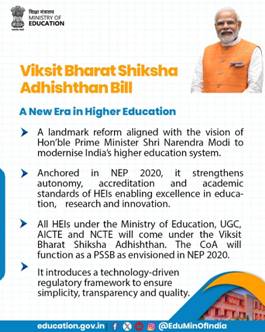
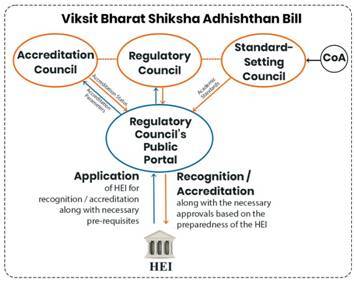
The Bill provides for the establishment of the Viksit Bharat Shiksha Adhishthan as an apex body, along with three Councils: the Viksit Bharat Shiksha Viniyaman Parishad (Regulatory Council), the Viksit Bharat Shiksha Gunvatta Parishad (Accreditation Council), and the Viksit Bharat Shiksha Manak Parishad (Standards Council). The Bill further provides for repealing the University Grants Commission Act (UGC), 1956, the All India Council for Technical Education Act (AICTE), 1987 and the National Council for Teacher Education Act (NCTE), 1993. All higher educational institutions under the purview of the Ministry of Education, UGC, AICTE, and NCTE will be under the purview of the Viksit Bharat Shiksha Adhishthan for determination of standards. The Council of Architecture (CoA) shall function as a Professional Standard Setting Body (PSSB) as envisioned in the NEP, 2020. The Bill ensures upholding the current level of autonomy accorded to the Institutions of National Importance.
The Adhishthan will provide strategic direction for the holistic growth of higher education and ensuring coordination among the Councils. The Standards Council will be responsible for synchronization and specifying minimum academic standards in HEIs; the Regulatory Council will ensure coordination and maintenance of these standards; and the Accreditation Council will function as an independent accrediting authority overseeing a robust and credible accreditation ecosystem.
The Regulatory Council’s public portal, which mandates disclosure of governance, financial, academic, and institutional performance data by HEIs, will also serve as the foundational basis for accreditation. This integrated approach will ensure transparency, accountability, and efficiency, while reinforcing the Government’s commitment to simplification of systems for the stakeholders in Higher Education.
The membership of the Adhishthan and various Councils primarily comprises eminent academicians, domain experts, and representatives from States/UTs, State HEIs, and Institutions of National Importance, ensuring balanced representation and informed decision-making.
In the present scenario the higher educational institutions are required to take multiple approvals by different Regulatory Bodies, multiple inspections, etc., resulting in over-regulation of the sector and duplication of control. There exists a strong need for providing simplified regulatory systems for higher educational institutions in the country.
Accordingly, the proposed Bill seeks to eliminate the complexities by introducing a unified and streamlined regulatory architecture. The entire regulatory framework will operate through technology-driven, faceless, Single Window Interactive Systems, based on principles of public self-disclosure and trust-based regulation.
The Regulatory Council will maintain a comprehensive public digital portal, where HEIs will be required to disclose information relating to financial probity, governance practices, finances, audits, procedures, infrastructure, faculty and staff, academic programmes, and educational outcomes. The data submitted on this public portal will also serve as the primary basis for accreditation, thereby ensuring transparency, accountability, and consistency across the higher education ecosystem.
Major Outcomes of the Proposed Bill
- Youth Empowerment
- Transparent and student-centric systems will ensure easier access to quality HEIsleading to improved outreach and higher Gross Enrolment Ratio (GER).
- A holistic approach to education will focus on academic excellence while nurturing critical thinking, creativity, and innovation among students.
- Interdisciplinary and flexible academic frameworks will allow learners to explore diverse disciplines and pursue continuous reskilling and upskilling.
- Strong emphasis on research, innovation, and entrepreneurship will strengthen problem-solving abilities, creativity, and self-reliance among youth.
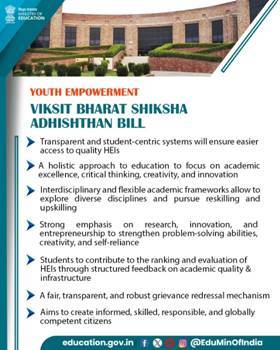
- Students will actively contribute to the ranking and evaluation of HEIs through structured feedback on academic quality, infrastructure, governance, and overall learning experience, ensuring accountability and continuous improvement.
- A fair, transparent, and robust grievance redressal mechanism will ensure timely and effective resolution of student concerns, strengthening trust in institutional systems.
- The Bill aims to create informed, skilled, responsible, and globally competent citizens capable of contributing meaningfully at national and international levels.
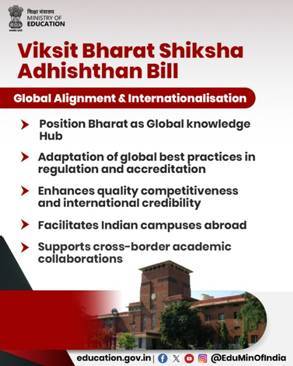
- Adaptation of Global Best Practices
- The adaptation of global best practices in higher education will enhance quality, competitiveness, and international credibility of Indian HEIs.
- It will facilitate the establishment of globally benchmarked institutions within the country, positioning Bharat as a knowledge hub while retaining domestic talent and attracting international students and faculty.
3. Regulatory Reforms
- Clear functional separation of Standard Setting, Regulation, and Accreditation through independent Councils will ensure objectivity, credibility, and freedom from conflicts of interest.
- Harmonised benchmarks for regulation will ensure uniform minimum quality standards while allowing flexibility and diversity in institutional missions and academic offerings.
- Objective, transparent, technology-enabled, faceless Single Window systemsopen to public scrutiny, will simplify processes, reduce discretion, and enhance efficiency and accountability.
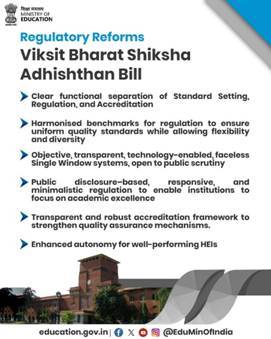
- Public disclosure–based, responsive, and minimalistic regulation will enable institutions to focus on academic excellence rather than procedural compliance.
- A transparent and robust accreditation framework will further strengthen quality assurance mechanisms.
- Enhanced autonomy for well-performing HEIs will enable them to function as independent and self-governing institutions, fostering innovation, efficiency, and superior academic outcomes.
Contact to : xlf550402@gmail.com
Copyright © boyuanhulian 2020 - 2023. All Right Reserved.