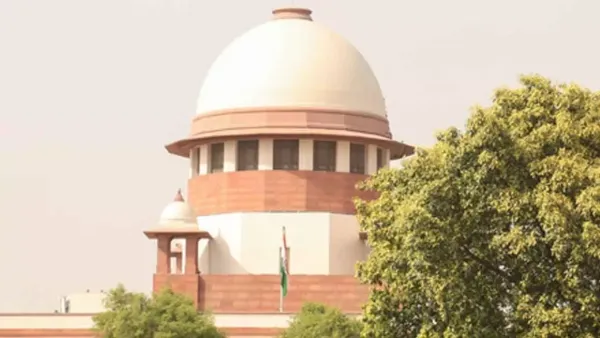
SC issues notice on Justice Varma’s plea challenging 3-member probe panel in cash discovery allegations
The Supreme Court on Tuesday issued notice on a plea filed by Allahabad High Court Judge Justice Yashwant Varma, challenging the impeachment proceedings initiated against him.
Justice Varma has been at the centre of controversy since burnt cash was discovered on March 14 in an outhouse of his official residence, which had been allotted to him while he was serving in the Delhi High Court.
A bench of Justices Dipankar Datta and Augustine George Masih sought responses from the office of the Lok Sabha Speaker and Lok Sabha and Rajya Sabha Secretariats and posted the matter for further hearing on January 7.
In his writ petition filed under Article 32 of the Constitution, Justice Varma has questioned the constitution of the three-member statutory inquiry committee announced by Lok Sabha Speaker Om Birla to probe allegations arising out of the discovery of burnt currency at his official residence earlier this year.
On August 12, the Lok Sabha had read out the impeachment motion against Justice Varma, marking the beginning of proceedings under Articles 124(4), 217 and 218 of the Constitution for his possible removal.
The Speaker informed the House that he had received the motion on July 31, backed by senior BJP leader Ravi Shankar Prasad and supported by 146 Lok Sabha members and 63 Rajya Sabha members. He said he had found "substance as per the rules" in the motion and admitted it for discussion.
Birla also announced the formation of a three-member committee comprising Supreme Court judge Justice Aravind Kumar, Madras High Court Chief Justice Maninder Mohan Shrivastava, and senior advocate B.V. Acharya to investigate the charges.
"The committee will soon give its report, and till then the motion will remain pending," he said.
Justice Varma has been at the centre of controversy since March, when bundles of burnt currency were discovered during a fire incident in an outhouse of his government-allotted residence in the national Capital, when he was serving as a judge of the Delhi High Court. Though he was not present at the time of the fire, a three-member in-house judicial inquiry later concluded that he exercised "secret or active control" over the cash stash.
Based on the inquiry report, the then Chief Justice of India (CJI) Sanjiv Khanna recommended initiation of removal proceedings.
In August this year, the Supreme Court dismissed Justice Varma's writ petition challenging the in-house inquiry. The apex court said that the in-house procedure laid down is "fair and just" and does not compromise judicial independence, which is a basic feature of the Constitution.
Contact to : xlf550402@gmail.com
Copyright © boyuanhulian 2020 - 2023. All Right Reserved.