Why Does Indian Football Get Just ~0.3% of the Sports Budget?
Every year, the Union Budget sets aside thousands of crores of rupees for sports development in India. This money supports athletes, builds infrastructure, funds training programmes, and helps India prepare for international competitions.
Within this overall spending, football occupies an interesting position. It is one of the most widely followed sports in the country, played across schools, colleges, clubs, and neighbourhood grounds. Yet, when central government spending is examined closely, football accounts for
a very small share of the total sports budget.
1. How India Spends on Sports at the Central Level At the national level, sports funding is allocated through the Ministry of Youth Affairs and Sports (MYAS). The ministry’s budget covers:
What this shows:
India’s central sports spending has grown steadily in absolute terms over time, with a particular focus on athlete development, infrastructure, and international competitiveness.
Source: Union Budget of India, MYAS Demands for Grants
2. How Football Is Funded Centrally

These grants are meant to support:
The FY 2024–25 figure of ₹8.78 crore comes from MYAS Demands for Grants and parliamentary disclosures. These grants are the direct central government contribution to the AIFF.
Source: MYAS Demands for Grants, Parliamentary responses, reported official figures
3. Where the ~0.3% Figure Comes From

This means that in that year, football received about one-quarter of one percent of central sports spending.
When similar calculations are applied to earlier years, football’s share generally falls within the 0.2%–0.4% range, which is why it is often referred to as “around 0.3%”.
4. Commentary and Public Statements from Football Stakeholders While most of the funding and governance processes are administrative, key individuals within Indian football have publicly commented on broader challenges affecting the sport.
Sunil Chhetri

5. How This Share Has Changed Over Time While the total sports budget increased, football’s central funding did not rise at the same pace.
As a result:
Within this overall spending, football occupies an interesting position. It is one of the most widely followed sports in the country, played across schools, colleges, clubs, and neighbourhood grounds. Yet, when central government spending is examined closely, football accounts for
a very small share of the total sports budget.
1. How India Spends on Sports at the Central Level At the national level, sports funding is allocated through the Ministry of Youth Affairs and Sports (MYAS). The ministry’s budget covers:
- Athlete training and preparation
- National sports federations
- Infrastructure and academies
- Multi-sport programmes such as Khelo India
| 2018–19 | 2,196 |
| 2019–20 | 2,216 |
| 2020–21 | 2,826 |
| 2021–22 | 2,596 |
| 2022–23 | 3,062 |
| 2023–24 | 3,397 |
| 2024–25 | 3,442 |
What this shows:
India’s central sports spending has grown steadily in absolute terms over time, with a particular focus on athlete development, infrastructure, and international competitiveness.
Source: Union Budget of India, MYAS Demands for Grants
2. How Football Is Funded Centrally
AIFF president Kalyan Chaubey feels Salt Lake Stadium fiasco during Messi's visit could dent India's soft power as it aims to host 2036 Olympics
Football receives central government funding primarily through grants given to the All India Football Federation (AIFF) under the Scheme of Assistance to National Sports Federations (ANSF).These grants are meant to support:
- National teams
- Domestic competitions
- Coaching and refereeing programmes
- Grassroots and youth initiatives
| 2018–19 | ~16 |
| 2019–20 | ~14 |
| 2020–21 | ~11 |
| 2021–22 | ~10 |
| 2022–23 | ~9 |
| 2023–24 | ~14 |
| 2024–25 | 8.78 |
The FY 2024–25 figure of ₹8.78 crore comes from MYAS Demands for Grants and parliamentary disclosures. These grants are the direct central government contribution to the AIFF.
Source: MYAS Demands for Grants, Parliamentary responses, reported official figures
3. Where the ~0.3% Figure Comes From
New Delhi, Aug 3 (IANS) The fourth edition of the AIFF Futsal Club Championship 2024-25 will kick off on Sunday, August 3, 2025, at the Shri Manoj Sarkar Stadium – Shivalik Hall in Rudrapur, Uttarakhand.
Using FY 2024–25, the calculation is straightforward:- Total sports budget (MYAS): ₹3,442 crore
- Football grant (AIFF): ₹8.78 crore
This means that in that year, football received about one-quarter of one percent of central sports spending.
When similar calculations are applied to earlier years, football’s share generally falls within the 0.2%–0.4% range, which is why it is often referred to as “around 0.3%”.
4. Commentary and Public Statements from Football Stakeholders While most of the funding and governance processes are administrative, key individuals within Indian football have publicly commented on broader challenges affecting the sport.
Sunil Chhetri
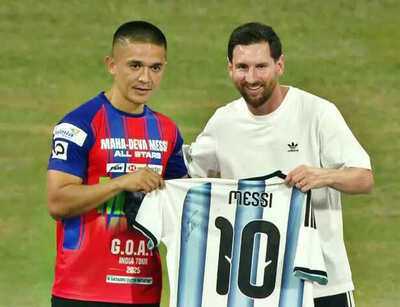
Mumbai, Dec 14 (ANI): Indian footballer Sunil Chhetri during an exhibition match as part of Lionel Messi's G.O.A.T India Tour 2025 at Wankhede Stadium, in Mumbai on Sunday. (ANI Photo)
Sunil Chhetri - India’s most capped footballer and one of its highest-profile athletes, has addressed the state of Indian football in public statements:- In 2025, Chhetri and other Indian Super League (ISL) players released a public plea urging authorities to restart the ISL season, signalling concern over the operational uncertainty that affected players and staff. The statement described the situation as “a standstill” and expressed urgency for action.
- In a separate 2025 social media post, Chhetri characterized the football ecosystem’s situation as “very concerning” during a period when the league’s season was under threat due to contractual and administrative issues. He noted that players, coaches, and support staff were anxious about the future.
5. How This Share Has Changed Over Time While the total sports budget increased, football’s central funding did not rise at the same pace.
As a result:
- In earlier years (around 2018–19), football’s share was closer to 0.7–0.8%
- Over time, as overall sports spending expanded, football’s percentage share declined
- By the mid-2020s, it settled at around 0.25–0.3%
Contact to : xlf550402@gmail.com
Copyright © boyuanhulian 2020 - 2023. All Right Reserved.