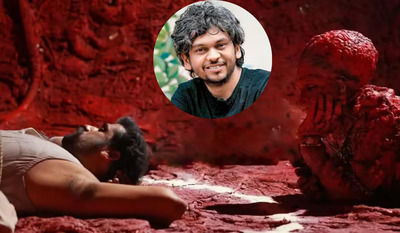
Even years after its release,
Tumbbad continues to loom large in conversations around Indian cinema , not just as a cult classic but as a marker of a certain kind of storytelling ambition. For Anand Gandhi , however, the film already feels complete. “For me,
Tumbbad was a distillation of many ideas, insights and warnings that had matured within me over a decade,” he says, firmly closing the chapter on any creative return. “I feel I have already said everything that I wanted to say within the framework of
Tumbbad.”
As speculation around a sequel continues, Gandhi is unequivocal. “My responsibility towards my audience is to keep giving them what they don't even know they want yet, not more of what I’ve already given them.” He clarifies his distance from the follow-up without hesitation. “I am not involved with
Tumbbad 2 at all, nor are any of my close collaborators who worked with me on
Tumbbad.”
That forward-looking impulse defines Gandhi’s larger body of work. “I don’t sit down thinking, ‘Let me be ahead of my time,’” he says. “I sit down thinking, ‘Let me respect the audience’s intelligence and trust that they want a better life.’” He believes Indian audiences are already living in accelerated realities. “Young people in India today are already living in the future. They’re juggling AI filters, climate anxiety, global oneness and loneliness before breakfast.”
His approach to storytelling, he explains, is deceptively simple. “So I try to give them two things at once: familiar emotions – love, fear, humour, moral drama – and unfamiliar lenses – evolutionary biology, information theory, inequality, AI.” The goal is accessibility without dilution. “Think of it as hiding medicine in candy,” he adds. “The story has to work first as thrill, laughter, wonder.”
That philosophy now extends into
MAYA: Seed Takes Root, a transmedia universe that spans novels, games and films, with Gandhi deeply involved in shaping its conceptual spine. “MAYA began with us asking the most fundamental questions raised by philosophers and children alike: Who are we? Where did we come from? What is the meaning of life?” he says. From there, the project expanded into something far more systemic. “We began simulating an entire world from scratch. We worked with experts across disciplines — geologists, biologists, linguists and architects — to ensure our first principles-driven worldbuilding was internally consistent, coherent and scientifically accurate.”
Set in a civilisation where stories, data and belief systems quietly govern reality,
MAYA reflects Gandhi’s long-standing fascination with invisible power structures. “There is a direct parallel with a question of unprecedented complexity facing us today: What does it mean to be human when you can't be sure your thoughts are actually yours?” Rather than offering answers, he prefers experiential understanding. “In MAYA, the revolution is the method. Instead of lecturing people about surveillance capitalism or algorithmic manipulation, we let people enter and experience these systems from the inside.” For Gandhi, the intent is quietly radical. “We hope that every reader takes away a cognitive toolkit — a new ability to spot when their attention is being harvested, when their choices are being narrowed, and when their futures are being predicted and shaped by forces they can't see.”
Contact to : xlf550402@gmail.com
Copyright © boyuanhulian 2020 - 2023. All Right Reserved.