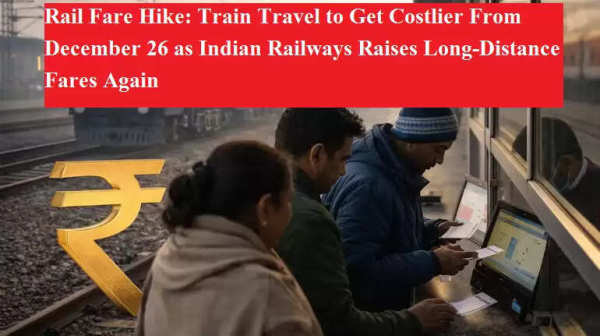
Rail Fare Hike 2025: Indian Railways has announced another increase in passenger fares, marking the second fare hike in a single year. The revised fares will come into effect from December 26, 2025, and will mainly impact long-distance यात्रियों traveling more than 215 kilometres. While long routes will become slightly more expensive, the Railways has provided relief to short-distance, suburban, and daily commuters, ensuring no additional burden on them.
According to the Railway Ministry, the fare revision is aimed at meeting rising operational costs and funding large-scale infrastructure development across the country.
What Has Changed in the New Rail Fare Structure?
Under the new fare rules, passengers travelling more than 215 km will have to pay a small additional charge per kilometre, depending on the train and class. The increase is marginal but will apply to the entire distance of travel once the 215 km threshold is crossed.
Here’s how the fare hike has been structured:
Ordinary (Non-AC) Class, above 215 km:
👉 1 paisa per kilometre extra
Mail/Express Non-AC Class:
👉 2 paisa per kilometre extra
Mail/Express AC Class:
👉 2 paisa per kilometre extra
Non-AC travel of 500 km:
👉 ₹10 additional fare
The Railways estimates that this change will generate around ₹600 crore in additional annual revenue.
No Fare Hike for Short Routes and Daily Commuters
In a major relief for millions of passengers, Indian Railways has clearly stated that no fare increase will apply to journeys up to 215 kilometres. This means passengers travelling on short and medium routes will continue to pay the same fares as before.
Additionally, there is no change in fares for suburban trains and Monthly Season Tickets (MSTs). This decision benefits daily commuters in metro cities such as Mumbai, Delhi, Kolkata, and Chennai, where local trains are a lifeline for office-goers and students.
City Commuters and Local Train Users Unaffected
Railways officials confirmed that:
Suburban/local trains: No change
Monthly Season Tickets (MST): No change
By keeping local and season ticket fares untouched, the Railways has ensured that regular travelers are shielded from inflationary pressure.
How Much More Will You Pay on Long Routes?
To understand the real impact, let’s take an example of a long-distance route.
For instance, the distance between Ayodhya and New Delhi is around 713 km.
Ordinary Class:
Extra fare = 1 paisa × 713 km ≈ ₹7.13
Mail/Express Non-AC or AC Class:
Extra fare = 2 paisa × 713 km ≈ ₹14.26
This shows that even on long routes, the fare increase remains limited and manageable, rather than a steep jump.
Why Did Indian Railways Increase Fares?
The Railway Ministry said the decision was taken after considering:
Rising operational and maintenance costs
Continuous investment in new trains and better coaches
Station modernisation projects
Improved passenger amenities and safety
Expansion of railway infrastructure
Indian Railways is one of the largest employers in the world, and maintaining such a massive network requires substantial funding. The additional revenue from the fare hike will be used to support these ongoing and future projects.
Second Fare Hike in 2025
This is not the first fare revision in 2025. Earlier, on July 1, 2025, Indian Railways had increased fares:
Non-AC Mail/Express: +1 paisa per km
AC Classes: +2 paisa per km
Before 2025, passenger train fares were last revised in 2020. According to the Railways, the July hike alone has already generated nearly ₹700 crore in additional revenue, strengthening its financial position.
Special Trains for Christmas and New Year
To manage the surge in passenger demand during the Christmas and New Year 2025-26 season, Indian Railways has announced 244 special train trips across eight zones.
Officials said more special services may be added if required. These trains aim to provide:
Additional seats
Reduced overcrowding
Smoother travel experience during peak holidays
Improved Connectivity on Busy Routes
Special focus has been given to high-demand routes, including:
Delhi – Howrah – Lucknow corridor
Mumbai – Goa (Konkan route)
Special daily and weekly trains between Mumbai CSMT/LTT and Karmali/Madgaon
Additional services on Mumbai–Nagpur, Pune–Sanganer, and other Maharashtra routes
These measures are expected to ease long-distance travel during the festive rush.
Rail Network Nears Complete Electrification
Indian Railways has also made major progress on infrastructure:
99.1% of the broad-gauge network is now electrified
This is expected to reduce fuel costs and improve operational efficiency
The Mumbai–Ahmedabad high-speed bullet train project has achieved 100% land acquisition in Maharashtra
Between 2014 and 2025, Indian Railways has added nearly 2 lakh wagons and over 10,000 locomotives, significantly boosting freight and passenger capacity.
Bottom Line
While the rail fare hike from December 26 will slightly impact long-distance travelers, the increase is modest and carefully targeted. Short-distance passengers, daily commuters, and local train users remain unaffected. With the additional revenue being channelled into infrastructure, safety, and service upgrades, Indian Railways aims to balance affordability with long-term sustainability.
Disclaimer:
This article is for informational purposes only. Fare structures and train services may change based on official notifications. Passengers are advised to check the Indian Railways website or IRCTC portal for the latest updates before planning their journey.
Contact to : xlf550402@gmail.com
Copyright © boyuanhulian 2020 - 2023. All Right Reserved.