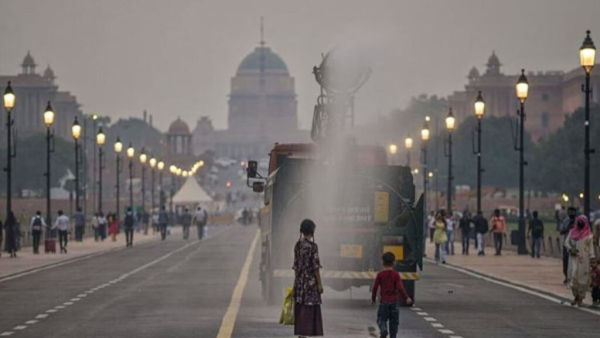
New Delhi: The country’s capital Delhi is once again facing the dual challenge of pollution and severe cold. For the past several days, poisonous air and dense fog had affected life. Although a slight improvement in the situation was recorded on Wednesday morning, the relief is very limited at present.
In the morning, the layer of pollution and fog was seen clearing to some extent, due to which visibility improved. Despite this, the effect of cold has become more intense. Experts say that the air quality still cannot be called safe for health.
Delhi is becoming a gas chamber
Increase in pollution in Delhi during winter season is not a new thing. The situation worsens every year due to stagnation in weather, low wind speed and pollution factors. This time too, the people of the capital had to breathe ‘very bad’ and ‘severe’ category air for several days. A slight decline was recorded in AQI on Wednesday morning, but the situation still remains a matter of concern.
Some relief from snowfall and sunshine in the mountains
According to experts, there are many reasons behind the slight improvement in Delhi’s air. Snowfall on the mountains increased the cold, but it also increased the wind speed, which affected the AQI. Apart from this, the bright sunshine throughout the day also helped in reducing the pollution a little.
AQI declines, but ‘very poor’ category remains intact
This morning, Delhi’s average air quality index (AQI) was recorded at 355, which falls in the ‘very poor’ category. In most areas of the capital, AQI remains between 350 to 400, which clearly shows that the danger is not over yet.
AQI was recorded at 333 in Alipur, 374 in Anand Vihar, 362 in Ashok Vihar, 352 in Bawana and 320 in Burari. The AQI in Chandni Chowk reached 382, while in Nehru Nagar it was 399, which is very close to the severe category.
Situation is worrying in NCR also
The air condition in NCR areas adjacent to Delhi was also not good. AQI was recorded at 302 in Noida Sector-62, while it was 248 in Indirapuram, Ghaziabad. AQI was recorded 272 in Loni and 377 in Vasundhara. The effect of pollution was clearly visible in the entire NCR.
Reduction in fog, better visibility
Recently, road and air traffic was affected due to dense fog. There was some reduction in fog on Wednesday morning, which improved visibility. However, the Meteorological Department says that this relief may be temporary.
Cold will increase in the coming days
According to the Meteorological Department, the cold may increase further in Delhi in the coming days. The minimum temperature is likely to fall to 7 to 8 degrees Celsius, while the maximum temperature may remain around 19 to 20 degrees. Cold will hurt more in the morning and night.
still need to be cautious
Experts say that a slight decline in AQI cannot be considered as relief. Unless the air quality consistently falls into the ‘moderate’ or ‘satisfactory’ category, caution is necessary. People have been advised to wear masks, go out less and take special care of health.
Contact to : xlf550402@gmail.com
Copyright © boyuanhulian 2020 - 2023. All Right Reserved.