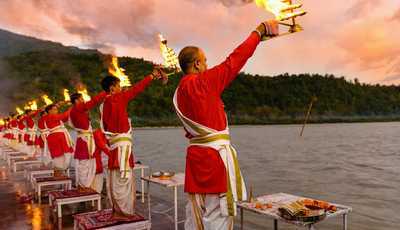
India is a land rich in culture, traditions, and deep-rooted religious beliefs, drawing millions of devotees every year. Among its most revered natural treasures are the sacred rivers, which symbolise purity, faith, and spiritual awakening. Many of the country’s holy cities are nestled along these riverbanks, and the rivers themselves are worshipped as goddesses by pilgrims from all corners of India. If you’re planning a journey along these divine waterways, prepare yourself for a truly soul-stirring experience.
To help you begin, here’s a curated list of the seven most sacred rivers of India—each steeped in mythology, devotion, and timeless beauty.
# Ganga River
No list of sacred rivers in India can begin without the Ganga. Revered in the Vedas and Puranas, the Ganga is worshipped as a goddess believed to have descended from Lord Shiva’s locks. Originating in the Himalayas, the river flows through Uttarakhand, Uttar Pradesh, Madhya Pradesh, Rajasthan, Himachal Pradesh, Chhattisgarh, Jharkhand, and Bihar before emptying into the Bay of Bengal.
Several holy cities flourish along its banks, with Varanasi being the oldest and most iconic. Lined with ghats and ancient temples, the city attracts devotees and travellers from across the globe. It is believed that bathing in the holy waters of the Ganga washes away sins and grants salvation. Stretching approximately 2,510 kilometres, the Ganga is also the longest river in India.
# Yamuna River
The Yamuna rises from Yamunotri in the Himalayas and is one of the most sacred rivers of North India. According to Hindu mythology, Yamuna is a goddess and the twin sister of Yama, the god of death. The river flows through Uttarakhand, Himachal Pradesh, Haryana, Rajasthan, Madhya Pradesh, Uttar Pradesh, and Delhi before meeting the Ganga at the Triveni Sangam in Prayagraj.
This confluence is famously known as the venue for the grand Kumbh Mela. Sacred towns like Gokul, Mathura, and Prayagraj lie along its banks, while the world-renowned Taj Mahal stands gracefully on the Yamuna’s edge in Agra.
# Kaveri River
The Kaveri, also known as Cauvery, is a revered river of South India, originating from the Brahmagiri Hills in the Western Ghats. Flowing through Karnataka, Tamil Nadu, and parts of Kerala, it eventually merges into the Bay of Bengal. One of its most striking highlights is the majestic Shivanasamudra Falls, among the largest waterfalls in India.
Spiritually, the Kaveri holds immense importance and is often referred to as Dakshina Ganga—the Ganga of the South. Devotees believe that bathing in its waters purifies the soul and absolves sins. Surrounded by lush landscapes, the river’s serene beauty enhances its sacred aura.
# Narmada River
Mentioned in several ancient Indian scriptures, the Narmada is believed to have descended to Earth on Lord Shiva’s command. The river is worshipped for its power to cleanse sins, bring peace, and grant spiritual liberation.
Rising from Amarkantak in Madhya Pradesh, the Narmada flows westward across central India before joining the Arabian Sea near Bharuch. Spanning around 1,312 kilometres, it is among India’s longest rivers. The iconic Sardar Sarovar Dam stands as a significant modern landmark on this sacred river.
# Kshipra River
Also known as the Shipra, the Kshipra River holds great religious significance, especially due to the holy city of Ujjain situated along its banks. Ujjain is home to one of the twelve Jyotirlingas and hosts the Kumbh Mela every 12 years, attracting millions of devotees worldwide. Taking a holy dip in the Kshipra is believed to be highly auspicious.
The river originates in the Vindhya Range’s Kakri Bardi Hills and flows northward across the Malwa Plateau before merging with the Chambal River. Numerous temples and shrines line its banks, making it a revered pilgrimage route.
# Godavari River
One of the longest rivers in India, the Godavari originates from the Brahmagiri Mountains near Trimbakeshwar in Nashik. Flowing eastward through Maharashtra, Telangana, Andhra Pradesh, Chhattisgarh, and Odisha, it finally drains into the Bay of Bengal.
The river holds immense religious importance, especially due to the Kumbh Mela held at Nashik, which attracts vast numbers of pilgrims. Several sacred towns and temples dot its banks, reinforcing its status as one of India’s most spiritually significant rivers.
# Saraswati River
The Saraswati holds a unique place in Indian history and mythology. Revered since the Vedic and post-Vedic periods, it is mentioned extensively in ancient scriptures as a sacred river of North India.
The Triveni Sangam in Prayagraj is believed to be the confluence of the Ganga, Yamuna, and the mystical Saraswati. Devotees consider this site exceptionally holy, believing that bathing here cleanses the soul of all sins.
Contact to : xlf550402@gmail.com
Copyright © boyuanhulian 2020 - 2023. All Right Reserved.