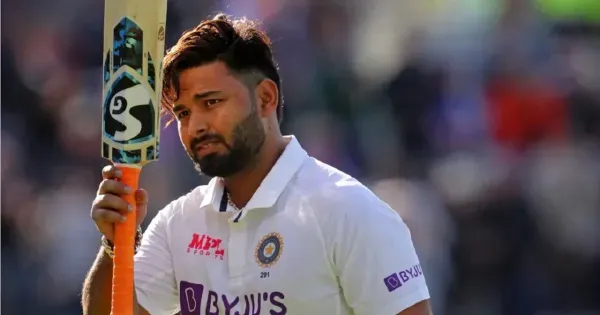
Bengaluru. BCCI’s Center of Excellence overlooks an airport runway on the horizon. The sound of planes taking off does not reach the ground, but the view does. For most of Delhi’s innings – after being asked to bat first by Gujarat – Rishabh Pant himself was ready to take off. But he remained composed, coming on the field after 3 wickets fell for 98 runs in the 20th over. On the outskirts of Bengaluru, in the absence of large crowds or traffic, the tempo of the game is dictated by the intervening sounds: the sound of the bat as the bowler runs in, fielders shouting appeals, sighs after a bouncer passes the batsman. The pitch offered little pace and bounce to the fast bowlers, making life more difficult for the batsmen, as Virat Kohli scored a half-century in 29 balls.
He had scored 77 of Delhi’s 108 runs before being stumped by Vishal Jaiswal’s brilliant left-arm spin bowling. With the field spread out, and Delhi’s batsmen in danger of being wiped out, it was important for Pant to hold on as there was no respite in sight. He mostly took singles by taking the balls past the in-fielders and scored 20 and then 30 runs. Pant focused on staying at the crease and largely avoided spectacular, aerial shots early on. His calmness at the crease was a far cry from the power he mustered every time he tapped his bat on the pitch; His conservative stroke play did not match the power he was using in it.
Another shot across the field took him to 49. Then as soon as he saw Ravi Bishnoi bowl an errant ball away from his hitting arc, he switched on – pouncing on it with a powerful swing across the line. His hand did not completely separate from the bat, as happens with many of his powerful shots, but the ball went well past the long-on boundary. The spring had been tight of late, and now having passed 50, there was something of a change in the pace of his movement between the balls: he suddenly appeared to be skipping across the crease, more eager to tap the gloves with Harsh Tyagi at the other end. Soon after his half-century, he went down on his knees, sweeping towards deep-backward square leg, even though he almost fell to the other side. He completed his half-century in 62 balls. He added 20 more runs in the next 16 balls.
The best shot of this set of runs was when he was standing well back in his crease and a ball rose awkwardly, just past a good length outside the off stump. He swung his bat, the arc of his follow-through looking like a helicopter shot. The result was that the ball raced towards the cover boundary, seemingly meant to trouble them.
Pant’s last ODI for India was more than a year ago – against Sri Lanka in August 2024 – but he remains on the fringes of India’s white-ball plans. The general feeling is that while his high-risk, high-reward strategy is perfect for Test cricket, he has not been able to find the right pace for himself in limited overs. These data support this notion. He has scored only one century in 31 ODIs and his average is 33.50. His List A figures are also not much different. By the time Pant was out on 70, Delhi’s resurgence was over, even before Pant’s own innings could reach its peak: a long-standing trait of how he plays his ODI innings.
Delhi’s wickets fell together in the last overs and the team could only score 254 runs for 9 wickets, whereas it seemed that they could have scored more runs. But Pant has a great opportunity to bounce back in form and create a new way of scoring runs, as his fellow batsman-keeper Ishan Kishan did during the Syed Mushtaq Ali Trophy.
Contact to : xlf550402@gmail.com
Copyright © boyuanhulian 2020 - 2023. All Right Reserved.