India is a land deeply rooted in spirituality, where faith has shaped not only the lives of its people but has also inspired devotees across the world. It is this unwavering devotion that has given rise to countless temples, mosques, churches, and monasteries over centuries. To truly experience India’s sacred soul, one must explore its revered jyotirlingas—divine shrines dedicated to Lord Shiva. Among these sacred sites, several magnificent jyotirlingas are nestled in the culturally rich state of Maharashtra.
Maharashtra is celebrated for its diverse attractions—majestic hill stations, serene beaches, historic landmarks, and thriving wildlife. Adding to this vibrant tapestry are its jyotirlinga temples, which stand as powerful spiritual landmarks and major highlights of the state’s tourism.
A visit to these jyotirlingas promises more than just a pilgrimage. The deep-rooted legends stir the mind, the spiritual aura fills the heart with devotion, and the scenic surroundings offer a feast for the eyes. It soon becomes evident why these jyotirlingas rank among the top places to visit in Maharashtra. With that, let’s take a closer look at the five most revered jyotirlingas in the state.
# Trimbakeshwar Temple
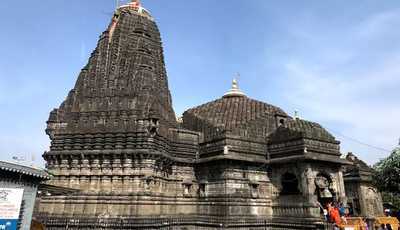
Set in the sacred town of Trimbak near Nashik and surrounded by the Brahmagiri, Nilagiri, and Kalagiri hills, Trimbakeshwar Temple is the first jyotirlinga on this list. It holds immense importance as one of the 12 most revered jyotirlingas in India. The temple is also known for its distinctive black stone lingam, which uniquely represents the trinity—Lord Brahma, Lord Vishnu, and Lord Shiva—in a three-faced form. Built in the elegant Hemadpanti architectural style, the temple is steeped in mythology, particularly the legend associated with the origin of the holy River Ganga.
According to legend, Maharishi Gautama was deceived into committing a sin by Lord Indra and was told that only a dip in the Ganga could absolve him. At that time, Ganga resided in Lord Shiva’s locks. Upon Gautama’s request, Lord Shiva commanded Ganga to descend to earth. Though reluctant, she complied, but out of resentment, she kept disappearing as she flowed, making it difficult for the sage to locate her. Eventually, Gautama found her at Kushavarta, within the Trimbakeshwar Temple complex. With its rich mythology, serene natural setting, and divine energy, Trimbakeshwar is truly a must-visit shrine.
# Bhimashankar Temple
The legend of Bhimashankar traces back to the three demon brothers—Tarakaksha, Vidyunmali, and Kamalaksha—who performed intense penance to please Lord Brahma. Granted a boon, they were given three invincible cities—Tripuri—placed in heaven, the sky, and on earth. The condition was that they could only be destroyed by a single arrow when the three cities aligned, an event that occurred once every thousand years for just a moment.
Lord Shiva accomplished the impossible by destroying Tripuri with his divine Pashupatastra and defeating the demons. After this intense battle, he rested atop a mountain in present-day Pune district. This very spot later became home to the Bhimashankar Temple.
The jyotirlinga here is a swayambhu lingam, believed to have emerged naturally from the earth. Apart from its spiritual significance, the temple attracts nature lovers and trekkers with its lush surroundings and scenic trails. The striking Nagara-style architecture further enhances its charm.
# Parli Vaijnath Temple
Perched atop a hill in the Beed district, Parli Vaijnath Temple is easily accessible via Latur airport. The shrine houses Lord Shiva in the form of Vaidyanath—the divine healer. The temple’s surroundings are rich in medicinal herbs, which is believed to be the reason behind this form and name of the deity. As you explore the temple, you’ll notice beautiful elements of Hemadpanti architecture throughout.
The legend associated with Parli Vaijnath is equally captivating. After years of penance, Ravana pleased Lord Shiva and requested him to accompany him to Lanka in the form of a jyotirlinga. Lord Shiva agreed on the condition that Ravana alone would carry it. Fearing Ravana’s growing power, the gods intervened. When Ravana grew tired during the journey, he handed the lingam to a young boy while he rested. Unable to bear its increasing weight, the boy placed it on the ground, where it became immovable. That sacred spot is where Parli Vaijnath Temple stands today.
# Aundha Nagnath Temple
Believed to have been constructed in the 13th century, Aundha Nagnath Temple is associated with Yudhishtir, the eldest of the Pandavas, who is said to have built it during their exile. Another legend claims that this was the very first jyotirlinga to appear on earth. The temple is also closely linked to Sant Namdev, the revered saint-poet.
According to folklore, Sant Namdev was once denied entry into the temple due to his caste. Undeterred, he continued singing bhajans outside the temple. Miraculously, the temple is said to have rotated itself so that the saint was once again facing the sanctum.
Located in the town of Aundha Nagnath in Hingoli district, this offbeat jyotirlinga is worth visiting for its spiritual significance, tranquil forest surroundings, and exquisite Hemadpanti architecture.
# Grishneshwar Temple
We conclude this sacred journey with Grishneshwar Temple, another of the 12 most revered jyotirlingas of India. Located in Verul near Aurangabad, the temple features an east-facing jyotirlinga and a majestic statue of Nandi. Built in the Hemadpanti style, the temple stands on a solid rock base and is adorned with 24 impressive pillars in its courtyard.
The legend of Grishneshwar is both touching and inspiring. A devout couple, Sudharm and Sudeha, longed for a child but remained childless. At Sudeha’s request, her sister Ghushma married Sudharm. Ghushma worshipped Lord Shiva daily by crafting 101 clay lingams and immersing them in a nearby lake. Her devotion was rewarded with a son. Consumed by jealousy, Sudeha killed the child, but Ghushma continued her prayers without anger or grief. Moved by her unwavering faith, Lord Shiva restored the child to life. Ghushma then asked the Lord to remain there and bless all devotees, and thus Lord Shiva manifested as Ghushmeshwar—now revered as Grishneshwar.
Contact to : xlf550402@gmail.com
Copyright © boyuanhulian 2020 - 2023. All Right Reserved.