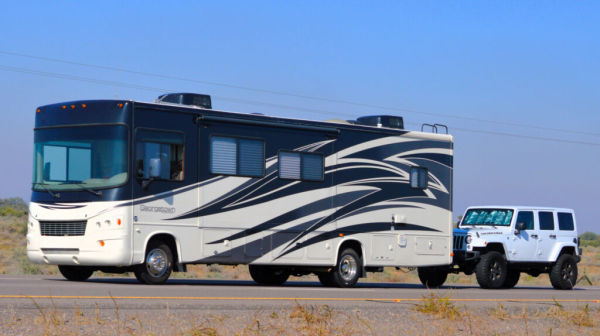
If you think working a desk job is mentally challenging, imagine working at a desk job inside an RV park. When I did it, the job itself was uninspiring, but watching hundreds of RVers come and go daily was kind of an impetus for me to seek more adventure on my days off.
Unfortunately, I learned pretty quickly that despite the stated towing limits on my minivan, I probably couldn’t tow the type of recreational vehicle I wanted. Though my only plea was for an onboard bathroom, the gross weights of my short list of favorite travel trailers outpaced my van’s limits. It was a bit baffling at the time, because I saw RVers towing all manner of vehicles all the time, and figured they knew what they were doing.
It turns out that while some RV owners tow whatever they want behind their motorhomes (or minivans), there are a lot of guidelines and actual laws surrounding the practice. Those folks do not, in fact, know what they are doing — or they do, and don’t care about the laws. There are a few important things to know before towing a car with your RV, one of them being those pesky gross weights I found to be a problem. Do note that while RV stands for recreational vehicle, here, we’re specifically talking motorhomes and what you should know before hitching up a vehicle behind them.
Towing capacity isn’t a single number
One of the first things I learned about RVing while working as a check-in agent is that numbers matter. More specifically, multiple numbers matter — not just the weight of your tow vehicle. A minivan’s gross combined weight rating (GCWR) is a good example. The GCWR is the sum of the vehicle weight, its cargo and passengers, and the towed vehicle’s weight. Your motorhome will have its own GCWR (along with a gross vehicle weight rating, GVWR), and it’s important to include the manufacturer-reported figure in your calculations.
In short, your RV needs a high enough GCWR to accommodate its onboard cargo and fluids, plus the towed vehicle’s. You might also need to factor in things like tongue weight. Tongue weight is the force exerted on the tow vehicle’s hitch, and that figure is added into your GCWR when you’re adding everything up.
Some budget-friendly camper vans, like older Thor Motor Coach models, can pull a towed vehicle, but you might be a bit limited. A 2025 Thor Scope, for example, has a GCWR of 11,500 pounds, and the vehicle itself has a GVWR of 8,550 pounds. Keep in mind the 80% rule for towing, which essentially says you shouldn’t max out your vehicle’s limits, even if the numbers technically add up. Some other numbers to be aware of? Towing can affect gas mileage and range in any vehicle, so pulling a car behind your motorhome could cost you more than you expect.
Not all cars can be towed via a hitch
During my RV park desk jockeying years, I saw plenty of cars pulled behind RVs, and most of them were via flat towing, meaning all four wheels were on the ground. However, some RVers opted for trailers or a dolly instead. While it was common for people to tow their Jeeps and Hondas behind their motorhomes, other models were commonly driven behind or towed on a trailer.
Given that experience, I’m not surprised that the most popular dinghy (towed) vehicles seem to be Jeeps, followed by a handful of Honda and Chevrolet models. The keys to flat towing friendliness are the ability to put the vehicle in neutral and not damage it by pulling it along manually. If you’re not sure whether your intended dinghy vehicle — another slang term is toad — is actually towable with your current setup, check the vehicle’s user manual, or reach out to the dealer you bought it from.
Setting up to tow a vehicle also involves getting your equipment ready. Your motorhome will need a tow hitch, of course, which means you’ll have to look at tow ball height and how everything sits. It also may be helpful to know that you can flip a tow hitch upside down, since it works both ways, if it’s not at the right height.
Onboard lights aren’t enough
Like anything else involving driving on roadways, towing a car with your RV requires that you adhere to state and local laws. Odds are, no matter where you’re traveling, you’ll need some essential equipment for safe and legal towing. For example, according to the California DMV, you must have “fully operational tail, brake, and turn signal lights” on the toad, which means you’ll likely need a wiring kit. California also requires safety chains on tow bars, although it doesn’t stipulate that breakaway switches are needed.
You might also want more than the minimum requirement for a safe drive. The California DMV points out how different it is to drive an RV versus a car, so it could be worth looking at some equipment to make it easier. For example, consider different types of tow mirrors you can add to your vehicle for better visibility and reducing blind spots while on the road.
In states like Oregon, it’s legally required that all vehicles be able to see 200 feet behind them at all times. In all, consider what states you’re traveling through and make sure you’re adhering to the applicable laws regarding tow equipment.
You might be banned from city streets
Stillgravity/Shutterstock
In my experience, most RVers are proactive about figuring out length limits for their rigs. When I worked at an RV park, I fielded plenty of calls asking questions about RV space sizes, and backing in versus pulling through. Some people would even plan to park their RV with their tow vehicle attached for the duration of their trip, since on-site transportation was available.
However, new RVers might be surprised to find out that state and city regulations also vary widely when it comes to length limits for RVs plus tow vehicles. For example, per the California DMV, the state law is that your vehicle combination cannot measure over 65 feet. Yet in various cities or counties throughout the state, lengths over 60 feet could be prohibited. That may mean an inability to drive through some cities, so you’ll need to park elsewhere and hop in your toad to get where you want to go.
You might find length restrictions in smaller towns, particularly those with narrow streets. Either way, it’s prudent to check maps ahead of time and even investigate local laws before you travel to avoid getting stuck (or facing fines).
Towing limits may apply
Although most RV owners probably don’t want to add even more length to their rig beyond a dinghy, some like to live a bit more dangerously. Thus, it’s important to know that states have specific laws governing how much you can tow behind your motorhome.
In California, only Class A drivers with the appropriate endorsement can tow two vehicles or trailers behind their primary vehicle. That means the standard Class C driver — you don’t need a special license to drive an RV in California, at least — is prohibited from towing a car and a boat behind their motorhome.
Even the most RV-friendly city in the U.S., Rapid City, South Dakota, has rules regarding towing limits, although South Dakota overall has more relaxed rules than, say, California. For example, in South Dakota, you are legally able to use a pickup to tow a camper or fifth wheel, while pulling a boat behind that combination. There is a length limit of 75 feet maximum, but the State of South Dakota website also points out that states have different laws regarding that combination, and not all permit it.