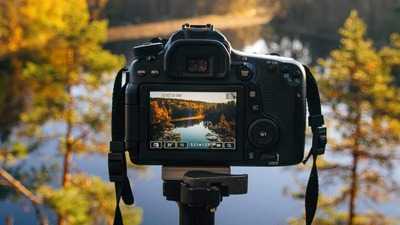
Full-image focus: How this experimental camera breaks photography's oldest limits
30 Dec 2025
Researchers from Carnegie Mellon University (CMU) have made a major breakthrough in camera lens technology.
They have developed a system that can bring multiple objects at different distances into sharp focus, capturing finer details across the entire image.
This is a major departure from traditional lenses which could only sharpen one focal plane at a time, leaving other areas blurred.
The limitations of traditional lenses and the new system
Technological advancement
Traditional lenses work by sharpening one focal plane at a time, which can create depth in images but requires combining multiple photographs shot at different focal lengths for a clear full picture.
The new "spatially-varying autofocus" system developed by CMU researchers uses a mix of technologies to let the camera decide which parts of an image should be sharp.
This is achieved through a computational lens system that combines advanced optical components to control focus at the pixel level.
The innovative design of the 'computational lens'
Design details
The researchers have developed a "computational lens" by combining a Lohmann lens with a phase-only spatial light modulator.
The Lohmann lens consists of two curved, cubic lenses that shift against each other to tune focus.
Meanwhile, the phase-only spatial light modulator controls how light bends at each pixel.
This combination enables the system to focus at different depths simultaneously and uses two autofocus methods: Contrast-Detection Autofocus (CDAF) and Phase-Detection Autofocus (PDAF).
Potential applications of the new lens technology
Future prospects
The experimental system could revolutionize how cameras perceive the world, CMU professor Aswin Sankaranarayanan said.
Although it's not yet available in commercial cameras, the researchers believe this tech could be used in other fields as well.
These include making microscopes more efficient, creating realistic depth perception for VR headsets, and enabling autonomous vehicles to see their surroundings with unprecedented clarity.
Contact to : xlf550402@gmail.com
Copyright © boyuanhulian 2020 - 2023. All Right Reserved.