Lowe’s is one of the most popular home improvement retailers in the U.S., and it sells a wide variety of products at its stores across the country. As expected of a retailer of its size, the company accepts returns and offers similar warranties to its close competitors — though Home Depot’s warranties might be slightly better than those Lowe’s offers. While tools sold by Lowe’s typically come with a 90-day return policy, other products are covered differently (48 hours for appliances, 30 days for TVs and HVAC systems, and 365 days for trees, shrubs, and commercial users). Customers who are not satisfied with their purchase can return or replace the product within the specified return period. But what happens to these returned products once you hand them back to the store?
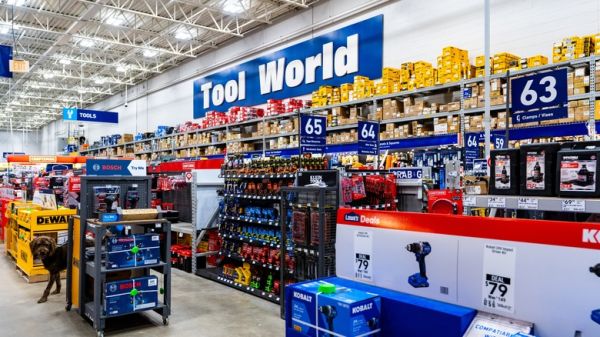
To understand how this works, we checked Lowe’s return policy in detail. Under the company’s “Outlet Return Policy,” Lowe’s specifies that items for sale at Lowe’s Outlets may have cosmetic imperfections or may have been previous returns. This essentially confirms that at least some products on sale at Lowe’s — albeit ones reserved for its Outlet locations — may have been previously returned by consumers. These items are usually unused or lightly handled products that were returned for reasons other than a manufacturing defect. That being said, only a few returned Lowe’s products end up back on store shelves. The majority of them are dealt with the same way returned tools are treated at Home Depot: They end up becoming part of the retailer’s B-Stock program.
Understanding how B-Stock works
PJ McDonnell/Shutterstock
For the uninitiated, a B-Stock program lets resellers and companies purchase returned products from retailers at deeply discounted prices. Large format retailers like Walmart, Home Depot, and Lowe’s take their returned items and then auction them off to smaller retailers by the truckload. Companies that are involved in the B-Stock program include Direct Liquidation, B Stock Solutions, and Select Liquidation. Products returned to Amazon and other large-scale online retailers often end up going to one of these liquidators as well.
These companies act as intermediaries, auctioning mixed-condition goods to small retailers, refurbishers, exporters, and bulk buyers. They’re sold as-is, often with limited manifests, no manufacturer warranty, and in varying conditions, ranging from unused open-box items to lightly used or incomplete products. It is up to the bidder to then sort, test, repair, repack, or resell individual items. Do note, however, that the goods sold by these B-Stock retailers are not curated for individual consumers.
B-Stock programs benefit almost everyone involved in the process. For Lowe’s, it no longer needs to deal with the logistics of having to store returned items, as it is more profitable for it to sell new items. Small retailers can access quality products from larger ones at prices they would never usually pay. In other words, when you drop off a product at Lowe’s, it might be worth remembering that its final fate could be very different from simply going back on the shelf.