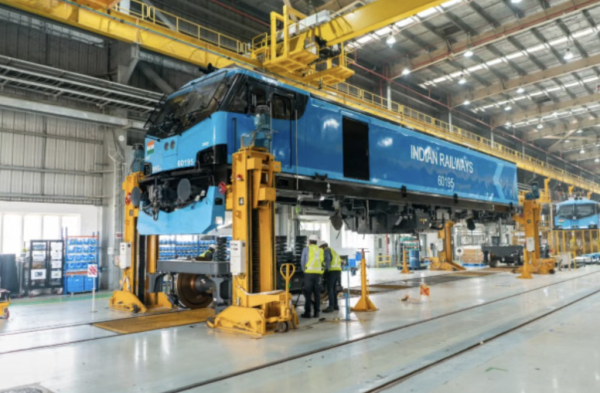
A recent Bussiness report revealed that India is moving closer to building its first indigenous high-speed train and its manufacturing is expected to commence between April and June once the final design is approved.
Manufacturing Of India’s First Indigenous High-speed Train Commenced
While that being said, it appears that the high-speed trainsets are being developed by the BEML–Medha consortium, which secured the contract from the Integral Coach Factory (ICF) in 2024 to build two chair-car trainsets.
These high speed trainers are designed for an operational speed of 250 kmph with a maximum speed of 280 kmph.
They are slated to run on the Mumbai–Ahmedabad High-Speed Rail corridor and are expected to enter service from 2027.
ICF General Manager U Subba Rao said, “The final design is nearing completion, and manufacturing will begin once it is frozen. We expect manufacturing to start between April and June. Component designs including carbody, bogies, suspension system, and doors are being developed in parallel and are in the final stages,” in the media report.
They are planning to develop each eight-coach trainset having seven chair cars and one executive class coach, along with pantry and toilet facilities, broadly aligned with those seen on chair-car Vande Bharat trains.
It appears that the design inputs for this project have been provided by Poland-based EC Engineering which has previously also collaborated with the consortium on the Vande Bharat sleeper train.
Reportedly, globally reputed vendors experienced in European high-speed rail systems have been roped in to meet international safety and performance standards said the officials.
First Prototype In December 2026
Besides this, they are also putting in efforts to build domestic manufacturing capability over time.
They are expecting the fabrication of carbody shells to begin at BEML’s Bengaluru facility, while Medha will manufacture bogies at its Hyderabad plant.
Similarly, Medha has started developing the Train Control and Management System software and integrated Siemens’ signalling technology.
They are expecting to roll out the first prototype by December 2026, after which it will undergo extensive testing and certification for seven to eight months.
When it comes to its Commercial operations, they are likely to begin on the Surat–Bilimora section, as the Mumbai–Ahmedabad corridor is commissioned in phases from 2027.
Contact to : xlf550402@gmail.com
Copyright © boyuanhulian 2020 - 2023. All Right Reserved.