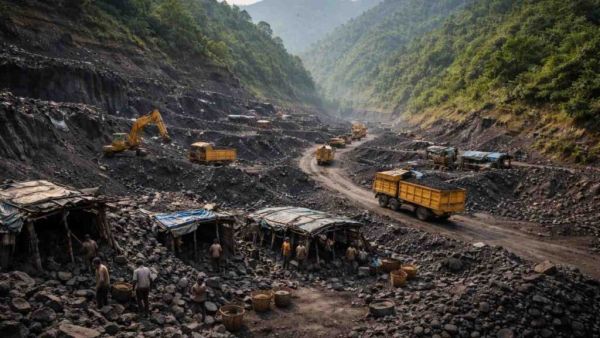
There are many coal mines in the country from which regular supply of coal is maintained. Coal mines are also active in the north-eastern states of India, Meghalaya, Assam, Nagaland and Arunachal Pradesh. After the ban on rat-hole mining in 2014, scientific mining was restarted in Meghalaya from 2025. About 1739 million tonnes of coal resources are available in the entire north-east region. A large number of mines are present in Meghalaya but in the hilly areas coal mining is still mainly done by rat-hole method. This method based on narrow tunnels is considered extremely dangerous. Despite the abundance of mines, mining remains unsafe, as illegal and unscientific methods are used in many places and safety standards are not followed.
Jaintia Hills and Khasi Hills of Meghalaya are major coal fields. Here production has started in Sayangkham (East Jaintia Hills) and Pindengshalang (West Khasi Hills) blocks from June 2025. Despite this, illegal rat-hole mining continues in the hilly areas, due to which accidents often occur. For example, an explosion in Thangsko village in East Jaintia Hills in January 2026 killed two people.
‘Rat-hole mining’
Coal mining in the mountains of Meghalaya is an extremely complex and controversial issue. The traditional method used to extract coal here is called ‘rat-hole mining’. In the hills of Meghalaya (Khasi, Jaintia and Garo Hills) the coal seams are very thin (about less than 2 metres). Here, mining with big machines is economically costly, so the local people dig narrow tunnels.
This technology itself is the biggest cause of death. In this, narrow tunnels of 3-4 feet wide are made. There is no support of pillars or concrete in these tunnels, due to which there is always a danger of soil and mountain landslides. There is a severe shortage of oxygen in the narrow tunnels and workers die due to leakage of poisonous gases.
impact on environment
Meghalaya’s coal has very high sulfur content. When this coal comes in contact with air and water, sulfuric acid is formed. Due to this, the water inside the mines becomes extremely poisonous and acidic. If a worker gets trapped in it, his skin and lungs get seriously damaged. Meghalaya is one of the highest rainfall regions in the world. Rain water seeps from the mountains and directly fills these deep tunnels. Since these mines are illegal and unplanned, there is no system for extracting water from them.
The water flowing from the mines is highly acidic, which has turned the water of rivers like Lukha and Kopili blue or orange, killing fish and other aquatic creatures. The National Green Tribunal had banned it in 2014 due to safety and environmental reasons.
Despite this, because it is privately owned land, clandestine mining continues here. In the 2018 mine accident, 15 laborers were trapped in a mine filled with water in Jaintia Hills. This was one of India’s longest rescue operations, requiring months of effort by the Navy and the NDRF. In recent years too, there have been reports of deaths of workers due to collapse of illegal mines.
major events
According to Shillong-based NGO Impulse Social Enterprises, it is estimated that 10,000 to 15,000 people – many of whom were children and migrant laborers – died in rat-hole mines in Meghalaya in this seven-year period (2007–2014) alone. In July 2012, at least 30 miners were trapped and killed when a mine in the Nongalbibra area was flooded. In 2021, 6 laborers died in another incident in East Jaintia Hills.
Mining in Meghalaya is unsafe because land owners themselves carry out excavations without any engineering advice or government safety standards. Children and short-lived laborers are sent into narrow tunnels, who have neither helmets nor oxygen masks.
Contact to : xlf550402@gmail.com
Copyright © boyuanhulian 2020 - 2023. All Right Reserved.