In Nghe An Province in central Vietnam, the four children of Ba Ngoc, aged five to 13, gather for breakfast at 8 a.m. every day. While their peers are already seated in classrooms, the siblings then split up to read books or draw. This marks the second year they have followed this approach: learning without formal schooling.
In Da Lat in the Central Highlands, 12-year-old Minh Nhat, the son of Huynh Dung, also does not attend school. Instead, he leads groups of foreign tourists on treks through pine forests and introduces them to organic coffee production, earning his first paychecks.
Anh, the son of Bach Duong, recently designed a two-week family trip to Japan rather than joining the race for entrance exams to high schools.
These three families, living in three different regions, share one decision: withdrawing their children from the formal education system to pursue a different path.
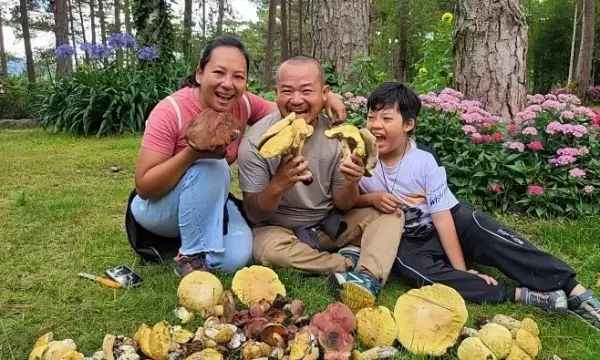
Huynh Dung (C), his wife and his son Minh Nhat (R) experience mushroom foraging in Da Lat, May 2025. Photo courtesy of Dung |
For these families, the unconventional choice stems from prolonged tensions between parental expectations and school realities.
Anh has studied in public, private and international schools in search of what he and his parents call “the right fit.” At the private school he attended, he felt stifled by strict discipline. At the international school, he found greater freedom but felt lost amid the race for overseas certificates.
“I wanted real-life experiences rather than chasing grades,” he says.
Dung, 42, said he struggled with watching his nature-loving son confined within four classroom walls just to complete assignments.
“The curriculum in current schools is heavy and lacks personalization,” he says. “I attended normal schools and spent many years learning things I never used at work, and I didn’t want my child to repeat that.”
For Ngoc, the decision to pull all four children out of school followed what he described as an educational “shock.” In 2023 he launched an emotion-focused preschool, only to close it a year later when parents were mainly concerned with early literacy rather than their children’s emotional development.
Seeing his own children becoming disengaged and addicted to games alarmed him and made him fear he was becoming an achievements-driven parent like those he saw.
During a summer break he took his children on a cross-country trip to visit families who had already allowed their children to leave the formal education system.
“I saw children learning at home who were lively and happy, completely different from the lethargy of students bent over textbooks from morning until night,” he says.
On Vietnamese social media platforms, dozens of groups dedicated to sharing experiences with homeschooling and unschooling have emerged, some with nearly 100,000 active members. The growth of these communities, along with internationally recognized online programs, suggests a quiet but strengthening undercurrent.
“Amid pressure from schools for gifted students and widespread extra tutoring, many parents in our community see ‘bringing children home’ as a way to protect their childhood,” Ngoc says.
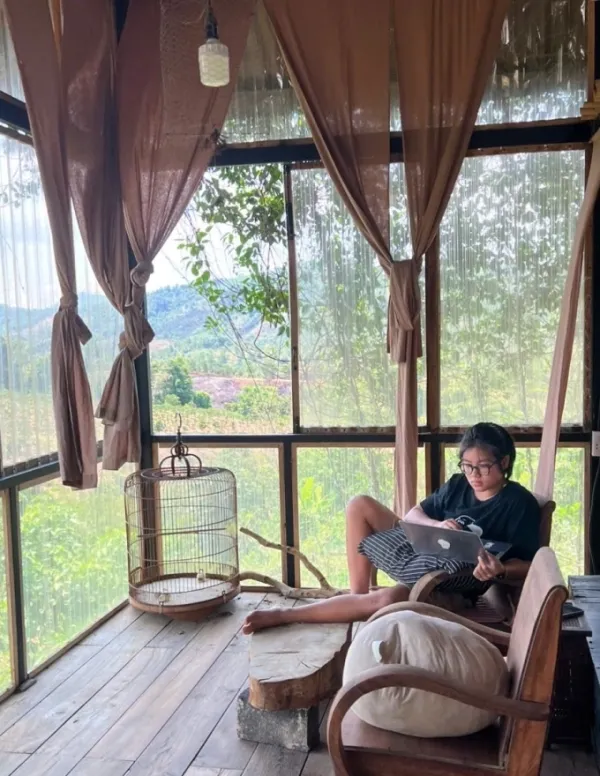 |
Phan Anh studies online while taking part in hands-on activities during summer 2025. Photo courtesy of Duong |
After allowing their children to step away from school, each of the three families designed its own version of a “school.”
Ngoc’s family allows the children to freely pursue their interests: his eldest son studies architecture online, his daughter learns tailoring, and his youngest son is likely to stay up until 2 a.m. to finish a painting he loves. Ngoc and his wife run a home business and observe and guide their children.
Dung’s family chose homeschooling under an international curriculum costing about VND16 million (US$608) a year. The flexible schedule allows his son Nhat to go hiking, camping or diving for weeks at a time while continuing his studies.
“Real-life experiences broaden his worldview in ways four classroom walls cannot,” Dung says.
For Anh, leaving school meant “no more summer breaks.” His schedule is tightly packed, beginning with morning river swims, followed by academic study through an online program affiliated with a U.S.-based high school to ensure he earns a diploma.
His family built his learning path around three pillars: knowledge, character and adaptability. With their belief that “anyone can be a teacher,” his parents enlist experts in swimming, writing, video production, and artificial intelligence to mentor him directly.
Last summer Anh tried 13 jobs as part of a “100 jobs” project, ranging from working as a barber’s assistant and repairing motorbikes to farming.
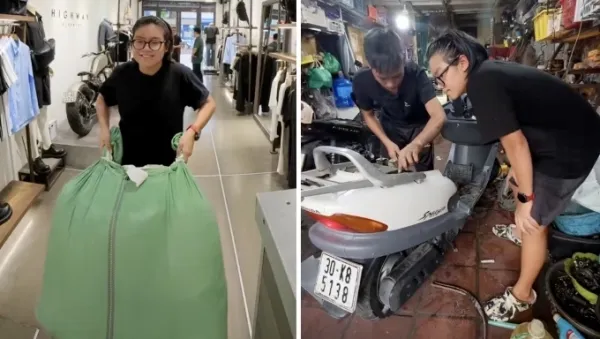 |
Phan Anh experiences different jobs, including motorbike repair, in his ongoing “100 jobs” project. Photo courtesy of Duong |
The greatest gain, these parents say, is their children’s happiness and initiative. However, the journey is a “battle” that demands strong conviction.
Ngoc faced fierce opposition from his own parents and neighborhood gossip, particularly over concerns about social interaction and academic credentials. He said he accepts that his children may not hold Vietnamese-standard diplomas.
“If later on my children are interested in jobs that require formal degrees, their options may narrow,” he says. “But I believe the real abilities they accumulate through homeschooling will open other paths.”
To ensure social interaction, Dung enrolls his son in art and swimming clubs and interest-based community groups.
“Real-life experiences help him interact with diverse groups, something traditional schools struggle to fully provide,” he says.
Concerns over formal qualifications are also easing as education options diversify in Vietnam. Even without traditional university entry, students can now study abroad, attend international universities right in this country or pursue specialized vocational training.
Dr. Nguyen Thi Thu Huyen, academic director of Pathway School, says parents’ motivation to “break away” often stems from school pressure and overloaded curricula. She notes that homeschooling tends to produce “sweet results” mainly for families aiming for overseas study or those with strong financial and educational foundations.
Nevertheless, there are some risks.
Huyen says she has seen many homeschooling attempts fail, forcing children back into school. Re-entry is relatively easy at the primary school level, but at secondary level the door is almost closed due to transcript requirements.
“This is a long battle not for the majority,” she warns. “To pursue this path, parents must be well-versed in education, have enormous time to devote to their children, and have deep pockets.”
Contact to : xlf550402@gmail.com
Copyright © boyuanhulian 2020 - 2023. All Right Reserved.