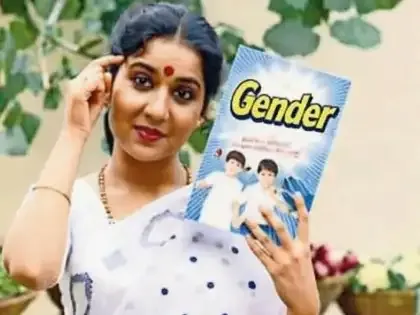
Tanishq ran a full-page ad recently, celebrating the Indian women's cricket team, featuring a gold ring on each player's finger. The image quietly skews several stereotypes - from Beyonce's commitment-demanding song 'Single Ladies (Put a Ring on It),' to the male-centricism of international cricket. Remember, if you're old enough to remember the'90s, the last time advertising, women, and cricket collided was when the Cadbury girl danced her way onto the pitch to the jingle-tune of 'Asli swaad zindagi ka' to hand a bar of chocolate to her batsman-beau.
The distance between the Tanishq and Cadbury advertisements is striking. It shows how far gender-neutral advertising has travelled in a few decades.
For years, advertising worldwide built male-only/for-men universes. 'Live Life Kingsize' and the Marlboro Man didn't merely sell products. They also normalised a world where men enjoyed, roamed and consumed freely.
When women did appear, they were slotted into a narrow template--the Nirma woman scrubbing clothes in a bucket so that the iconic girl in a pristine white frock can keep twirling, or Surf's Lalitaji buying the 'right' detergent from the market. Essentially, cleaning clothes, or scolding and haggling for every rupee. Men lived expansively. Women economised, laboured, and were expected to find fulfilment in self-sacrifice.
In the 2000s, exclusion persisted. The 'BlackBerry Boys' jingle, once catchy and aspirational at the dawn of the smartphone age, now reads like a tidy indictment of women's absence from corporate culture, even though the Vodafone-BlackBerry ad was an ironic take with the line, 'Not just for the office guys' - and having non-suited-booted folks, including women, join in and essentially shunt out the 'BlackBerry Boys'.
Visuals matter. Unlike films or novels, advertising doesn't tell long stories. It sells an aspirational self in a few seconds. In doing so, it also defines boundaries of belonging. Advertising places us inside a crowdsourced 'average' of desire and normalcy. We either measure up-- or we don't fit. In industry terms, this is often celebrated as 'capturing the zeitgeist'.
Empowerment, though, is also signalled through false flags, rather than lived shifts. In the early 2000s, a brief spurt of 'feminist' advertising portrayed women as punitive or predatory. In one campaign of innerwear company Rupa, a man played by Zulfi Sayed is ambushed with lipstick marks after straying into a women's restroom. In another, two women secretly spy on a man walking around his home in briefs in a VIP ad.
These campaigns don't linger in public memory because they misread women's realities. They were narratives imagined through the male gaze - how a roomful of men might assume women would behave in a 'feminist' world. Consent is misread, distorted, trivialised. Because that is how power has long functioned in a man's world.
Contemporary urban advertising looks different. Men and women share baby baths and kitchen duties. Ariel's 'Share the Load' was among the early hits. Fathers make breakfast for daughters - without a watchful female spouse in the background to reward them.
Today, such depictions are presented as normal. Sometimes the balance is so perfect it feels more like a mathematical exercise than a household. But that, too, is advertising. When creative leadership and decision-making remain uneven, representation can race ahead of power.
Taken together, these shifts form a cultural narrative of gender struggle. They show how social change and narrative move alongside each other, each nudging the other forward. Which one leads and which follows may still be debated. But for anyone denying women's historical subjugation - or resisting equality- advertising's evolving imagery offers a mirror that invites uncomfortable reassessment.
Does this mean the work is done? Hardly. Progress on the ground moves slowly, filtering unevenly through layers of society. And here's the spoiler: the glass ceiling of patriarchy is always invisible in the present moment. Gains are real, yet partial. Perhaps the next question for advertising isn't whether women are fully included in a man's world, but whether the world itself is allowed to become more feminised.
Every social justice movement sounds unreasonable before it becomes normal. Women's inclusion was once dismissed as impractical, excessive, even dangerous. That historical amnesia is precisely why progress is always celebrated - and challenged - at the same time.
The distance between the Tanishq and Cadbury advertisements is striking. It shows how far gender-neutral advertising has travelled in a few decades.
For years, advertising worldwide built male-only/for-men universes. 'Live Life Kingsize' and the Marlboro Man didn't merely sell products. They also normalised a world where men enjoyed, roamed and consumed freely.
When women did appear, they were slotted into a narrow template--the Nirma woman scrubbing clothes in a bucket so that the iconic girl in a pristine white frock can keep twirling, or Surf's Lalitaji buying the 'right' detergent from the market. Essentially, cleaning clothes, or scolding and haggling for every rupee. Men lived expansively. Women economised, laboured, and were expected to find fulfilment in self-sacrifice.
In the 2000s, exclusion persisted. The 'BlackBerry Boys' jingle, once catchy and aspirational at the dawn of the smartphone age, now reads like a tidy indictment of women's absence from corporate culture, even though the Vodafone-BlackBerry ad was an ironic take with the line, 'Not just for the office guys' - and having non-suited-booted folks, including women, join in and essentially shunt out the 'BlackBerry Boys'.
Visuals matter. Unlike films or novels, advertising doesn't tell long stories. It sells an aspirational self in a few seconds. In doing so, it also defines boundaries of belonging. Advertising places us inside a crowdsourced 'average' of desire and normalcy. We either measure up-- or we don't fit. In industry terms, this is often celebrated as 'capturing the zeitgeist'.
Empowerment, though, is also signalled through false flags, rather than lived shifts. In the early 2000s, a brief spurt of 'feminist' advertising portrayed women as punitive or predatory. In one campaign of innerwear company Rupa, a man played by Zulfi Sayed is ambushed with lipstick marks after straying into a women's restroom. In another, two women secretly spy on a man walking around his home in briefs in a VIP ad.
These campaigns don't linger in public memory because they misread women's realities. They were narratives imagined through the male gaze - how a roomful of men might assume women would behave in a 'feminist' world. Consent is misread, distorted, trivialised. Because that is how power has long functioned in a man's world.
Contemporary urban advertising looks different. Men and women share baby baths and kitchen duties. Ariel's 'Share the Load' was among the early hits. Fathers make breakfast for daughters - without a watchful female spouse in the background to reward them.
Today, such depictions are presented as normal. Sometimes the balance is so perfect it feels more like a mathematical exercise than a household. But that, too, is advertising. When creative leadership and decision-making remain uneven, representation can race ahead of power.
Taken together, these shifts form a cultural narrative of gender struggle. They show how social change and narrative move alongside each other, each nudging the other forward. Which one leads and which follows may still be debated. But for anyone denying women's historical subjugation - or resisting equality- advertising's evolving imagery offers a mirror that invites uncomfortable reassessment.
Does this mean the work is done? Hardly. Progress on the ground moves slowly, filtering unevenly through layers of society. And here's the spoiler: the glass ceiling of patriarchy is always invisible in the present moment. Gains are real, yet partial. Perhaps the next question for advertising isn't whether women are fully included in a man's world, but whether the world itself is allowed to become more feminised.
Every social justice movement sounds unreasonable before it becomes normal. Women's inclusion was once dismissed as impractical, excessive, even dangerous. That historical amnesia is precisely why progress is always celebrated - and challenged - at the same time.
(Disclaimer: The opinions expressed in this column are that of the writer. The facts and opinions expressed here do not reflect the views of www.economictimes.com.)
Kanika Gahlaut
Journalist, author and artist