
Tucked away in the heart of Erfurt city in Thuringia, Germany, lies a heritage-listed medieval arch bridge that not only links different parts of the city for locals, but also provides them with homes. The Krämerbrücke, or Merchant's Bridge, holds the record as the longest series of inhabited bridges across Europe, reports the Express.
Stretching 125 metres, the bridge was initially built from wood, but was reconstructed in stone in 1325. Originally, it housed 62 narrow buildings along its length, but after redevelopment, only 32 remained.
The earliest references to the bridge can be traced back to 1156, when it was documented as 'Pons rerum venalium', meaning the bridge of offered things, according to the bridge's official website.
- Experience 'world's best' train journey for half price using simple ticket trick
- British expat who quit UK for Spain shares brutally honest truth about move
The bridge features six arches crafted from sandstone, while the foundation of the bridge piles conceal hidden cellar vaults. Its eventual redesign showcases influences from Gothic, Renaissance, and Baroque styles.
Linking two sections of the city along the Gera river, it became a crucial spot for local merchants and traders to peddle their goods in small wooden huts along the bridge during the Middle Ages. The bridge ultimately got its name from the merchants who traded in fine fabrics, spices and jewellery.
The bridge was originally flanked by two churches at each end, St Aegidius (St Giles) Church to the east, and St Benedict's Church to the west. However, only St Giles remains at the eastern end, offering a splendid view of the bridge from its tower. The spire reaches a height of 33 metres.
Over subsequent centuries, the bridge suffered numerous fires, resulting in many of the timber-framed houses being remodelled between the 16th and 18th centuries. The original 62 houses were eventually consolidated into 32.
After the Reformation, the churches fell into disuse, with St Benedict's Church ultimately being sold into private ownership. The church was demolished at the start of the 19th century.
Krämerbrücke underwent several restoration efforts, including the building of the Rathausbrücke to cope with increasing traffic. Following the conflicts of the 20th century, the Krämerbrücke sustained damage, leading to a series of modern restoration projects.
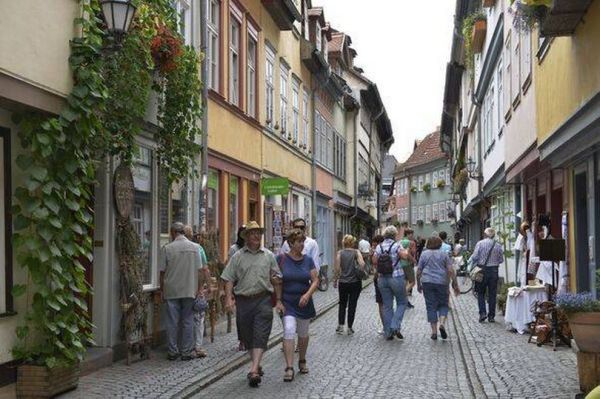
Today, alongside local residences, the bridge is lined with a diverse array of galleries, cafés and boutiques selling traditional crafts, Thuringian blue printed fabrics, ceramics, handblown glassware, jewellery, wood carvings, antiques and mouth-watering Thuringian delicacies.
If you want ideas and inspiration to plan your next UK adventure plus selected offers and competitions, sign up for our 2Chill weekly newsletter here
Contact to : xlf550402@gmail.com
Copyright © boyuanhulian 2020 - 2023. All Right Reserved.