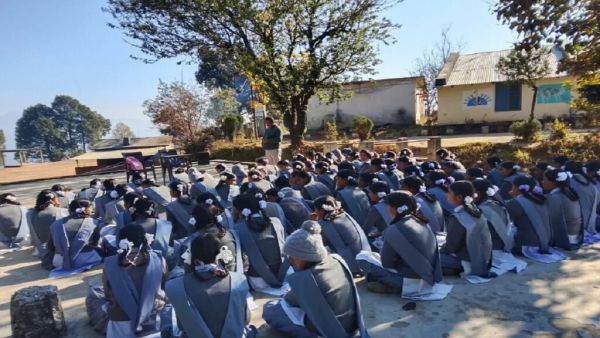
Many small villages situated in the hilly areas of Uttarakhand are still struggling with the basic challenge of the right to education. Just having a school here is not enough, but reaching there safely and getting continuous education is the biggest problem. This problem becomes more complex when the issue of the right to education for adolescent girls comes to the fore. The story of Surag, an inaccessible village located about thirty kilometers away from Garud block of Bageshwar district, brings out this truth. This is not the story of any one girl, but of hundreds of teenage girls for whom going to school has become a daily struggle.
The girls of this village leave their homes in the morning in the dark. This journey, which starts around five o’clock, ends when we reach the school at eight o’clock. Raw and narrow paths, dense forests, fear of wild animals and harsh weather, all this is a part of their path. Even after reaching school, their challenges do not end. Along with studies, domestic responsibilities and social expectations, all together make education a big challenge for them. It gets late by the time they return home in the evening and then getting involved in household chores becomes their daily routine.
This situation in rural areas is not limited to geographical difficulties only. Social and economic reasons are equally influential. Girls’ education has still not become a priority for many families. When the path is difficult and risky, it is natural for parents to fear. Due to this fear, many girls drop out of school midway. The village elders also believe that such a long and unsafe journey creates mental pressure for the girls, due to which they remain nervous.
The story of Pinky, a teenager from this village, further clarifies this entire scenario. She tells that since there was no high school in the village, she had to go to the high school located in Salani. Which was far away from home. Where there is no transportation facility to reach there. Carrying heavy bags every day to cover the hilly roads and worrying about returning home on time, everything was difficult for him.
But due to her dedication towards education, she and other girls like her in the village used to face these difficult situations and go to school every day. He hoped that one day the facility of transportation to and from school would also start. Although she has completed her 10th class, till today the girls have to walk on foot to go to school from the village.
Such stories are not limited to this village. According to a UNICEF report, a large number of girls in India drop out of school by the time they reach the secondary level, especially in rural and hilly areas. Education Ministry data for 2021-22 shows that school dropout rates in remote areas are higher than the national average. At the same time, according to the National Family Health Survey, lack of clean toilets and safe transportation for adolescent girls is a major obstacle to continuity in education.
The school administration is also not unaware of these problems. He knows how girls come to school every day, passing through difficult mountain roads and facing every kind of danger. During rainy days, she often remains absent for several days. The main reason behind this is the fear of slippery mountain roads. Some adolescent girls are deprived of technical or educational facilities because regular attendance is not possible. When the continuity in studies is broken, their mind gradually starts moving away from school.
Some women of the village want their children, especially their girls, to get better education and facilities. She believes that education is the only way to change the future. But lack of resources and systemic obstacles stand as a wall in front of their intentions. Sometimes girls are kept from going to school to help with household chores, as the daily needs of the family come first.
However, many schemes are being run by the government to promote girl education, such as Samagra Shiksha Abhiyan, scholarship schemes for adolescent girls and free text books. But the benefits of these schemes can be effective only if safe access to school is ensured for girls. Facilities like roads, transport and residential schools can make education accessible in hilly areas. A NITI Aayog report also emphasizes that investment in infrastructure for education in remote areas is most essential.
In this entire scenario it becomes clear that education is not limited to books and classrooms only. This is a question of respect, security and opportunity. Unless adolescent girls get a safe environment, health facilities and social support, school will remain an unfulfilled dream for them. It is necessary that policies are made understanding the ground realities and the local community is also made a part of the solution.
But the question arises whether the path of these girls will be easy in the future? Will easy access to school really be accessible to adolescent girls in remote hilly areas like Culag? Until concrete answers to these questions are found, the struggle of these teenage girls from the hills will continue, and their voices will continue to remind us time and again that access to education is still not equal for all.
(Report by Sarita Armoli from Bageshwar, Uttarakhand)
Contact to : xlf550402@gmail.com
Copyright © boyuanhulian 2020 - 2023. All Right Reserved.