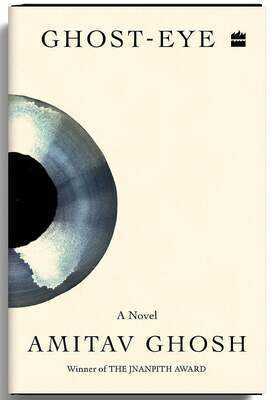
Memories play a big role in Amitav Ghosh’s novels, but in his latest book Ghost-Eye, those memories belong to a past life. When three-year-old Varsha Gupta from a vegetarian Marwari family starts demanding fish and rice for lunch, it leads to a series of events that brings together food, family and climate change — the latter being a topic oft-visited by the Jnanpith Award-winner in several of his books. In a candid conversation, the author discusses different aspects of the book, including the role of myth and folklore as other forms of reason.
Excerpts from the interview:
How did you decide to have reincarnation as one of the central plots of Ghost-Eye? Have you met anyone who claims to have remembered their past life?
In our part of the world the idea of past lives is not an esoteric belief but a part of the lived vernacular, a way of asserting that time is not only linear but also cyclical. I grew up with many stories of relatives or acquaintances who would speak of such things in a totally matter of fact way. Whether one "believes" in past lives is almost beside the point; what is significant is that it represents a profound cultural acknowledgement that our lives are not isolated, self-contained occurrences that end with bodily death.
There seem to be a number of commonalities between The Hungry Tide, Gun Island and now, Ghost-Eye. How do you see this evolution?
I did not intend for The Hungry Tide, Gun Island and Ghost-Eye to be a trilogy but that is in fact what they have become, and an important part of the reason for that is the Sundarban itself. Certain landscapes have the power to engrave themselves very deeply on the imagination and this is what has happened to me with the Sundarban. Now, no matter what I am writing, it is always there somewhere in the background.
Another focal point of the novel is food. You are known to be really fond of cooking yourself. In a way, the book brought this love of yours to the fore as well...
I have always been very interested in food and in cooking. This in turn means that you have to be interested in ingredients, and where they come from. I think it was this above all that was responsible for my interest in ecology and the environment. I am, after all, someone who grew up mainly in cities so it was not as if I had any direct experience of farming, or fishing, or the jungle. It was food mainly that connected me to the environment of whatever place I happened to be in. Whenever I travel, I love to visit farmers markets to see what is available and what grows in a particular place. And this is as it should be because food is the primary medium through which human beings relate to their environments and to each other. In Ghost-Eye, the characters' relationship to food—what they can gather, cook, or have lost—becomes a silent, powerful language of their relationship to a changing world.
While Sundarbans is where we find the conclusion, the novel is also an ode to Calcutta. Is this how you remember your city when you were growing up?
I came of age in Calcutta in the 1960s and ’70s, a time when the city was in constant turmoil because of various political upheavals and rivalries. It was a time when the infrastructure was completely disrupted and we had to live through hours of power cuts (or what we called load shedding). Yet at the same time, it was an incredibly productive place culturally. That was when film makers like Satyajit Ray, Mrinal Sen and Ritwik Ghatak were at the height of powers, as were great writers like Mahasweta Devi, Sunil Gangopadhyay and many others. In a sense my work was also shaped by this strange cauldron of paradoxes.
Are you, in some ways, projecting your thoughts, doubts and ideas through your protagonist?
To have a “rational mind” trained in the academies of the West is to be given a powerful tool, but also to be fitted with a set of blinkers. That kind of rationality often dismisses as superstition the very stories, folklore, and intuitive knowledge systems that have allowed communities to understand and navigate complex ecologies for centuries. I don't see folklore and myth as the opposite of reason. I see them as other forms of knowledge, born of long, close observation of the Earth and the many kinds of beings that inhabit it. The reconciliation is not about choosing one over the other, but about letting them converse.
Do you believe that given the state of the world, it is nearly impossible to come up with practical, modern solutions and instead, turn to the unexplained mysteries to help us through the crisis?
It is not that practical technological solutions are impossible; indeed, we need them desperately, and many technological solutions do indeed exist. Why then does the world not adopt them at scale? It’s because the mindset of economic and political elites is fundamentally founded upon an extractivist and exploitative set of beliefs about the world.
Author Amitav Ghosh Shares Insights On His Latest Book 'Wild Fictions'Until we change that mindset, unless we begin to acknowledge that the world is infinitely more mysterious than the technocratic mindset acknowledges, there can be no change. Turning to folklore, indigenous knowledge, and non-linear ways of thinking isn't escapist; these are the oldest survival guides we have. They don't offer a technological fix, but they might help us fix the broken relationship that made technology so destructive in the first place. In that sense, "mystery" may be our most practical tool.
Contact to : xlf550402@gmail.com
Copyright © boyuanhulian 2020 - 2023. All Right Reserved.