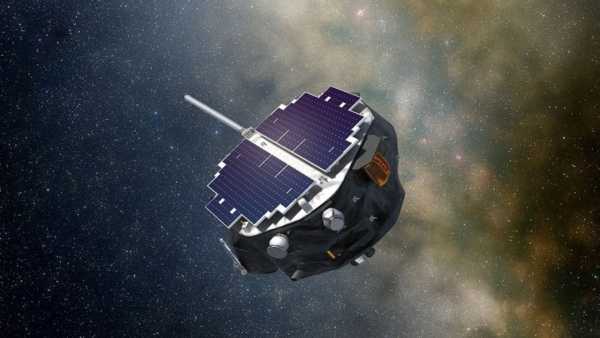
New Delhi: NASA’s Interstellar Mapping and Acceleration Probe (IMAP) mission has entered into a halo orbit around the first Lagrange point (L1) in the Sun-Earth system. This is a region of stable gravity around between the Earth and the Sun, at a distance of about 1.5 million km from the Earth, where spacecraft need to expend minimal fuel to maintain their positions. The regime is popular for heliophsyics observatories, including ISRO’s Aditya-L1 mission. The spacecraft was launched along with two other heliophysics instruments by a SpaceX Falcon 9 rocket in September 2025. The Carruthers Geocorona Observatory launched with IMAP also uses the same target regime, and also reached L1 at around the same time.
IMAP reached its target regime on 10 January, and will remain there for the rest of its mission. The primary goal of the instrument is to map the boundaries of the heliosphere, or the protective bubble created by solar wind that encapsulates the entire Solar System. The spacecraft will also study how the heliosphere interacts with the local galactic neighbourhood beyond the heliosphere. IMAP will explore and chart the range of particles in interplanetary space, and provide critical data that can help mitigate the adverse effects of space weather events on spacecraft and humans.
Science operations to commence on 1 Feb
The mission is nearing the end of its commissioning phase, and will begin its science mission from 1 February. IMAP will map the boundaries of the heliosphere primarily using energetic neutral atoms or ENAs. These are a type of uncharged particle formed when an energetic positively charged ion runs into a slow moving neutron atom. The ion picks up an extra negatively charged electron in the collision, making it neutral. This process frequently occurs when there is plasma in space. ENAs travel in a straight line, and are unaffected by magnetic fields. IMAP will use the ENAs detected at L1 to trace them back to their origins, to assemble a map of the boundaries of the heliosphere.
Contact to : xlf550402@gmail.com
Copyright © boyuanhulian 2020 - 2023. All Right Reserved.