
When Krishna left Vrindavan, it should have marked an ending. The land where divine play unfolded, where laughter echoed along the Yamuna, and where love lived without rules should have slipped quietly into the past. In most stories, when the central figure departs, the place loses its meaning.
But Vrindavan did not fade. It deepened. What kept it alive was not the hope of Krishna’s return, but the presence of Radha. Mythology suggests that after Krishna left, Vrindavan did not become empty. It became a home. Radha did not remain there out of helplessness or attachment. She stayed because Vrindavan had transformed into the space where love itself could continue to exist without form, without expectation, and without conclusion. That decision is the reason Vrindavan is still remembered, not as a location from the past, but as a living spiritual experience.
1. Radha Did Not Leave Because Her Life Was Rooted There 
Mythological thought presents Radha as deeply rooted in Vrindavan, not just emotionally, but spiritually. Her identity was woven into its forests, riverbanks, and rhythms of daily life.
When Krishna left, Radha did not experience Vrindavan as a reminder of loss. She experienced it as home. Leaving would have meant abandoning the very space where love had taken form. Staying allowed that love to remain alive in its original soil.
Vrindavan was not holding memories for Radha. Radha was holding Vrindavan.
2. Vrindavan Became a Space of Presence, Not AbsenceAfter Krishna’s departure, Vrindavan did not become silent. It became contemplative.
Radha’s presence transformed the land into a space of inner awareness. The songs, the river Yamuna, the groves, and the seasons continued to exist as expressions of devotion rather than play. Mythology suggests that Radha’s emotional presence replaced Krishna’s physical presence.
This is why Vrindavan is described as spiritually awake even in Krishna’s absence. It did not feel abandoned. It felt inhabited.
3. Radha Turned Vrindavan Into a Living Memory 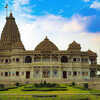
In bhakti philosophy, remembrance is not passive. It is an active spiritual force.
Radha’s staying ensured that remembrance itself became a form of worship. Every breath she took in Vrindavan preserved Krishna’s presence without needing his return. Through her, the land learned how to remember.
This is why Vrindavan is not a place people visit to recall history. It is a place people visit to feel something still ongoing.
4. Vrindavan Did Not Follow Krishna Because It Belonged to RadhaKrishna’s later life unfolded in Mathura and Dwarka. Those places reflect order, power, and governance. Vrindavan reflects something else entirely.
It reflects intimacy.
Radha’s staying fixed Vrindavan’s identity as the land of love rather than authority. Had Radha left, Vrindavan would have followed Krishna’s trajectory into legend. Instead, it stayed grounded in emotion, simplicity, and devotion.
That is why Vrindavan belongs to Radha more than to Krishna in mythological memory.
5. Radha’s Home Became the World’s RefugeOver time, Vrindavan stopped being just Radha’s home. It became a spiritual refuge for countless devotees.
Mythology holds that Radha’s inner state shaped the atmosphere of the land. Her longing, surrender, and quiet devotion created a space where others could arrive with their own emotions and find resonance.
Even today, devotees believe that Vrindavan absorbs pain, longing, and love because Radha once made it her home after Krishna left.
6. Vrindavan Was Preserved Through Stillness, Not Action
Krishna’s life beyond Vrindavan was full of action. Battles were fought. Kingdoms were ruled. Dharma was defended.
Vrindavan survived through stillness.
Radha’s staying taught the land how to remain sacred without spectacle. There were no thrones or victories, only remembrance. That stillness is why Vrindavan remains spiritually potent long after the stories have ended.
7. Vrindavan Is Remembered Because Radha Never Walked AwayMythology repeatedly suggests that places become holy not because gods pass through them, but because devotion stays.
Radha staying ensured that Vrindavan did not fade into mythology. It became mythology. Her presence anchored it in spiritual time rather than historical time.
This is why Vrindavan is remembered not as the place Krishna left, but as the place Radha remained.
Contact to : xlf550402@gmail.com
Copyright © boyuanhulian 2020 - 2023. All Right Reserved.