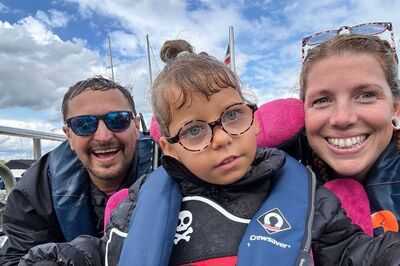
A mum whose daughter has a smooth brain and endures up to 500 seizures daily, and whose self-employed husband has undergone emergency heart surgery, says she has to fundraise to keep her family afloat. Alexandra Bufton, 37, welcomed her daughter Doris in 2019, and soon spotted developmental issues, including excessive sleeping and trouble holding her head up.
In April 2020, after Doris was taken to hospital with a swollen head and fever, medics diagnosed her with a rare genetic microdeletion and lissencephaly, meaning she has a smooth brain. Alexandra and her husband Kris, 40, a self-employed builder, were informed Doris is unlikely to survive beyond 10 and would never manage to sit, walk or speak, with mental abilities equivalent to a one year old.
Now aged six, Doris's condition has worsened – she experiences hundreds of seizures daily and receives palliative care centred on her quality of life. The family, from Locks Heath, Hampshire, also faces additional "stress" after Kris was diagnosed with a heart condition and required emergency open heart surgery, leading them to launch a fundraiser as they "take each day as it comes".
- 'I nearly died from botched BBL - it left me with a huge hole in my bum'
- Vitamin D users told stop taking if you have one of four symptoms
Alexandra, who has two other children, Amelia, 14, and Poppy, nine, said: "She's continuously seizing at the moment, she can't even smile. I'm just pretending everything is OK even when it isn't.
"Kris and I have always said that everything is about a quality of life – we would never keep her alive for our sake. It's always about her, and as long as she's not in pain and she's still getting enjoyment out of things, and she's comfortable and happy, then we will do that for as long as we can, so we're hopeful."
When Alexandra was expecting Doris in 2019, her waters ruptured at 29 weeks, though medics managed to delay labour until 34 weeks. Doris arrived in September 2019, weighing 3lb 9oz, and at approximately six months old, Alexandra and Kris started noticing developmental setbacks, including her difficulty in lifting her head and excessive sleeping.
Initially, they believed this was because she had arrived early, and medics indicated they would reassess her progress at two years old. In April 2020, Alexandra rushed Doris to hospital after she developed a fever and swelling on her head.
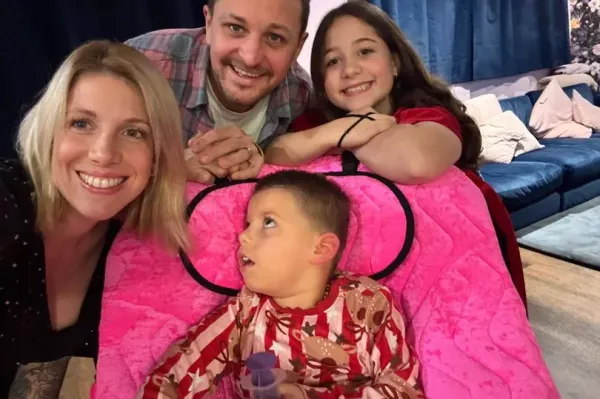
After numerous examinations, doctors revealed Doris's brain was underdeveloped and confirmed she had a rare genetic condition called a 17p13.3 microdeletion. This is an uncommon disorder where a tiny portion of the genetic material forming one of the body's 46 chromosomes is absent.
She was additionally diagnosed with lissencephaly, indicating she has a smooth brain. Alexandra, who had worked as a mobile hairdresser while running her own cake business, subsequently became Doris's full-time carer.
She said: "They told us she may not live until two and it is unlikely she will live until 10. So it was all a bit of a shock."
Doris subsequently began experiencing difficulties with feeding and required a gastrostomy tube to be fitted. Alexandra and Kris were informed she would never manage to sit, walk or speak, and that mentally she operates at approximately the level of a one year old.
"I don't think it even sank in for a long time," Alexandra said. At age one, in September 2020, Doris was diagnosed with refractory epilepsy, caused by her other conditions.
At first, she suffered a few seizures daily and remained "lively and very smiley", frequently engaging with her toys sporting a "massive grin on her face". Yet in 2021 Doris's health worsened and the family relocated to a bungalow to make everyday living more manageable.
Doris requires a specialist bath, ceiling-track hoists in her bedroom, bathroom and living room, a bed with padded sides, a wheelchair, a standing frame and specialist chairs. In May 2025, Doris had a device inserted into her chest to send mild electrical pulses to the brain via the vagus nerve, helping to reduce the frequency, length and severity of seizures associated with drug-resistant epilepsy.
But, despite this, she now has up to 300 to 500 seizures a day and is asleep for around 23 hours a day. "Now, although we can slow some of her seizures down, and we have rescue medications to bring her out of big ones, we cannot control her seizures at all," Alexandra said.
"We're struggling to get her awake and unfortunately, all the seizures are just causing potential brain damage or just making things more difficult for her."
Doris can no longer grin or lift her head up and must be hoisted everywhere. She is now receiving palliative care, which concentrates on managing her quality of life, though she has not yet reached the "end of life" phase of her treatment.
"We are hoping that we can get another year, or even a couple of years, from her, if her doctors work out the medication well and properly," Alexandra explained. On top of this, Alexandra's husband Kris has recently discovered he had a heart condition.
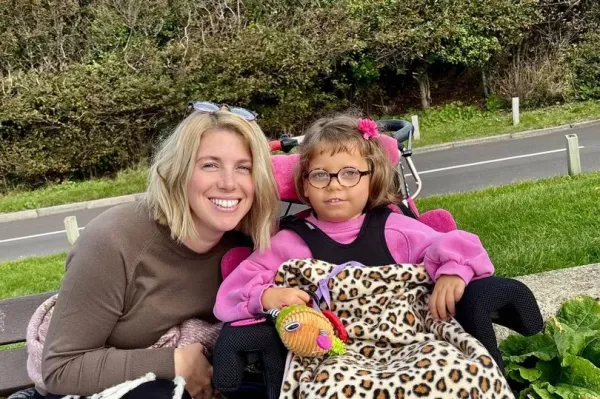
Kris first discovered he had high blood pressure around 12 years ago, and scans in December 2025 subsequently revealed he had a bicuspid aortic valve, a heart condition where the aortic valve has two leaflets rather than the normal three. He underwent additional tests and medics informed him he had an aortic aneurysm – a bulge in a weakened part of the aorta – along with a heart murmur and a leaky valve, meaning he needs a valve replacement.
Kris then attended a routine appointment with his surgeon on January 13, 2026, and, following more tests and Kris experiencing chest pains, he underwent open heart surgery on January 15.
Alexandra said: "It went well, although he had mild complications post-surgery of a partially collapsed lung, resulting in severe pain and needing a chest tube and further drains. He is up and down regarding pain and management, but hopefully he can come home soon so I can look after him and Doris under one roof, as it's been very difficult splitting my time between Kris and my girls."
Medics believe he will need at least 6 months off work to recover. "It was a huge shock, he was definitely quite upset and afraid," Alexandra said.
"It's the fear that he's the only one working, because I'm a full-time carer for Doris, I can't work because of the unpredictability of Doris. He's self-employed, so if he doesn't work, we don't earn anything. I've been ringing around, cancelling our Sky TV and installing smart meters so we can do our best to not be in debt while he's off work."
Consequently, Alexandra has established a GoFundMe to assist the family financially, and at the time of writing they had collected over £10,500. Alexandra revealed she frequently finds herself "pretending everything is OK" during challenging periods.
"I will only cry on my own in the van, when I'm driving somewhere – I don't cry in front of people," she added. "I wish I could, because I don't think it's healthy for my girls, it's just not something that we're very good at.
"I think we use humour a lot just to try and survive. I think since having Doris, we know nothing's going to change her, so moping around isn't going to make it any better, so we just try and just get on with it."
Looking towards the future, she remarked: "I think we'll just take each day as it comes, because that's all we can do at the moment."
To contribute to Alexandra's fundraiser, visit her GoFundMe page.
Contact to : xlf550402@gmail.com
Copyright © boyuanhulian 2020 - 2023. All Right Reserved.