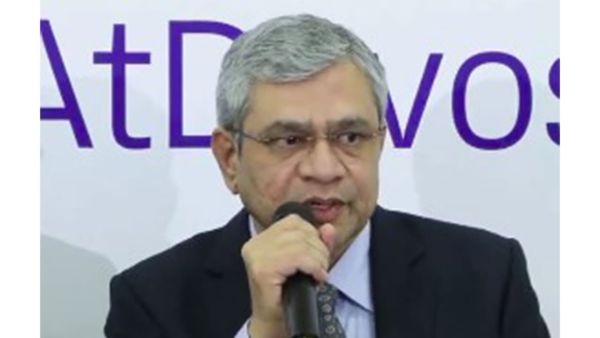
At WEF Davos, Union Minister Ashwini Vaishnaw highlighted growing global confidence in India as a trusted value-chain partner, citing strong interest from leaders in partnering across infrastructure, technology, logistics, and manufacturing.
Union Minister for Electronics and Information Technology Ashwini Vaishnaw on Thursday underscored growing global confidence in Bharat and India's emergence as a trusted value-chain partner during his engagements at the World Economic Forum (WEF) in Davos. He said that engagements at WEF, Davos reinforce Bharat's growth story, with sustained interest from global leaders in partnering with India across infrastructure, technology, logistics, manufacturing, and emerging sectors.

Growing Interest from Global Leaders
During discussions, Teo Chee Hean, Chairman, Temasek, expressed interest in expanding Temasek's presence in India, reaffirming Singapore's commitment to invest in India's physical and digital infrastructure as well as deep-tech startups. Interactions with leaders in artificial intelligence, robotics and cybersecurity further reflected India's growing stature as a trusted value-chain partner.
The Minister noted that global confidence in India was evident across engagements. Maersk is actively engaging with India to strengthen logistics infrastructure across shipping, ports and railways, and is also working with India on semiconductor materials. Honeywell is partnering with India in railway modernisation and has expressed interest in expanding its manufacturing operations in the country, a release said.
Vaishnaw also met Demis Hassabis, CEO & Co founder, Google DeepMind and Chris Lehane, Chief Global Affairs Officer, OpenAI, at WEF, Davos. The Minister discussed India's growing role in shaping AI for global good. He encouraged the AI leaders to actively participate in the AI Impact Summit, to be held in New Delhi in February this year.
India as a Reliable Partner
Speaking on the sidelines of his engagements in Davos, Vaishnaw observed that at a time of global turbulence, with old rules and alliances undergoing change, India is increasingly seen as a reliable partner - a vibrant democracy that delivers and provides leadership focused on inclusive growth. He said that across discussions and meetings, there is consistent trust in India as a country with which global partners can comfortably work, co-create and co-develop new technologies.
Strategic Focus on Key Sectors
Critical Minerals
On critical minerals, the Minister said that the value chain is complex and requires coordinated participation across multiple stages, particularly in refining and processing. He emphasised that meaningful international collaborations are essential to securing resilient critical mineral value chains. He noted that India already has collaborations with Japan, South Korea, Singapore, Australia, Europe and the United States, and these partnerships can play a significant role in strengthening critical mineral ecosystems.
Artificial Intelligence
On artificial intelligence, Vaishnaw outlined India's approach across the AI stack, from applications and models to chips, infrastructure and energy. He noted that India's IT industry has pivoted towards delivering AI-based solutions that drive productivity and value.
Referring to the forthcoming AI Impact Summit, the Minister said the Summit will focus on three objectives: assessing the real-world impact of AI in improving productivity and returns; ensuring wider access to technology through democratisation; and putting appropriate guardrails in place to manage risks while harnessing AI's benefits.
Semiconductors
On semiconductors, the Minister said that pilot production has commenced in several approved facilities, with commercial production expected to begin shortly. He emphasised that the government is proceeding in a careful and methodical manner to build a robust semiconductor ecosystem and strengthen India's long-term capabilities in this critical sector.
He added that commercial production is set to begin shortly at one of the four semiconductor plants where pilot production has already commenced, with the first plant expected to start production in February. Vaishnaw described this as a major milestone achieved after six decades of effort, reflecting Prime Minister Narendra Modi's strong focus on building foundational technologies.
Indigenous Mobile Brands on the Horizon
The Minister said that with a strong and mature electronics ecosystem now in place in the country, the time is right for India to develop its own indigenous mobile phone brands. Describing the progress as very encouraging and satisfying, he said that India is expected to see its own mobile phone brands emerge within the next 12 to 18 months.
Global Confidence in India's Growth
The Minister said that engagement with global industry leaders at Davos reflects strong optimism about India. He noted that virtually every major company he met expressed confidence in India's growth trajectory and enthusiasm about expanding their presence in the country, particularly across artificial intelligence, semiconductors and advanced electronics manufacturing.
The Minister observed that India's consistent economic growth, strong reform momentum and focus on building digital public infrastructure are being recognised globally. He said that the world increasingly sees India as a reliable and trusted partner, capable of co-creating and co-developing advanced technologies. (ANI)
(Except for the headline, this story has not been edited by Asianet Newsable English staff and is published from a syndicated feed.)Contact to : xlf550402@gmail.com
Copyright © boyuanhulian 2020 - 2023. All Right Reserved.