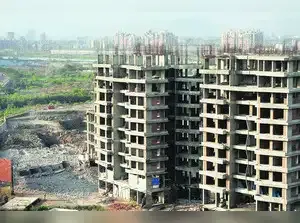
MUMBAI: The Maharashtra government has tightened norms under the Pradhan Mantri Awas Yojana (Urban) 2.0 by mandating at least 25% beneficiary attachment before construction begins or scheme benefits are availed for select affordable housing projects.
This will apply to projects under the Affordable Housing in Partnership (AHP) and AHP-public private partnership (AHP-PPP) categories where the sale price of economically weaker section (EWS) homes exceeds the prevailing annual statement of rates (ASR) by more than 20%.
The revised norms, issued on January 23, follow a review of detailed project reports (DPRs) submitted under PMAY (Urban) 2.0, which revealed inconsistencies in EWS pricing, built-up area calculations and documentation across projects.
Based on directions issued by the State Level Appraisal Committee (SLAC) during its meetings held in August and October 2025, the state government decided to issue standardised guidelines to bring uniformity to project approvals.
Under the new framework, AHP projects where EWS sale prices breach the ASR threshold will be required to secure beneficiary registration for at least 25% of the units before starting physical construction.
In the case of AHP-PPP projects, beneficiary attachment will be mandatory prior to the grant of additional floor space index (FSI) under the scheme or before extending any other benefits available under PMAY (Urban) 2.0. Such proposals will have to be resubmitted to the state-level project management unit after beneficiary linkage.
The guidelines also standardise unit sizing norms for EWS homes. The built-up area of EWS units cannot exceed 1.4 times the carpet area, a cap that will apply while filling project annexures and calculating sale prices. The government resolution (GR) said the move was necessitated by wide variations observed in earlier submissions.
In a further tightening of compliance requirements, the housing department has made it mandatory for all implementing agencies to submit key no-objection certificates (NOCs) at the proposal stage itself.
These include approvals for water supply, sewerage and electricity from the concerned municipal corporations, councils, utilities, or authorised agencies. Officials noted that several earlier proposals had either omitted these clearances or indicated that they would be furnished at a later stage.
The circular also clarifies that the state government will not bear any liability for unsold or vacant units after completion of PMAY (Urban) 2.0 projects, placing the commercial risk on the implementing agencies.
All authorities implementing PMAY (Urban) 2.0 projects have been directed to ensure strict compliance with the revised guidelines while submitting proposals.
This will apply to projects under the Affordable Housing in Partnership (AHP) and AHP-public private partnership (AHP-PPP) categories where the sale price of economically weaker section (EWS) homes exceeds the prevailing annual statement of rates (ASR) by more than 20%.
The revised norms, issued on January 23, follow a review of detailed project reports (DPRs) submitted under PMAY (Urban) 2.0, which revealed inconsistencies in EWS pricing, built-up area calculations and documentation across projects.
Based on directions issued by the State Level Appraisal Committee (SLAC) during its meetings held in August and October 2025, the state government decided to issue standardised guidelines to bring uniformity to project approvals.
Under the new framework, AHP projects where EWS sale prices breach the ASR threshold will be required to secure beneficiary registration for at least 25% of the units before starting physical construction.
In the case of AHP-PPP projects, beneficiary attachment will be mandatory prior to the grant of additional floor space index (FSI) under the scheme or before extending any other benefits available under PMAY (Urban) 2.0. Such proposals will have to be resubmitted to the state-level project management unit after beneficiary linkage.
The guidelines also standardise unit sizing norms for EWS homes. The built-up area of EWS units cannot exceed 1.4 times the carpet area, a cap that will apply while filling project annexures and calculating sale prices. The government resolution (GR) said the move was necessitated by wide variations observed in earlier submissions.
In a further tightening of compliance requirements, the housing department has made it mandatory for all implementing agencies to submit key no-objection certificates (NOCs) at the proposal stage itself.
These include approvals for water supply, sewerage and electricity from the concerned municipal corporations, councils, utilities, or authorised agencies. Officials noted that several earlier proposals had either omitted these clearances or indicated that they would be furnished at a later stage.
The circular also clarifies that the state government will not bear any liability for unsold or vacant units after completion of PMAY (Urban) 2.0 projects, placing the commercial risk on the implementing agencies.
All authorities implementing PMAY (Urban) 2.0 projects have been directed to ensure strict compliance with the revised guidelines while submitting proposals.