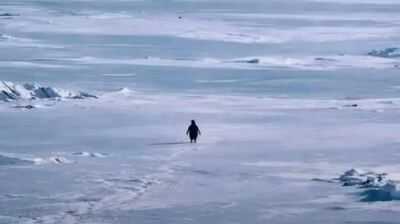
In early 2026, internet users around the world found themselves captivated by a seemingly simple wildlife clip from Werner Herzog’s 2007 documentary Encounters at the End of the World. The footage, featuring a lone Adélie penguin walking away from its colony toward a distant mountain range, has exploded across social media as the “Nihilist Penguin” meme, sparking both humour and introspection — despite being nearly two decades old.
The scene in question shows the penguin abandoning its fellow birds and heading inland on the icy expanse of Antarctica — a direction that leads away from food, community and survival, since penguins typically stay close to the ocean where they hunt and breed. Herzog’s narration in the original documentary described this strange behaviour as akin to a “death march,” pointing out that the bird was likely heading toward certain death.
What breathed new life into this quiet moment was the internet’s reinterpretation of the penguin’s slow, solitary stride. Dubbed the “Nihilist Penguin,” the clip has been widely edited, shared and captioned on platforms like TikTok, Instagram, X and Reddit with themes of existential dread, burnout and quiet rebellion. Users project human emotions onto the penguin’s perceived aimless march, pairing the visuals with dark or philosophical captions such as “when you’re done with everything” or “walking away from life’s pressures,” transforming a wildlife moment into a cultural symbol of modern malaise.
The meme’s emotional resonance lies in its metaphorical alignment with contemporary experiences: feelings of disorientation, burnout, detachment and questioning purpose. Many people today find the idea of a lone penguin wandering into the unknown suddenly relatable, interpreting the visual as a reflection of personal struggles or societal disengagement. This projection represents how digital culture frequently overlays human narratives on natural phenomena to convey collective emotions.
Despite the meme’s philosophical framing, wildlife scientists caution that the penguin’s behaviour likely has biological explanations rather than intentional meaning. Experts suggest that navigational errors, disorientation, stress or illness can cause penguins to stray from normal routes, leading to unusual inland treks that are rare but documented in nature. Such movements are instinctual reactions to physical conditions, not conscious symbolic acts.
The widespread popularity of the “Nihilist Penguin” also highlights the internet’s role in repurposing archival footage into contemporary cultural touchstones. Almost twenty years after Encounters at the End of the World premiered, the clip has reemerged in a new context — one that connects wildlife observation with broader themes of human psychology, digital storytelling and shared emotional expression.
Ultimately, the “Nihilist Penguin” meme illustrates a fascinating intersection between science and symbolism: while the animal’s real behaviour may stem from physical or environmental causes, it has become a canvas onto which millions have projected modern anxieties, curiosities and humorous introspection.
Contact to : xlf550402@gmail.com
Copyright © boyuanhulian 2020 - 2023. All Right Reserved.