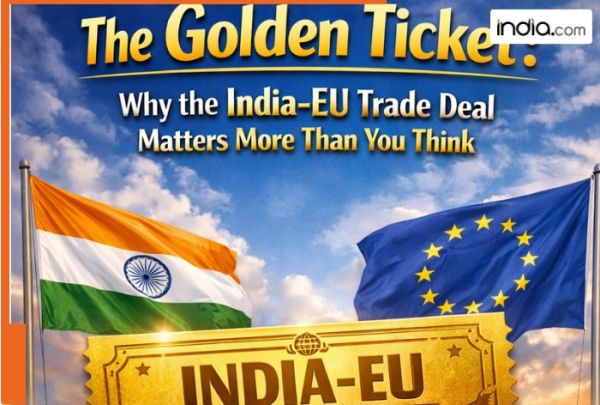
Picture this: After eighteen long years of talking arguing stopping and starting again India is finally about to sign what experts are calling the mother of all trade deals with the European Union. On January 27th when EU leaders arrive in New Delhi as chief guests for our Republic Day celebrations they will also be signing an agreement that could change what you pay for European goods where your older siblings might find jobs and how Indian factories compete globally.
Now you might wonder why this deal with Europe is such a big deal when we have already signed trade agreements with countries like Australia UAE and the United Kingdom. The answer is brilliantly simple. Europe is not just one country. The EU is a customs union of twenty-seven rich nations acting as one giant market. So with just one signature Indian businesses get a golden ticket to sell products in all twenty-seven European countries without paying the heavy import taxes that currently make our goods expensive there. That is like buying one movie ticket and getting access to twenty-seven different cinema halls. No other trade deal gives us this kind of access in one go.
Also Read: India to sign free trade agreement with European Union today sends message against tariffs — How deal will impact exports key sectors
Let me break down why this matters to ordinary Indians like you and me. Right now if an Indian textile factory wants to sell shirts to Germany it pays up to ten percent extra as import duty. For leather shoes or footwear the charges go even higher sometimes twenty percent. Imagine trying to compete with Vietnamese or Bangladeshi factories when they pay zero percent because they already have special trade privileges with Europe. Our manufacturers are essentially running a race with weights tied to their ankles. This FTA removes those weights. Once tariffs drop to zero Indian garments shoes leather goods and auto parts can compete fairly in the European market. And since these are labour-intensive industries more orders mean more factory jobs in India especially in sectors that employ millions of workers.
But here is where it gets interesting and a bit complicated. While India wants easier access to sell goods in Europe the EU wants something in return. European car manufacturers for instance want India to slash our import duties on their vehicles from the current hundred to hundred and twenty-five percent down to maybe ten or twenty percent. If that happens those sleek BMWs and Mercedes you see in movies could become much cheaper here. Sounds great right? Not quite. Here is the catch. If luxury European cars flood our market at low prices why would companies bother setting up factories in India? We have seen this horror story before. In Australia during the nineteen-eighties there were ten car companies manufacturing locally. Then Australia started cutting import duties in trade deals. One by one every single car factory shut down. Today Australia does not manufacture a single car. Everything is imported. India does not want to repeat that mistake. That is why our negotiators have reportedly agreed to reduce car import duties but only partially perhaps from hundred percent to around forty percent and only for a limited number of vehicles. It is a delicate balancing act between giving European carmakers some access while protecting Indian manufacturing jobs.
Then there is wine and whisky which always makes headlines. Europe wants us to cut our hundred and fifty percent tariff on imported wines down to ten or twenty percent. But honestly this is more noise than substance. India imports barely eight million dollars worth of wine from Europe annually. That is tiny compared to our overall trade. What India has cleverly done with Australia UAE and EFTA countries is offer bigger tariff cuts on expensive wines because they do not compete with local cheap wines anyway while keeping duties high on cheaper imports that could hurt Indian winemakers. The EU deal will likely follow the same practical approach.
The real game-changer though is services. This is where India is genuinely strong. Our IT professionals software engineers and tech workers earn billions servicing European companies. But there are frustrating barriers. Indian companies providing remote IT services are often asked to open physical offices in Europe which defeats the whole purpose of remote work. Indian professionals face tough visa restrictions because of rising anti-immigration feelings across Europe. And here is something that sounds technical but affects real people: if an Indian software engineer works temporarily in Germany they have to pay social security contributions both in India and Germany which eats into their salary. India wants a totalisation agreement to stop this double payment. We also want Europe to recognise us as a data-secure country under their strict GDPR privacy laws. Right now Indian IT companies face extra legal hurdles and costs when handling European data because we lack this recognition even though our own Digital Personal Data Protection Act is quite similar to European standards.
What should we be watching closely when this deal is signed? First whether India gets meaningful relief from CBAM the carbon tax Europe is imposing on steel and aluminium imports based on emissions. If Europe removes tariffs with one hand but imposes climate-linked charges with the other the benefits disappear. Second whether those non-tariff barriers like excessive testing requirements and unreasonable pesticide limits on rice and spices get addressed through a proper complaint mechanism. Third whether Indian professionals actually get easier movement and data-secure status or if these remain just words on paper.
This FTA also sends a clear message to America after the US slapped fifty percent tariffs on Indian goods when President Trump returned to office. India is telling Washington: we have options. We are not dependent on you alone. With Europe potentially becoming our largest trading partner Indias negotiating position with everyone else strengthens.
The mother of all trade deals is not perfect but it is necessary. The real test begins after signing when the fine print matters most.
Contact to : xlf550402@gmail.com
Copyright © boyuanhulian 2020 - 2023. All Right Reserved.