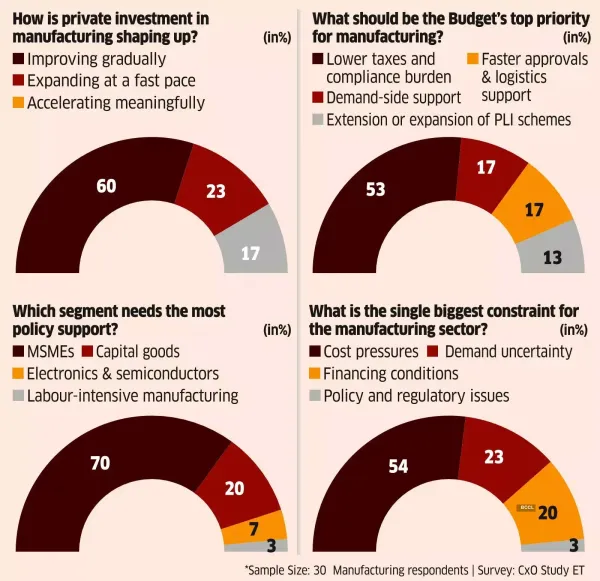
New Delhi: India's manufacturing sector has pitched for tax relief and lowering compliance costs in the upcoming budget, with more than half of industry CXOs flagging it as the top priority, an ET-PwC survey showed.
In addition, 17% of respondents called for stronger demand-side support and faster approvals along with better logistics infrastructure, while 13% advocated for an extension of production linked incentive (PLI) schemes.
The survey gathered insights from 30 CXOs representing companies with annual revenue ranging from less than ₹500 crore to more than ₹10,000 crore.
When asked which segments require the most policy support, 70% of respondents pointed to micro, small and medium enterprises (MSMEs). This was followed by capital goods at 20%, electronics and semiconductors at 7%, and labour-intensive manufacturing at 3%. The respondents who said MSMEs need the most policy support were from across the revenue board.
Finance minister Nirmala Sitharaman will present the budget for FY27 on February 1.
India aims to increase the share of manufacturing to 25% in its gross domestic product from 16-17% now.
Rising consumer demand will have a positive impact on the manufacturing sector, said Parle Products vice president Mayank Shah. Putting more money in the hands of consumers either through revision of income tax slabs or other measures would directly boost consumption and in turn demand, he noted. Increased spending on infrastructure would generate employment, leading to higher purchasing power and stronger demand, Shah said.
Private investment sentiment in manufacturing appears to be improving. Around 60% of respondents observed a gradual pick up in investment activity while 23% said it's expanding rapidly. Around 17% noted a meaningful acceleration.
Shah emphasised that greater investment in the agriculture sector could improve yields and output, helping keep input prices in check.
Though an expansion of the PLI scheme would help, he said that addressing these three areas would have a positive impact on the manufacturing sector.
Views on the current policy environment were mixed. About 30% of CXOs described it as moderately supportive for manufacturing, while 17% found it highly supportive. Half the respondents said the policy landscape remains mixed, and 3% felt it was adequate.
ICRA senior vice president and group head Jitin Makkar said support is needed in three critical areas: incentivising value-added production through component-level PLI schemes; addressing persistent skill gaps by strengthening apprenticeship programmes and vocational training systems; and meaningfully reducing the compliance burden by moving toward single registrations, self-certification and streamlined reporting requirements.
"As states operationalise the new labour codes over time, India's manufacturing ecosystem will see further improvements in flexibility and ease of operations," he said.
Rising cost pressures emerged as the single largest challenge for the manufacturing sector, cited by over half the respondents. Demand uncertainty was identified as the key concern by 23%, while 20% highlighted financing conditions. Policy and regulatory issues were flagged by 3%.
India's expanding network of trade agreements was also assessed in the survey. The country has signed trade deals with various countries over the years, with the European Union becoming India's 22nd FTA partner. Nearly 60% of respondents said that existing foreign trade agreements (FTAs) are providing partial support to the manufacturing sector, while 13% reported limited benefits and 10% said they offer hardly any help. Meanwhile, 17% felt that additional measures are needed to fully leverage these agreements, while 3% said recent FTAs are proving helpful.
In addition, 17% of respondents called for stronger demand-side support and faster approvals along with better logistics infrastructure, while 13% advocated for an extension of production linked incentive (PLI) schemes.
The survey gathered insights from 30 CXOs representing companies with annual revenue ranging from less than ₹500 crore to more than ₹10,000 crore.
When asked which segments require the most policy support, 70% of respondents pointed to micro, small and medium enterprises (MSMEs). This was followed by capital goods at 20%, electronics and semiconductors at 7%, and labour-intensive manufacturing at 3%. The respondents who said MSMEs need the most policy support were from across the revenue board.
Majority of CXOs also want lower compliance costs in the upcoming budget, finds survey
Finance minister Nirmala Sitharaman will present the budget for FY27 on February 1.
India aims to increase the share of manufacturing to 25% in its gross domestic product from 16-17% now.
Rising consumer demand will have a positive impact on the manufacturing sector, said Parle Products vice president Mayank Shah. Putting more money in the hands of consumers either through revision of income tax slabs or other measures would directly boost consumption and in turn demand, he noted. Increased spending on infrastructure would generate employment, leading to higher purchasing power and stronger demand, Shah said.
Private investment sentiment in manufacturing appears to be improving. Around 60% of respondents observed a gradual pick up in investment activity while 23% said it's expanding rapidly. Around 17% noted a meaningful acceleration.
Shah emphasised that greater investment in the agriculture sector could improve yields and output, helping keep input prices in check.
Though an expansion of the PLI scheme would help, he said that addressing these three areas would have a positive impact on the manufacturing sector.
Views on the current policy environment were mixed. About 30% of CXOs described it as moderately supportive for manufacturing, while 17% found it highly supportive. Half the respondents said the policy landscape remains mixed, and 3% felt it was adequate.
ICRA senior vice president and group head Jitin Makkar said support is needed in three critical areas: incentivising value-added production through component-level PLI schemes; addressing persistent skill gaps by strengthening apprenticeship programmes and vocational training systems; and meaningfully reducing the compliance burden by moving toward single registrations, self-certification and streamlined reporting requirements.
"As states operationalise the new labour codes over time, India's manufacturing ecosystem will see further improvements in flexibility and ease of operations," he said.
Rising cost pressures emerged as the single largest challenge for the manufacturing sector, cited by over half the respondents. Demand uncertainty was identified as the key concern by 23%, while 20% highlighted financing conditions. Policy and regulatory issues were flagged by 3%.
India's expanding network of trade agreements was also assessed in the survey. The country has signed trade deals with various countries over the years, with the European Union becoming India's 22nd FTA partner. Nearly 60% of respondents said that existing foreign trade agreements (FTAs) are providing partial support to the manufacturing sector, while 13% reported limited benefits and 10% said they offer hardly any help. Meanwhile, 17% felt that additional measures are needed to fully leverage these agreements, while 3% said recent FTAs are proving helpful.