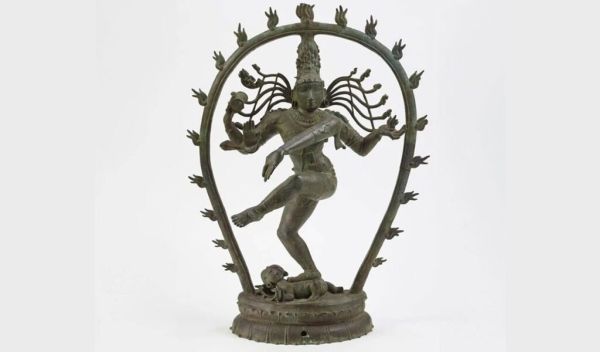
The Smithsonian’s National Museum of Asian Art will return three illegally removed South Indian bronze sculptures to India following provenance research, while retaining one Chola-period Shiva Nataraja on a long-term loan agreed with the Indian government
Published Date – 29 January 2026, 08:55 AM
Smithsonian admits illegal removal, returns historic Tamil Nadu bronzes
Washington: The Smithsonian’s National Museum of Asian Art has announced that it will return three historic South Indian bronze sculptures to India after provenance research established that the works had been illegally removed from temple settings decades ago.
The museum on Wednesday (local time) stated that one of the sculptures, a Chola-period “Shiva Nataraja,” will remain in the United States on a long-term loan agreed upon with the Indian government, allowing the museum to continue displaying the work while publicly documenting its history, removal and return.
The three sculptures — “Shiva Nataraja” (Chola period, ca. 990), “Somaskanda” (Chola period, 12th century), and “Saint Sundarar with Paravai” (Vijayanagar period, 16th century) — are regarded as important examples of South Indian bronze-casting traditions, a media release said.
They were originally sacred objects carried in temple processions in Tamil Nadu.
The museum said the “Shiva Nataraja,” which will be placed on long-term loan, will be displayed as part of the exhibition “The Art of Knowing in South Asia, Southeast Asia, and the Himalayas.”
Such a decision by the museum follows a multi-year investigation conducted as part of a systematic review of the museum’s South Asian collections.
In 2023, researchers working with the Photo Archives of the French Institute of Pondicherry confirmed that the three bronzes had been photographed in temples in Tamil Nadu between 1956 and 1959.
The Archaeological Survey of India later reviewed the findings and determined that the sculptures had been removed in violation of Indian law, it said.
“The National Museum of Asian Art is committed to stewarding cultural heritage responsibly and advancing transparency in our collection,” museum director Chase F. Robinson said.
“The return of these sculptures, the result of rigorous research, shows our commitment to ethical museum practice. We are profoundly appreciative to the Indian government for enabling us to continue exhibiting the long-admired Shiva Nataraja for the benefit of our visitors,” Robinson said.shiva na
The museum said it is working closely with the Embassy of India to finalise arrangements marking the agreement. The process was supported by the museum’s provenance team, curators of South and Southeast Asian art, and international research partners.
According to the museum, the “Shiva Nataraja” originally belonged to the Sri Bhava Aushadesvara Temple in Tirutturaippundi Taluk in Tamil Nadu, where it was photographed in 1957.
The sculpture was later acquired by the National Museum of Asian Art from the Doris Wiener Gallery in New York in 2002. Museum researchers found that the gallery had provided falsified documentation to facilitate the sale.
The other two sculptures entered the museum’s collection as part of a 1987 gift of about 1,000 objects from Arthur M. Sackler. Research confirmed that the “Somaskanda” was photographed at the Visvanatha Temple in Alattur village in 1959, while the “Saint Sundarar with Paravai” was photographed at a Shiva temple in Veerasolapuram village in 1956.
The museum described provenance research as a process that combines physical examination of objects with extensive documentary review, including export licenses, dealer records, historical photographs, correspondence and shipping records, to reconstruct an object’s ownership history.
For decades, India has been seeking the return of cultural artefacts removed illegally from temples and archaeological sites.
The Smithsonian Institution, the world’s largest museum and research complex, oversees multiple museums on the National Mall and attracts millions of visitors annually.
The National Museum of Asian Art, which opened in 1923, houses one of the world’s most significant collections of Asian art and is free to the public.
Contact to : xlf550402@gmail.com
Copyright © boyuanhulian 2020 - 2023. All Right Reserved.