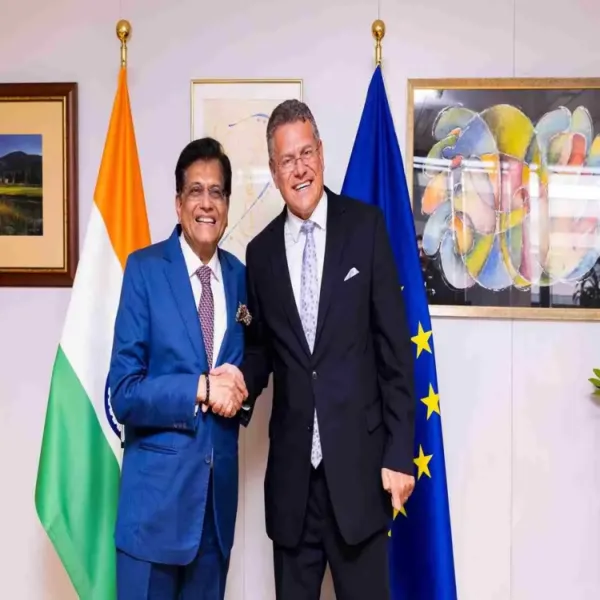
Global: Union Commerce and Industry Minister Piyush Goyal has described the newly concluded Free Trade Agreement between India and the European Union as a decisive step that elevates India’s position in global economic and geopolitical affairs. He said the agreement reflects growing international confidence in India’s economy and opens new pathways for long-term growth, investment, and employment.
Strategic Importance of the Agreement
Addressing the significance of the deal, Goyal noted that the FTA places India among influential global economic partners. He credited the leadership of Narendra Modi for reshaping India’s approach to international trade, moving away from caution toward active global engagement. According to the minister, India is now widely viewed as the world’s fastest-growing major economy, supported by strong macroeconomic fundamentals and rising domestic demand from a population of 1.4 billion.
He added that India’s expanding global role has made it an increasingly attractive trading partner and strategic ally for countries across regions, particularly developing economies seeking stable and reliable partnerships.
Shift in India’s Trade Outlook
Goyal pointed out that India’s trade policy has undergone a clear transformation over the past decade. Earlier, the country often approached trade negotiations defensively, wary of potential risks to domestic industries. That stance, he said, has changed as India works toward its long-term objective of becoming a developed nation by 2047.
He explained that deeper international trade and economic integration are essential to achieving that goal. The agreement with the EU, which consists of 27 advanced economies, is seen as complementary rather than competitive. Europe and India bring different strengths to the table, creating opportunities for mutual benefit rather than rivalry.
Safeguards for MSMEs and Domestic Industry
Emphasising domestic interests, Goyal said the agreement has been structured to protect Micro, Small, and Medium Enterprises and Indian manufacturers. He noted that European countries generally adhere to principles of fair and transparent trade and do not rely on irregular subsidies that could distort markets.
According to him, European industries focus heavily on advanced technologies and high-end products, while India’s competitive advantage lies in its skilled workforce and labour-intensive manufacturing. This difference, he said, reduces direct competition and allows Indian products and services to find space in European markets without undermining domestic producers.
Major Opportunities for the Textile Sector
One of the most significant gains from the FTA is expected in the textile and apparel sector. Goyal highlighted that India’s current textile exports to the EU are modest compared to Europe’s overall import demand. He explained that Indian exporters have historically faced import duties of up to 12 percent, putting them at a disadvantage compared to countries such as Bangladesh and Vietnam, which enjoyed zero-duty access due to special trade arrangements.
Under the new agreement, all duties on Indian textile exports to the EU will be eliminated from the first day. This change, Goyal said, will allow Indian manufacturers to compete on equal terms and could substantially increase export volumes. He expressed confidence that textile exports could rise to between $30 billion and $50 billion in the coming years, supporting large-scale job creation across the country.
Broader Economic Impact
India and the European Union formally announced the conclusion of FTA negotiations on Tuesday, marking a major milestone in their economic relationship. The agreement is designed as a modern, rules-based framework that addresses current global trade challenges while encouraging closer market integration.
With a combined market value estimated at around USD 24 trillion, the partnership covers nearly two billion consumers across India and Europe. The FTA is expected to provide market access for more than 99 percent of India’s exports by trade value, while still allowing policy flexibility in sensitive areas. Officials say the deal aligns with India’s broader development priorities and sets the stage for stronger trade, innovation, and investment ties in the years ahead.
Contact to : xlf550402@gmail.com
Copyright © boyuanhulian 2020 - 2023. All Right Reserved.