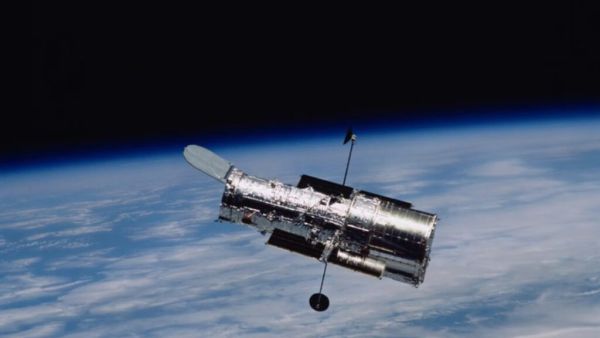
Astronomers are using Artificial Intelligence to discover thousands of unusual and ignored objects concealed in years of space telescope data. By using AI to scan images from the Hubble Space Telescope, researchers have identified around 1,400 “anomalous objects”, cosmic oddities that don’t neatly fit into known categories.
The discovery was made by two astronomers working with the European Space Agency (ESA), David O’Ryan and Pablo Gómez. Rather than manually searching through Hubble’s enormous archive, which spans more than 35 years, the team trained an AI system to do the heavy lifting. This enabled them to analyse the data more quickly and thoroughly than they could have before.
Since its launch, Hubble has captured millions of images, leading to one of the largest data collections ever assembled. However, the sheer amount of data is also a problem. Only a small amount of data can be analysed by human observers, which means that unusual or unexpected objects can easily be overlooked. This is where AI proved especially useful.
Using a custom-built system called AnomalyMatch, the researchers asked the AI to look for objects that appeared unusual when compared with typical galaxies, stars, or other known celestial structures. Instead of telling the model exactly what to find, they trained it to spot anything that looked different enough to deserve a closer look.
How the AI search worked
AnomalyMatch analysed nearly 100 million image cutouts from the Hubble Legacy Archive, making this the first time the dataset has been systematically searched for anomalies. The AI was able to finish the job in just two and a half days, which would have taken human researchers many years, or perhaps never been possible at all.
The AI does not replace astronomers. Instead, it serves as a filter that identifies atypical objects for further investigation by researchers. The team subsequently examined the collection of items that the AI had selected and checked manually which ones were relevant.
The outcomes, printed in the journal Astronomy & Astrophysics, were rather unexpected. Most of the unusual objects were indeed galaxies that were merging or interacting with one another, a process that can lead to significant alterations in their shape. Then there were the gravitational lenses, in which huge bodies warp light into arcs or rings, and the jellyfish galaxies, which appear to have gas trails stretching behind them like tentacles.
Story continues below this ad
Among the most astonishing findings was a group of objects that defied classification on any level. These enigmatic objects exhibit no patterns and may signify unusual occurrences in galaxy evolution or phenomena that remain unexplained.
According to ESA researchers, this study proves the potential of advanced AI in the field of astronomy. Even with the most studied telescope in the world, such as the Hubble telescope, there are still surprises waiting to be discovered. The success of AnomalyMatch also provides a chance to search for anomalies in the data of newer telescopes, such as the James Webb Space Telescope.
In conclusion, AI is providing astronomers with a new perspective on exploring the universe, as it assists them in discovering the unusual, the uncommon, and the unexpected that is right in front of them.
Contact to : xlf550402@gmail.com
Copyright © boyuanhulian 2020 - 2023. All Right Reserved.