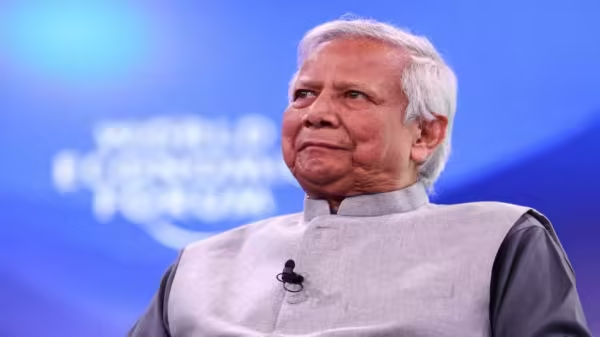
New Delhi: The recent free trade agreement (FTA) between India and the European Union has stirred unease in Bangladesh. Muhammad Yunus, the interim government’s chief advisor, has called on the EU to initiate immediate negotiations to secure similar trade terms for Dhaka. In a statement released from his office, he emphasized the need for “duty-free access to be ensured through prompt FTA discussions with the EU”.
He met EU Ambassador to Bangladesh Michael Miller and Nuria Lopez, chairperson of the European Chamber of Commerce (EuroCham) in Dhaka. According to the statement, he stressed that it is vital for Bangladesh to protect its trade priorities in the European market once the present duty-free status expires in the coming years.
During the meeting at Dhaka’s State Guest House Jamuna, Yunus discussed ways to enhance European investment in Bangladesh, strengthen smooth trade relations between Dhaka and the EU and improve the country’s business environment through additional reforms.
Add Zee News as a Preferred Source
He highlighted that the interim government recently signed an economic partnership agreement (EPA) with Japan, granting duty-free access for more than 7,300 Bangladeshi products to the fourth-largest economy in the world.
He indicated that similar agreements with other countries, including the EU, are being prepared to secure continued duty-free access, especially for ready-made garments.
Nuria Lopez highlighted the urgency of starting FTA negotiations, pointing out that Bangladesh risks losing its current trade advantages once it graduates from the least-developed country (LDC) status. She stressed that immediate action is required to protect the country’s largest export market.
Bangladesh’s concerns stem from the fact that the India-EU FTA could directly affect its textile industry. Until now, Bangladesh enjoyed duty-free access to the European market under the “Everything But Arms” (EBA) scheme, allowing it to export garments without tariffs, while Indian exports faced a 9 to 12 percent tariff. Under the new agreement, Indian textiles, leather and marine products will also enjoy zero tariffs.
With a larger raw cotton base and a fully integrated supply chain, India is now positioned to compete directly in Europe at lower prices. Analysts warn that by November 2029, India will have stable zero-duty access to the EU, while Bangladeshi exports could face higher tariffs, making them more expensive for European buyers. This could jeopardize more than half of Bangladesh’s garment industry, which is the backbone of the nation’s economy.
The Bangladeshi government is watching closely as the regional trade scenario changes, urging swift action to safeguard its textile sector and maintain competitiveness in the global market.
Contact to : xlf550402@gmail.com
Copyright © boyuanhulian 2020 - 2023. All Right Reserved.