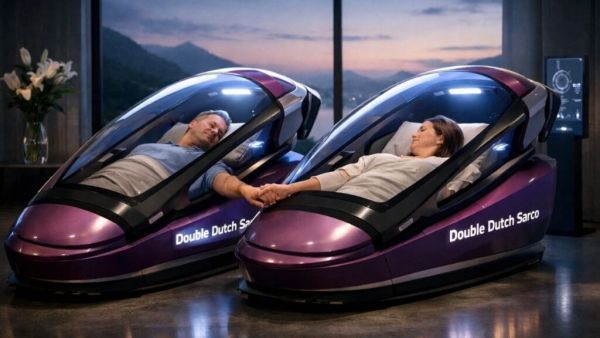
The ‘Sarco Pod’ that shocked the world first time Only a year has passed since its use, but this device has once again come to the center of global debate. This machine came into limelight after the death of a 64-year-old American woman in a forest in Switzerland in September 2024. Now its inventor Philip Nitschke has made another new claim, which has raised new questions on morality, law and technology.
According to The Daily Mail report, the woman entered this 3D-printed capsule in the Schaffhausen area of Switzerland and died within a few minutes. After this, the police took immediate action and seized the device, detained the people present at the spot and started investigation. Although charges of deliberate murder were later dismissed, the incident made the ‘Sarco Pod’ a symbol of global controversy.
Long story of a doctor surrounded by controversies
Australian-born Philip Nitschke has been a long-time supporter of euthanasia. He is associated with an organization called ‘Exit International’, which provides information on issues to euthanasia. According to him, the purpose of the Serco Pod is to give people control over their own death, but critics consider it an inhumane and dangerous experiment. After the first incident, Nitschke was shocked by the strictness of the Swiss police. The device is still in the possession of the police and the investigation has not been completed. Nitschke says their next steps are being held up by legal ambiguity, even as technological developments have progressed.
Thinking of seeing death in pairs
Nitschke is now working on a new version called ‘Double Dutch Sarco’. It will be bigger than the previous pod and has been specially designed for those couples who want to end their lives together. He claims that many elderly couples found the idea of dying alone uncomfortable, which gave rise to this new idea. There will be space for two people in this new pod and both will have to press the button simultaneously. If even one person steps back, the machine will not work. Nitschke calls it a symbol of ‘shared decision’, although for critics this thought is even more scary.
Now will the machine decide mental capacity?
The most controversial aspect is the Artificial Intelligence added to it. Nitschke claims that in the future, mental ability will not be tested by a psychiatrist, but by an AI system. This technology will decide whether a person is mentally capable of taking his own decisions or not, which has sparked deep debate in the medical and ethical worlds.
Why did Switzerland become the centre?
In most countries of the world, euthanasia is subject to strict medical conditions, but in Switzerland the rules are relatively lax. This is why Nitschke believes that the future of machines like ‘Double Dutch Serco’ is only possible there at present.
Criticism, pain and personal tragedy
Anti-euthanasia organizations have even called this device a ‘personal gas chamber’. He argues that making death easier in the name of technology will take society in the wrong direction. On the other hand, Nitschke says that he is merely responding to the demands of those who want control over the final decisions of their lives. Amidst this entire controversy, the death of Nitschke’s close associate Dr. Florian Willett made the matter more serious. His death after prolonged detention and mental stress raised questions on the police investigation and system. Nitschke considers this to be the result of administrative pressure.
technology moving towards the future
Apart from Sarco, Nitschke is also working on ‘Chiros Collar’ and other devices. He believes that older people want ‘complete control’, so that they do not have to fear the uncertainty of the future. But legal hurdles are currently keeping these schemes limited to the laboratory. The Serco pod and its new ‘Double Dutch’ version are not just a technological innovation, but a question of how much power humans should have over their own death. This is a story of technology versus morality, freedom versus law and human compassion versus fear, the final verdict of which is probably still a long way off.
Contact to : xlf550402@gmail.com
Copyright © boyuanhulian 2020 - 2023. All Right Reserved.