Expect IT outsourcing leaders with eye-popping cash on their balance sheets to announce buybacks.
After the budget reclassified the repurchase exercise as capital gains, lowering the tax outgo for investors, the $280-billion industry could return to its favourite mode of rewarding long-term shareholders, experts said.
“It is expected that IT firms will continue with buybacks as a tool to return capital because it would allow them to return cash without triggering heavy tax burdens for most (particularly retail) shareholders,” said Aditi Goyal, partner for the tax practice at Trilegal.
Finance Minister Nirmala Sitharam on Sunday proposed to tax buyback for all types of shareholders as ‘Capital Gains.’ This moved away from the earlier policy, notified in the October 2024 budget, when the new buyback rules shifted the income tax liability from the corporates to the shareholders. Under this, the money received by shareholders was taxed as a “deemed dividend,” with the tax being levied on the gross amount, not just the profits made.
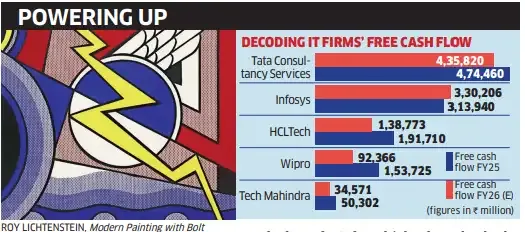
Until 2024, the top five large-cap companies had conducted multiple share buybacks, with TCS and Wipro having undertaken five share buybacks, Infosys having done four, while HCLTech and Tech Mahindra did two and one share buybacks, respectively.
But a change in the law in 2024 had discouraged the cash-heavy IT sector from engaging share repurchases, often the preferred avenue for IT companies to reward long-term shareholders, increase earnings per share, and enhance return ratios.
Infosys was the only exception to this case, which announced its Rs. 18,000 crore share buyback in 2025.
However, despite the 19% premium offered in the buyback, Infosys promoters had chosen not to participate, owing to the higher tax outgo that arose under the 2024 budget, explained Shriram Subramanian, founder of InGovern Research Services.
On budget day, Finance Minister Sitharaman also said a 22% capital gains tax for corporate entities and 30% for non-corporate entities (plus surcharge and cess) would apply, essentially discouraging promoter-led tax arbitrage and benefiting minority shareholders in a buyback decision.
Lower tax incidence
But by ceasing to treat share buybacks as dividend income and taxing buybacks only as capital gains, the new provisions make share buybacks by companies attractive again for domestic investors, Subramanian added.
Analysts at Kotak Securities highlighted in a February 3, 2026, note that while promoters face higher capital gains, the new regime is still more favourable since only the gain is taxed rather than the full-sale proceeds being taxed at the marginal rate, adding that the revised structure will incentivise buybacks.
“IT firms often have limited high-return domestic investment opportunities relative to their accumulated cash….this may lead to companies considering approaches such as special dividends, or a hybrid approach of combining dividends with selective buybacks,” Goyal added.
After the budget reclassified the repurchase exercise as capital gains, lowering the tax outgo for investors, the $280-billion industry could return to its favourite mode of rewarding long-term shareholders, experts said.
“It is expected that IT firms will continue with buybacks as a tool to return capital because it would allow them to return cash without triggering heavy tax burdens for most (particularly retail) shareholders,” said Aditi Goyal, partner for the tax practice at Trilegal.
Finance Minister Nirmala Sitharam on Sunday proposed to tax buyback for all types of shareholders as ‘Capital Gains.’ This moved away from the earlier policy, notified in the October 2024 budget, when the new buyback rules shifted the income tax liability from the corporates to the shareholders. Under this, the money received by shareholders was taxed as a “deemed dividend,” with the tax being levied on the gross amount, not just the profits made.
Until 2024, the top five large-cap companies had conducted multiple share buybacks, with TCS and Wipro having undertaken five share buybacks, Infosys having done four, while HCLTech and Tech Mahindra did two and one share buybacks, respectively.
But a change in the law in 2024 had discouraged the cash-heavy IT sector from engaging share repurchases, often the preferred avenue for IT companies to reward long-term shareholders, increase earnings per share, and enhance return ratios.
Infosys was the only exception to this case, which announced its Rs. 18,000 crore share buyback in 2025.
However, despite the 19% premium offered in the buyback, Infosys promoters had chosen not to participate, owing to the higher tax outgo that arose under the 2024 budget, explained Shriram Subramanian, founder of InGovern Research Services.
On budget day, Finance Minister Sitharaman also said a 22% capital gains tax for corporate entities and 30% for non-corporate entities (plus surcharge and cess) would apply, essentially discouraging promoter-led tax arbitrage and benefiting minority shareholders in a buyback decision.
Lower tax incidence
But by ceasing to treat share buybacks as dividend income and taxing buybacks only as capital gains, the new provisions make share buybacks by companies attractive again for domestic investors, Subramanian added.
Analysts at Kotak Securities highlighted in a February 3, 2026, note that while promoters face higher capital gains, the new regime is still more favourable since only the gain is taxed rather than the full-sale proceeds being taxed at the marginal rate, adding that the revised structure will incentivise buybacks.
“IT firms often have limited high-return domestic investment opportunities relative to their accumulated cash….this may lead to companies considering approaches such as special dividends, or a hybrid approach of combining dividends with selective buybacks,” Goyal added.