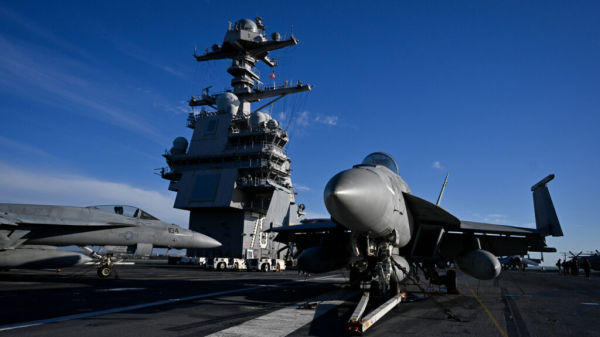
The Ford class of aircraft carriers is the latest addition to the US Navy’s already formidable carrier fleet. Currently, the USS Gerald R. Ford is the only operational carrier from the class, although the John F. Kennedy recently completed a major milestone when it began sea trials. Impressive as these ships undoubtedly are, there are well-documented teething problems with the ships — such as the Gerald R. Ford’ continuing plumbing problems.
While these issues are inconvenient at best, they’re far from the only issues besetting the ship. One of the most prominent and controversial of these surrounds the Navy’s cutting-edge (but misfiring) advanced arresting gear (AAG). The system was introduced with the Ford-class carriers and replaces the Mk 7 hydraulic system used on the Nimitz-class carriers.
The new system was designed to update the reliable but aging hydraulic system. Rather than relying on hydraulics, AAG takes a fundamentally different approach that relies on digitally controlled systems and energy-absorbing water turbines to recover aircraft. The thinking behind this design was to create a system that was lighter, easier to maintain, adaptable, and more efficient than the Mk 7.
While these are worthy goals, many of the technologies underpinning the system have proven to be unreliable. Hardware problems and software glitches have dogged the system, problems that the Navy and the AAG’s builder — General Atomics — are working to resolve.
Why was the advanced arresting gear introduced?
Teething problems with advanced “first-generation” systems of any kind are not unexpected, and even the world’s most advanced aircraft carrier is not immune to them. That prompts a reasonable question: why introduce such a complex system when hydraulic arresting gear had successfully recovered aircraft for decades?
There are several main reasons that drove the decision. One of the main advantages of the new system is its ability to deal with aircraft across a range of sizes. This means it can deal with heavier aircraft like the F-35C, but it can also be configured to recover smaller aircraft, including UAVs — many of which are incompatible with the Mk 7. This consideration is becoming increasingly relevant as the use of such platforms continues to expand. The AAG can also be scaled to suit any future launch platforms that become operational.
Another advantage is the system’s ability to adjust energy absorption in real time. This reduces stress on the system and on the airframes of the recovered aircraft. This saves both in terms of manpower for maintenance, and also in less wear and tear on arresting cables and landing gear.
The ultimate aim of the system is to make the Ford-class carriers much more efficient in terms of the aircraft launch rate. The Navy is aiming for a “sortie generation rate” for the Ford-class that is 33% higher than Nimitz carriers could manage. Which would be an incredibly meaningful upgrade given that launching aircraft is an aircraft carrier’s primary function.
Why advanced arresting gear has struggled to mature
What separates AAG from its predecessor is not just the hardware involved, but also the complexity of the system. AAG requires a level of coordination between software, sensors, and mechanical systems during every recovery. In short, the system depends on real-time control logic to interpret conditions on the flight deck and manage how arresting forces are applied. Theoretically, this should give the AAG distinct advantages over its forerunner, but it also introduces far more potential failure points than its simpler predecessor.
The upshot of this is that the system has failed to consistently meet required performance thresholds, including the Navy’s Mean Cycles Between Failure benchmark. Assessments cited by the Congressional Research Service note that reliability and maintainability issues with AAG continue to adversely affect flight operations, particularly when operating at higher tempos. The report also points out that publicly reported performance stats have not been updated since 2023. Although this reflects the limited availability of representative test data rather than a lack of ongoing use.
Those same assessments identified several contributing factors to the system’s underperformance. Key among them were the difficulty of integrating a highly complex first-of-its-kind system into service, software- issues, an ongoing reliance on off-ship technical support, and issues with obtaining replacement parts.
One potential improvement being discussed is the retrofitting of a fourth engine. This had been present in the original Ford-class design, but was dropped to save costs. Introducing this would build in another level of redundancy, improve reliability & availability, and increase the pilot boarding rate.