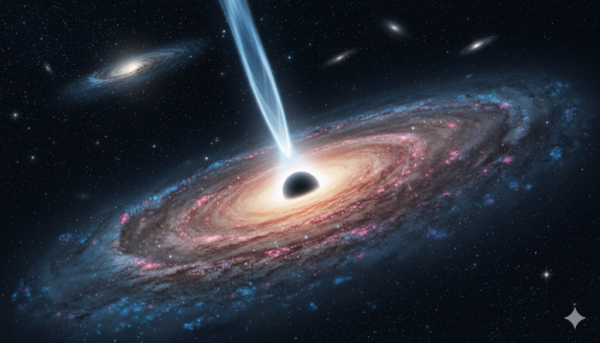
At the heart of most large galaxies, including our Milky Way, there sits a supermassive black hole. These are millions or billions of times heavier than the Sun, as compared to the “normal” stellar-mass black holes which are just a few kilometres across.
How did these monsters become so big? That is one question that puzzled scientists for decades. It got even more puzzling when modern space-based telescopes looked into the past, right into the childhood of our universe, and saw evidence that these monsters were already there.
Let’s frame that in an easier language. It’s like looking into a family photo from decades ago, and from among the toddlers, finding one that’s eight feet tall. Now, how do we explain toddlers who are over eight feet tall and keep adding a foot every year?
That’s why supermassive blackholes puzzled astrophysicists. One leading theory proposes that such black holes were formed directly from heavy seeds — born big from direct collapse of enormous gas clouds during the chaotic initial years of the Universe. They did not take the route of a stellar-mass black hole, where a big star explodes as a supernova at the end of its life and forms a black hole.
New research: Birth from light seeds
Researchers from Ireland’s Maynooth university have now come up with an alternative model based state-of-the-art simulations of data from James Webb telescope. Their finding is that a black hole can begin with a light seed — alike a stellar-mass black hole — and grow super massive through a frenzied accretion of matter. That’s like a child being born normal and becoming a supergiant in a few years by guzzling tons of food.
“Early galaxies were extremely dense, gas-rich, and chaotic. In such environments, black holes could accrete gas much more efficiently and for extended periods. This allowed them to grow rapidly, starting from relatively small “seed” black holes left behind by the first stars, lead researcher Daxal Mehta told indianexpress.com
The early galaxies are the ones which were formed when our universe was only a few hundreds of millions of years old. The universe is now 13.8 billion years old.
The researchers said it did not matter whether the black holes were born big or small. “What really matters is how black holes feed in the early Universe. Our simulations show that early black holes experienced episodes of very intense accretion, sometimes exceeding what was previously thought to be a hard limit,” said Dr John A Regan.
This hard limit on the mass that can be safely accreted by an astronomical object is called the Eddington limit, and obviously these black holes, in their episodes of super gluttony, were exceeding this limit.
Heavy seeds vs Light seeds for supermassive black holes
A favourite theory on supermassive blackholes is one which is modelled on heavy seeds. Astrophysicist and Yale professor Dr Priyamvada Natarajan, who was recently a guest at the Idea Exchange of the Indian Express, is a leading proponent. She and her collaborators, through the study of an early black hole, said it began with a heavy seed – when super enormous gas clouds collapsed directly into a black hole.
“In that picture, some black holes start life already very massive because they form from the direct collapse of large gas clouds. Our work does not rule this out. Instead, it shows that heavy seeds may not be the only or even the dominant pathway. We demonstrate that light seeds can also reach the required masses if the environment is right,” said Dr. Lewis Prole.
In other words, these findings do not seek to counter Dr Natarajan’s findings on supermassive blackholes. It only adds that there is another possible way of reaching there. The study also showed that black holes can become bigger by merging.
“The early Universe likely produced supermassive black holes through multiple channels, not just one,” Mehta said.
The study was published recently in the journal Nature Astronomy. Researchers hope further observations of distant black holes by the James Webb Space Telescope and detections of future gravitational-wave observatories such as LISA, will come up with evidence that validate their simulations.
Contact to : xlf550402@gmail.com
Copyright © boyuanhulian 2020 - 2023. All Right Reserved.