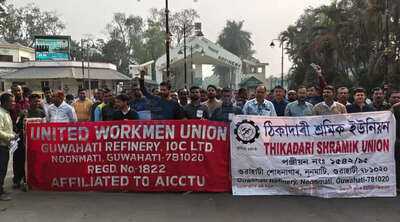
On February 12, parts of Assam experienced significant disruptions due to the nationwide 'Bharat Bandh', impacting refineries, transportation hubs, and city streets.
The strike, organized by a coalition of ten central trade unions, led to service interruptions across Assam from early morning, with organizers claiming participation from approximately 300 million workers nationwide.
In Guwahati, the entrance of the Guwahati Refinery in Noonmati became a focal point for protests as members of the United Workmen Union and the Thikadari Shramik Union gathered to demand the repeal of the controversial labour codes.
Girish Kalita, General Secretary of the United Workmen Union, stated, 'We urge the Central government to abolish the labour codes. Their implementation would jeopardize job security and infringe upon workers' rights.'
The impact of the bandh was evident throughout the city, with public transport severely affected; only a few electric buses were operational, leaving many commuters stranded.
A mother waiting at a bus stop in Mathgharia expressed her frustration, saying, 'I didn't expect the bandh to disrupt transport services this much. I need to take my child to school, and now there’s no public transport. Schools should have been closed today.'
In Upper Assam's Digboi, hundreds of workers from the Digboi Refinery also protested outside the facility, warning of escalated actions if their demands were not met.
Nagen Chutia, General Secretary of the Petroleum and Gas Workers Federation of India in Digboi, remarked, 'This protest signifies that we will not remain silent. The proposed labour codes will strip workers of their rights. Today, workers have halted their work to show solidarity.'
He further warned that the agitation could escalate if the government does not reconsider its stance on labour reforms.
'This BJP government has consistently oppressed the common people. They are attempting to privatize industries,' Chutia added.
The strike has garnered support from major trade unions, including INTUC, AITUC, HMS, CITU, AIUTUC, TUCC, SEWA, AICCTU, LPF, and UTUC. The Samyukta Kisan Morcha (SKM) has also shown support, with various farmer organizations expressing solidarity.
The bandh was organized in response to the four labour codes introduced by the Centre in 2020, which consolidated 29 existing central labour laws into a single framework.
Trade unions argue that these new codes undermine essential protections regarding job security, social welfare, and collective bargaining rights.
Key demands of the bandh include the withdrawal of the four labour codes, restoration of MGNREGA, and a rollback of policies perceived to undermine civil services.
Contact to : xlf550402@gmail.com
Copyright © boyuanhulian 2020 - 2023. All Right Reserved.