Virendra Pandit
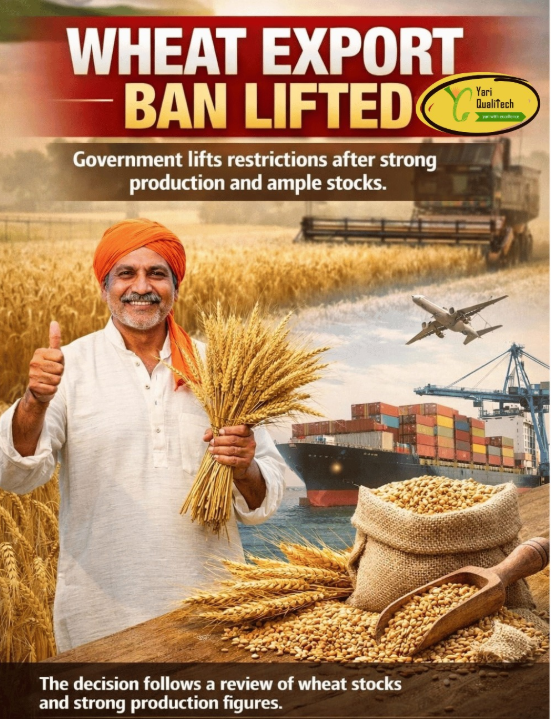
New Delhi: Lifting a three-year-long ban, India on Friday approved the export of 2.5 million tonnes (mt) of wheat along with an additional 0.5 mt of wheat products, and 0.5 mt of sugar, the media, quoting officials, reported.
The ban on wheat product exports was lifted a few months ago.
The government approved these exports to “stabilize domestic markets and ensure remunerative returns to producers.”
The additional quantity will be over and above 0.5 mt of wheat products and 1.5 mt of sugar already allowed for export.
“This calibrated decision has been taken after a comprehensive assessment of the current availability and price scenario, reaffirming the government’s commitment to protecting farmers’ interests,” the Food Ministry said in a statement.
At present, wheat stock with private entities during 2025–26 stands at about 7.5 mt, which is nearly 3.2 mt higher than that in the corresponding period last year.
The ministry felt this year-on-year increase was comfortable for domestic availability. Besides, total wheat availability in the central pool with the Food Corporation of India (FCI) is projected at 18.2 mt as on April 1, 2026, when the next harvesting season starts. Officials said export permissions will not impact domestic food security requirements.
Besides wheat, the government also approved an additional export of 0.5 mt of sugar in 2025-26, which started in October 2025. It had earlier permitted exports of 1.5 mt of sugar in 2025-26.
The decision to allow wheat exports comes just ahead of the 2025-26 procurement season, expected to start in April.
India’s wheat production in the 2025-26 marketing season is projected to cross the previous record of nearly 118 mt.
Wheat crops for the 2025-26 season, until last month, were sown in around 33.41 million hectares, which is 107 percent of the normal area and 6.13 percent more than in the corresponding period last year.
Surplus stock
As of January 16, 2026, India had a huge stockpile of wheat and rice, around 60 mt, as against a buffer requirement of 21.4 mt.
In wheat alone, traders said India’s closing stock as of March 31, 2026, is likely to be around 20 mt, as against a buffer requirement of 7.5 mt.
The decision to allow exports follows a comprehensive review of current stock availability and price trends, with the Center asserting that the move will not compromise domestic food security. Wheat prices in the open market were trading at around Rs. 2,675-2,680 per quintal in Delhi, while the MSP for the 2025-26 season has been fixed at around Rs. Rs 2,585 per quintal. Indian wheat was selling in international markets at around Rs. 2,400 per quintal.
Officials said the wheat stocks held by private entities during 2025-26 are estimated at around 7.5 mt, nearly 3.2 mt higher than in the corresponding period last year, indicating a comfortable supply position.
This substantial buffer would adequately meet domestic requirements even after permitting exports.
Increased wheat acreage during the ongoing Rabi 2026 season reflects strong farmer confidence in wheat cultivation, supported by the assured minimum support price (MSP) and procurement mechanisms. The higher sowing area also signals expectations of another robust harvest.
With higher stock availability, softening prices, and peak market arrivals under way, the government said allowing exports would help prevent distress sales by farmers. The export window is expected to improve market liquidity, enable efficient stock rotation, and support price stability, thereby strengthening farm incomes while safeguarding national food security.
Earlier, an export quota of 1.5 mt of sugar had been allowed through an order dated November 14, 2025. However, only about 0.19 mt of sugar has been exported up to January 31, 2026. Additionally, around 0.27 mt was contracted for export so far.
The newly-approved 0.5 mt export quota for sugar will be available to willing mills on the condition that at least 70 percent of their allocated quantity is exported by June 30, 2026.
The quota will be distributed on a pro rate basis among eligible mills. Mills are required to submit their willingness within 15 days from the date of issue of the order. The allocated export quota cannot be swapped or exchanged with other mills.
The government said the additional sugar export window would help manage surplus availability in the domestic market and facilitate higher shipments, complementing efforts to balance supply and support the sector.
Contact to : xlf550402@gmail.com
Copyright © boyuanhulian 2020 - 2023. All Right Reserved.