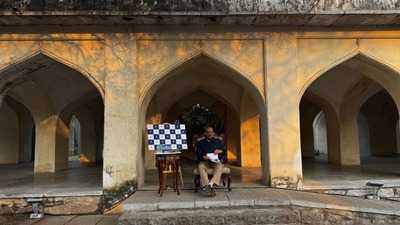
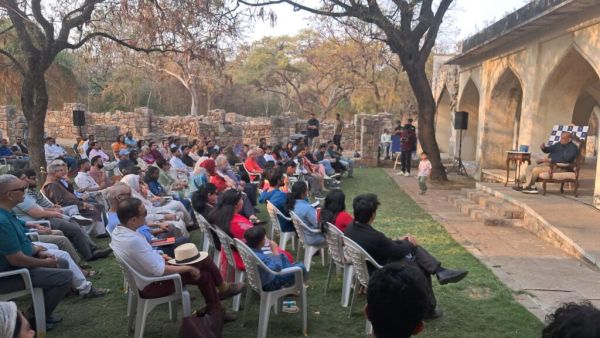
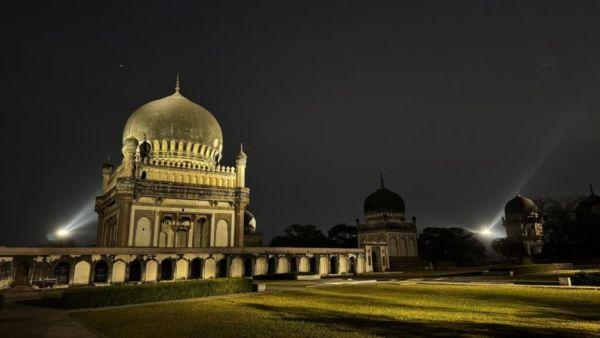
The Deccan has always drawn people with an inexplicable pull – a sense of belonging that runs deeper here than elsewhere. Whatever it is, it drew history enthusiasts to the Qutb Shahi tombs in Hyderabad on Sunday, February 15, for an informal talk about the region’s past.
Amid the glorious lawns nestled between the complex of the domed monuments, Sajjad Shahid, the co-convenor of INTACH, Hyderabad Chapter, took the captivated audience through the history of the Deccan in what seemed more like a drawing room conversation than a formal talk.
“Deccan has been known for its prosperity and was synonymous with wealth and luxury. There was something about the Deccan that made people come here. There’s a sense of belonging here,” said Shahid, a chronicler of Hyderabad, at the talk organised by Sangat and Aga Khan Trust for Culture.
The region remained relatively isolated from the Aryans, a debate within itself. It was never considered a part of India by North Indians, so much so that the Mughals looked at the Deccan as a separate country, he said, adding that despite this, it was a region of inkesari, or humbleness, which was the defining culture of the Deccan.
In Hyderabad itself, the city had a stark contrast between the Dakhni people and the Hindustanis, or those who came from outside the region, with each group having its own customs and traditions. “For instance, people sent by the Mughal rulers settled in a separate area, which later came to be known as Mughalpura,” Shahid said.
Telangana represents the cultural core of the Deccan. Many people have come and settled here, becoming an integral part of its fabric. And when new people come, they become the “outsiders” till they fully become part of the culture, he quipped.
Also Read
The varied history of Dakhni Urdu literature in south India A language for the masses, an identity of its ownDakhani, the language of the region born from the interaction of Dehalvi, Telugu, Marathi and Kannada, is the most important aspect of the Deccan. “It was a language that was made for everyone to understand, a rekhta (mixture) of sorts. It was the language of the masses that was suddenly given a literary status,” Shahid said.
“Dakhni literature is unique because it is both the same as the written language and the language spoken by the people,” Shahid said, explaining that this was unlike Latin, where the written language was different – formal and more elitist in nature – from what is spoken.
Elaborating on the accessibility of Dakhni, the co-convenor of INTACH said that poetry in the language is rich with the flora, fauna and animals that exist in the region, which can be found in the architecture in the region, especially in Hyderabad.
On its unique identity, Shahid said that Hyderabad did not mint coins in its own name or rulers until 1858 under the rule of Afzal-ud-Daulah, the fifth Nizam of Hyderabad, a year after the last Mughal emperor, Bahadur Shah Zafar, was overthrown.
The identity was also different in the way women dressed at the time. For instance, the historian said, Muslim women in the north could be differentiated from women of other faiths by what they wore, but women from the Deccan always wore sarees.
Also Read
Hyderabad’s forgotten cinema: Inside film culture of Nizam’s era A clever, witty HyderabadOn a lighter note, Shahid said Hyderabad is a city of intrigue and very welcoming, while also being a city of chakma dena, or misleading in a clever and witty way. “It is a place where you sympathise with the perpetrator and not feel too bad for the victims,” he joked, with the audience bursting into laughter at the street-smart way of the people here.
The city has had a syncretic culture, where religion was culture-driven, and that is what actually makes Hyderabad. On an audience question of how Hyderabad balances the cultural differences of Shias and Sunnis, Shahid said, “Hyderabad is a city that does not get into such contrasts and is, in fact, an amalgamation of cultures. For example, almost every Ashoorkhanas and Imambaras, which are places of worship for Shias, in the city are headed by Sunnis.”
He pointed to an example of his friend, a Shia Muslim who married a Sunni Muslim, who, he said, sometimes asks him in jest if he is actually Sunni instead. “He also asks me if I am Shia,” Shahid said. In another example, he said his co-worker and friend Anuradha Reddy, the convenor of INTACH Hyderabad, went to an Ashoorkhana to get a mannat dhaaga – a sacred thread seeking blessings – for him when he was ill. “When I got better, she also took me to a few dargahs to get blessings,” Shahid said.
“That’s the beauty of Hyderabad.”
Get the latest updates in Hyderabad City News, Technology, Entertainment, Sports, Politics and Top Stories on WhatsApp & Telegram by subscribing to our channels. You can also download our app for Android and iOS.
Contact to : xlf550402@gmail.com
Copyright © boyuanhulian 2020 - 2023. All Right Reserved.