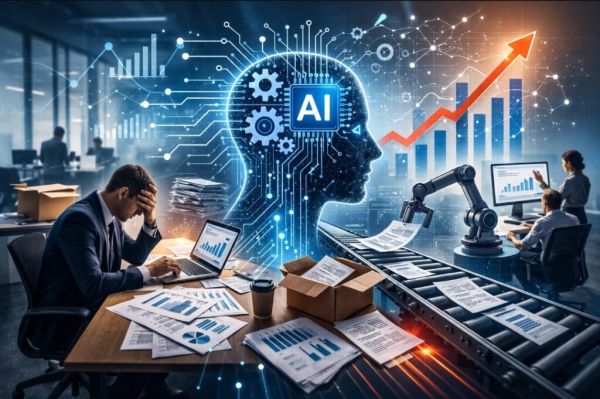
Nearly 40 years after economist Robert Solow highlighted a puzzling disconnect between rapid technological progress and sluggish economic productivity, analysts are beginning to see similar warning signs in the age of artificial intelligence.
In the late 20th century, breakthroughs in computing — including transistors, microprocessors, and integrated circuits — were expected to transform workplaces and dramatically improve efficiency. Instead, productivity growth in the United States slowed after the early 1970s. Offices were flooded with new computer systems that often generated excessive data and complex reporting rather than immediate efficiency gains. Solow’s observation that the computer revolution was not reflected in productivity statistics became known as the productivity paradox.
Today, AI is generating comparable expectations. Businesses across industries are investing heavily in artificial intelligence and promoting it as a transformative force. Yet broad economic data has not shown a clear and sustained jump in productivity, prompting economists to question whether AI is following a familiar historical pattern.
Surveys Show Limited Day-to-Day AI Impact in Offices
Recent research suggests that while AI adoption is spreading, its practical influence on daily business operations remains limited. A large survey conducted by the National Bureau of Economic Research gathered responses from roughly 6,000 senior executives across the United States, the United Kingdom, Germany, and Australia.
The study found that about two-thirds of executives reported some use of AI tools within their organizations. However, actual usage levels were relatively low. On average, executives said they personally used AI for only about 1.5 hours per week. One in four respondents reported no workplace AI use at all. Most firms indicated that AI had not significantly changed employment levels or overall productivity in the past three years.
Despite this modest impact, corporate expectations remain optimistic. Many executives believe AI will gradually lift productivity and output over the next several years, even as they anticipate minor shifts in workforce size. Public enthusiasm is also reflected in corporate communications. An analysis by the Financial Times found that hundreds of S&P 500 companies referenced AI in earnings calls between late 2024 and 2025, often portraying it as a positive development. Still, those upbeat assessments have yet to translate into clear economy-wide performance gains.
Conflicting Research Paints an Uncertain Picture
Economists examining early AI data see a mixed and sometimes contradictory landscape. Torsten Slokchief economist at Apollo Global Managementhas noted that AI’s influence is difficult to detect in major macroeconomic indicators such as employment trends, inflation, and productivity statistics. Outside a small group of leading technology companies, there is limited evidence that AI has substantially boosted corporate profit margins.
Academic findings vary widely. A report from the Federal Reserve Bank of St. Louis estimated that productivity growth rose modestly following the late-2022 launch of ChatGPT. In contrast, research led by Daron Acemoglu at the Massachusetts Institute of Technology projected only gradual productivity improvements over the coming decade.
Worker attitudes may also be influencing adoption. A global survey by ManpowerGroup found that although regular AI use increased among employees in 2025, overall confidence in the technology declined. This suggests lingering concerns about reliability, job security, and the real benefits of AI tools.
At the same time, companies are reconsidering hiring strategies in response to automation. IBM has signaled plans to increase recruitment of younger workers, reflecting worries that excessive automation of entry-level roles could weaken the long-term development of experienced managers.
Hints of a Delayed Productivity Surge
Some economists argue that AI’s benefits may simply take time to materialize. Historical experience with earlier information technology shows that productivity gains can lag behind initial investment. After years of slow growth, the digital boom of the 1990s and early 2000s eventually produced a measurable acceleration in economic performance.
Erik Brynjolfsson of Stanford University has suggested that early signs of a turnaround may already be emerging. Strong economic output combined with more moderate job growth could indicate rising efficiency, potentially linked to companies beginning to extract practical value from AI investments.
Similarly, economist Mohamed El-Erianformer chief executive of PIMCOhas pointed to a widening gap between economic expansion and hiring. Such divergence has historically accompanied major waves of automation and may signal shifting productivity dynamics.
Slok and other analysts describe this process as a potential “J-curve,” where early implementation slows measurable performance before longer-term gains appear. Whether AI follows that trajectory depends largely on how effectively organizations redesign workflows and integrate new tools into everyday operations.
Contact to : xlf550402@gmail.com
Copyright © boyuanhulian 2020 - 2023. All Right Reserved.