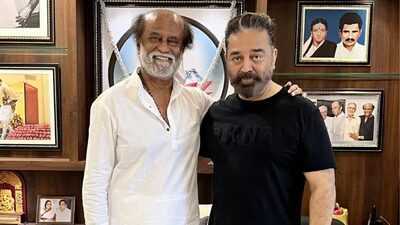
The announcement of the Rajinikanth Kamal Haasan reunion has triggered a wave of excitement rarely witnessed in contemporary Indian cinema. When two of the industry’s most influential and enduring figures — Rajinikanth and Kamal Haasan — come together after 47 years, the event transcends routine film news. It becomes a cultural moment charged with memory, symbolism, and expectation. Their collaboration, tentatively titled KHxRK, is not merely another addition to their illustrious careers, but a cinematic convergence that invites reflection on legacy, audience psychology, and the transformation of Indian filmmaking itself.
The last time Rajinikanth and Kamal Haasan shared screen space was in the late 1970s, a period that now occupies a mythic place in Indian film history. Much has changed since then. The industry has expanded across markets, technologies have redefined storytelling, and audiences have evolved in taste and consumption patterns. Yet both actors have remained constants, adapting, reinventing, and sustaining relevance across generations. Their reunion, therefore, operates at the intersection of nostalgia and reinvention.
KHxRK emerges as a project heavy with historical resonance. These are not two stars meeting at the peak of rising careers, but two legends collaborating after decades of parallel dominance. Each has carved a distinct artistic identity. Rajinikanth embodies charisma, style, and mass appeal, while Kamal Haasan represents versatility, experimentation, and narrative complexity. Their coming together promises not just spectacle but the blending of cinematic philosophies.
The production banner behind this reunion, Red Giant Movies, has positioned the project as an event film. Such framing is significant. Modern cinema increasingly thrives on scale-driven narratives where anticipation itself becomes part of the product. In this context, KHxRK is already functioning as a narrative long before cameras roll, generating discourse across media, fan communities, and digital platforms.
Legacy, memory, and the extraordinary weight of cinematic historyFew reunions carry the historical density associated with the Rajinikanth Kamal Haasan reunion. Both actors emerged from the same cinematic era yet pursued radically different trajectories. Rajinikanth’s rise transformed him into a pan-Indian phenomenon, redefining mass heroism through stylized performance and screen presence. Kamal Haasan, meanwhile, evolved into one of India’s most versatile performers, consistently pushing boundaries in characterisation, genre, and narrative form.
Their separation across decades allowed each to cultivate distinct audience ecosystems. Fans often align not only with actors but with the cinematic ideologies they represent. Rajinikanth’s films frequently celebrate larger-than-life narratives, while Kamal Haasan’s body of work reflects experimentation and thematic depth. KHxRK thus becomes a symbolic meeting of mass spectacle and artistic exploration.
Cinema thrives on memory. Audiences carry emotional archives shaped by decades of viewing experiences. For older viewers, this reunion revives an era when both actors were young collaborators navigating the industry’s formative years. For younger audiences, the event represents the collision of legendary reputations largely constructed through retrospective admiration.
The temporal gap of 47 years amplifies anticipation. Time, in celebrity narratives, enhances mythmaking. Absence often strengthens aura. The reunion’s emotional impact lies not simply in collaboration but in the prolonged distance preceding it. KHxRK becomes a bridge between eras, inviting intergenerational engagement.
The language of legacy also carries commercial implications. Modern filmmaking frequently leverages nostalgia as a narrative engine. Legacy-driven collaborations generate curiosity that extends beyond conventional promotional cycles. KHxRK benefits from decades of accumulated goodwill, reputation, and symbolic capital.
The spokesperson from Red Giant Movies articulated this sentiment by framing the project as a dream fulfilled. Such rhetoric underscores how cinematic collaborations increasingly adopt the language of cultural events rather than standard productions. Emotional vocabulary reinforces audience connection, transforming industry announcements into moments of collective celebration.
The involvement of director Nelson Dilipkumar further shapes expectations. Dilipkumar’s recent success with Jailer established him as a filmmaker adept at balancing commercial scale with stylistic flair. His association suggests KHxRK may attempt to harmonise spectacle with narrative dynamism.
Music composer Anirudh Ravichander’s participation adds another layer of contemporary relevance. Ravichander’s compositions have become synonymous with high-energy cinematic experiences. Soundtracks today function not only as narrative accompaniment but as standalone cultural artifacts shaping promotional momentum.
Modern cinema, scale-driven storytelling, and the economics of anticipationThe Rajinikanth Kamal Haasan reunion also reflects broader transformations within Indian cinema. Films are increasingly conceived as multi-platform experiences where theatrical release represents only one component of a larger ecosystem. Digital streaming, global distribution, and transmedia engagement redefine how projects generate value.
KHxRK’s planned release across Tamil, Telugu, and Hindi markets illustrates the industry’s pan-Indian orientation. Linguistic boundaries have steadily blurred as filmmakers pursue nationwide audiences. Cross-market appeal is no longer aspirational but structural. Collaborations of this magnitude are strategically positioned to maximise reach.
Scale-driven filmmaking now prioritises eventisation. Audiences are drawn not only to narratives but to the perceived magnitude of cinematic experiences. Legacy collaborations amplify this effect by merging star power with symbolic significance. KHxRK exemplifies how anticipation itself becomes a marketable commodity.
Digital culture intensifies this phenomenon. Online platforms accelerate discourse, speculation, and fan engagement. The project’s emergence as a trending topic reflects the feedback loop between celebrity news and digital visibility. Searches, discussions, and reactions collectively construct pre-release momentum.
Celebrity collaborations today operate within a hybrid economy of nostalgia and novelty. KHxRK benefits from established reputations while promising fresh narrative possibilities. This dual appeal broadens demographic engagement, capturing audiences motivated by memory, curiosity, and spectacle.
The reunion also signals shifts in audience psychology. Contemporary viewers navigate an environment saturated with content. Event films differentiate themselves through scale, legacy, and cultural weight. KHxRK’s significance lies partly in its rarity — collaborations of this nature resist commodification through frequency.
Industry dynamics further contextualise the project. Veteran actors increasingly redefine longevity by embracing roles that celebrate legacy rather than merely extend presence. KHxRK positions Rajinikanth and Kamal Haasan not as nostalgic relics but as active participants shaping contemporary cinematic discourse.
The collaboration’s framing as a historic moment reflects cinema’s evolving grammar. Films now function as cultural nodes where memory, technology, economics, and identity intersect. KHxRK embodies this convergence, operating simultaneously as narrative, spectacle, and symbolic event.
The post Rajinikanth and Kamal Haasan’s Reunion After Nearly Five Decades Reshapes Nostalgia, Stardom, and the Evolving Grammar of Indian Cinema | Cliq Latest appeared first on CliQ INDIA.
Contact to : xlf550402@gmail.com
Copyright © boyuanhulian 2020 - 2023. All Right Reserved.