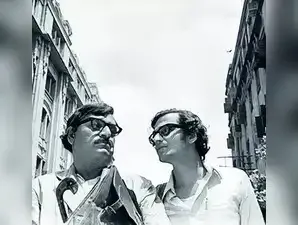
Few writers have managed to capture a city's pulse - any city's pulse - with the precision of a stethoscope as well as Mani Sankar Mukherjee a.k.a. Sankar did with Kolkata from the 50s down to the late-90s.
This ability stems much from his not being the archetypal Bengali man of letters, but a man of the soil - if that soil is of streets and paths of a bustling city.
From the corridors of the Calcutta High Court to the hectic streets of Chowringhee, his novels map the inner cartography of a city's people. Sankar's city was not merely precarious brick and tramlines but a throbbing organism of ambition, compromise, romance and material longing.
Long before 'urban studies' became a term, Sankar was sketching universal archetypes of urban life: the hotel receptionist balancing dignity and despair in Chowringhee (1962); the clerk dreaming of escape in Koto Ajanare (So Much Unknown, 1955); the drifter negotiating survival in Jana-Aranya (The Human-Jungle/Middleman, 1973)....
It is no accident that filmmakers gravitated to his novels, with Satyajit Ray famously adapting his stories Seemabaddha (Limited) and Jana-Aranya to film that explored the paradoxes of a city both decaying and reinventing itself.
To read Sankar today is to encounter a writer who anticipated dilemmas of globalisation before the word entered our lexicon. His were attempts at understanding the eternal negotiations of humans caught in the machinations of cities.
Sankar, who passed away on Friday, made urbs hominum and urbs mulier, the city man and woman, ever-evolving. In doing so, he ensured that Kolkata, made peripheral for most of us over time, became a precursor for avatars of future urban existence in every city inhabited by restless, ambitious, complicated human life.
This ability stems much from his not being the archetypal Bengali man of letters, but a man of the soil - if that soil is of streets and paths of a bustling city.
From the corridors of the Calcutta High Court to the hectic streets of Chowringhee, his novels map the inner cartography of a city's people. Sankar's city was not merely precarious brick and tramlines but a throbbing organism of ambition, compromise, romance and material longing.
Long before 'urban studies' became a term, Sankar was sketching universal archetypes of urban life: the hotel receptionist balancing dignity and despair in Chowringhee (1962); the clerk dreaming of escape in Koto Ajanare (So Much Unknown, 1955); the drifter negotiating survival in Jana-Aranya (The Human-Jungle/Middleman, 1973)....
It is no accident that filmmakers gravitated to his novels, with Satyajit Ray famously adapting his stories Seemabaddha (Limited) and Jana-Aranya to film that explored the paradoxes of a city both decaying and reinventing itself.
To read Sankar today is to encounter a writer who anticipated dilemmas of globalisation before the word entered our lexicon. His were attempts at understanding the eternal negotiations of humans caught in the machinations of cities.
Sankar, who passed away on Friday, made urbs hominum and urbs mulier, the city man and woman, ever-evolving. In doing so, he ensured that Kolkata, made peripheral for most of us over time, became a precursor for avatars of future urban existence in every city inhabited by restless, ambitious, complicated human life.