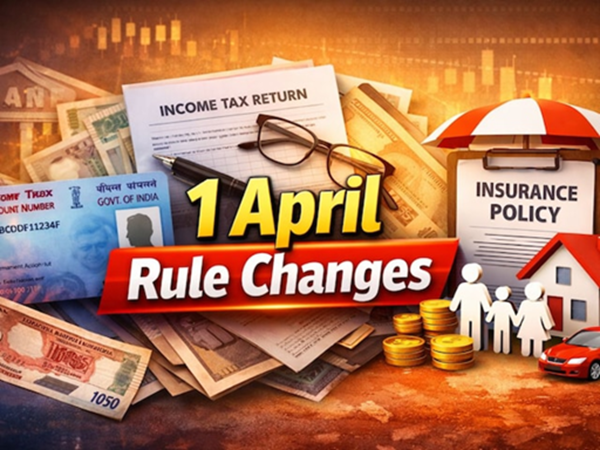
Your daily financial life is set to undergo a major transformation from April 1, 2026. Yes, the provisions announced in Budget 2026 will now be implemented, and the time has come to change many rules under the new Income Tax Act 2025. These changes will directly impact salaried individuals, small businesses, investors, stock market traders, and even property buyers. So, if you're wondering, "What impact will it have on us?", the answer is, it will be significant. So, let's understand in simple and clear terms what will change from April 1.
Relaxation in PAN Card Rules
Until now, PAN has been required even for small financial transactions. Starting April 1, 2026, some restrictions will be relaxed.
PAN details will not be required for cash deposits or withdrawals of up to ₹10 lakh annually at a bank or post office.
PAN will not be required for expenses up to ₹1 lakh at hotels, restaurants, or functions.
A PAN will not be required even for purchasing a car or bike worth up to Rs 5 lakh.
Providing a PAN will not be mandatory for property deals worth up to Rs 20 lakh.
However, the government is tightening its monitoring of large transactions.
Therefore, not linking your PAN with Aadhaar may cause problems.
It should be noted that if you are purchasing a house or land from an NRI, there will no longer be a need to obtain a separate TAN number for TDS deduction.
TDS can be deducted using only a PAN.
This will simplify and expedite transactions between Indians living abroad and property buyers in India.
Major tax relief on children's education
The most reassuring news for middle-class families relates to children's education.
The exemption on education allowance has been increased from Rs 100 to Rs 3,000 per month per child.
The exemption on hostel allowance has been increased from Rs 300 to Rs 9,000 per child per month.
These benefits will be available for a maximum of two children, and this exemption will be available to those who choose the old tax system.
This could be a major tax-saving opportunity for parents who are educating their children in hostels.
Insurance Tightening
From April 1, 2026, PAN will be required when purchasing every insurance policy.
This rule previously applied to large amounts, but now it will apply to every policy; a significant relief has also been provided.
There will now be no tax on the interest on compensation received from the Motor Accident Claims Tribunal (MACT).
Previously, TDS was deducted from this amount, resulting in a lower amount for the victim. Now, the entire interest will be tax-free.
Stock Market Trading is Expensive
If you trade futures and options in the stock market, your costs are going to increase.
The STT on futures trading has been increased from 0.02% to 0.05%.
The STT on options premiums has been increased from 0.10% to 0.15%.
STT on options exercise will also be levied at 0.15%.
The government's clear objective with this is to curb excessive speculation and bring balance to the market.
New Tax Formula on Share Buybacks
Until now, proceeds from share buybacks were considered dividends and taxed according to the income tax slab.
From April 1, 2026, the proceeds from buybacks will be considered capital gains.
This means that tax can be calculated based on the purchase price of the share and the holding period.
This may benefit long-term investors, but may result in higher taxes in the short term.
Change in ITR Filing Deadline
A major change in Budget 2026 also relates to the ITR filing deadline.
Non-audit businesses or professionals will now be able to file their ITR by August 31st instead of July 31st.
This significant change will be effective from AY 2026-27.
For the salaried class and those filing ITR-1/ITR-2, the last date will remain July 31st.
Small businesses and professionals will now receive an additional month's relief.
What will the overall impact be on your pocket?
You will receive relief for small transactions, but the government will tighten its grip on large transactions and market speculation.
Buying smaller cars and cheaper property will become easier.
Tax savings on children's education will increase.
Trading will become more expensive.
PAN will be required when purchasing insurance.
The tax system will become more digital and tracking-based.
This means that April 1, 2026, is no longer just a calendar date, but a new part of your financial planning. So, it's best to update your investments, tax plans, and documents before the end of March. Because this time, the changes aren't small; they directly impact your finances. (Note: This news is based on general information.)
Contact to : xlf550402@gmail.com
Copyright © boyuanhulian 2020 - 2023. All Right Reserved.