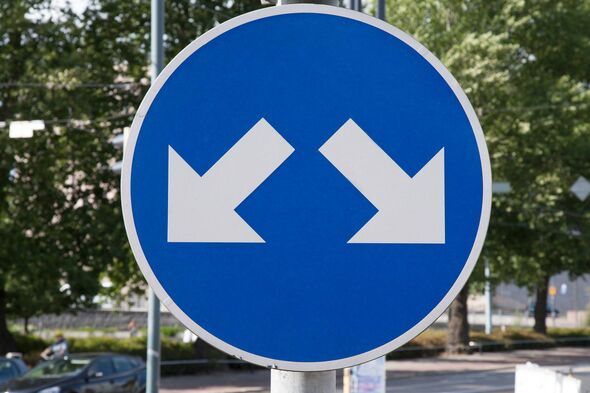
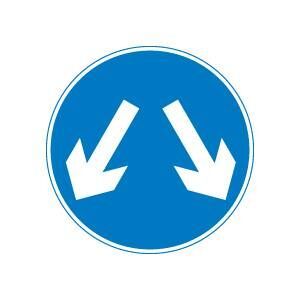
Motorists are being cautioned about a blue circular road sign featuring white arrows that frequently gets mixed up with other Highway Code instructions. The sign, displaying two white arrows pointing diagonally downwards in opposing directions, indicates vehicles may pass on either side of an obstruction up ahead.
As the sign contains no text, some motorists may pause or misinterpret it - especially in unfamiliar locations. According to the official Highway Code, the sign is typically deployed to indicate a traffic island, refuge, or central divider, and confirms that motorists are permitted to navigate around it on either side. Nevertheless, it's frequently confused with similar-looking blue signs that provide very different directions.
Unlike other blue arrow signs that mandate drivers pass on a particular side, this one offers motorists flexibility.
This means you can navigate either way around the obstacle, depending on your position and traffic circumstances.
The Department for Transport employs the sign to help traffic flow more efficiently and avoid unnecessary congestion.
Depending on your position in the road and surrounding traffic, it means you can:
- Pass to the left
- Pass to the right
The sign is typically positioned directly in front of the obstruction so motorists have time to choose safely.
The sign is frequently encountered in areas such as:
- Pedestrian refuge islands
- Traffic calming schemes
Narrow residential streets
Roads with central bollards
Even though both directions are permitted, drivers must still look out for approaching traffic, yield where required and position their car safely.
The sign does not grant priority - it merely indicates both routes are acceptable. Failing to navigate safely could still result in penalties if it leads to careless driving.
Contact to : xlf550402@gmail.com
Copyright © boyuanhulian 2020 - 2023. All Right Reserved.